To compare a filmmaker to Robert Redford is not something you should do lightly. The late, great actor, director, activist and founder of the Sundance Film Festival is a titanic figure in cinema. His shadow is long, extending over not just decades of outstanding films, but the careers of countless other artists who’ve become some of the most exciting new voices we have.
Thus, when discussing “See You When I See You,” the sweet, silly and profoundly sad new film from director Jay Duplass, referencing Redford’s directorial debut “Ordinary People” is something one must do with some caveats. Duplass himself has cheekily done so, calling it “Like Funny ‘Ordinary People,’” which is a pretty good entry point to their connective tissue and a summation of the film’s general energy.
It’s also a testament to how compelling a film Duplass has made that this doesn’t feel like it’s overstating anything. Even as his film is more than a little messy, it’s a productive messiness that reflects the way life itself is forever upended when you lose the person you love.
Like “Ordinary People,” Duplass’ film is an adaptation — it’s based on the memoir and now script written by stand-up comedian Adam Cayton-Holland. More critically, both films are about the agonizing pains that come from dealing with the death of a loved one.
Both effectively, earnestly grapple with questions of mental health, family strife and how you can find happiness in a world now defined by a yawning chasm of a person that you can only now see in your memories.
“See You When I See You” begins with such a memory where we get a glimpse of a family photo from a more tranquil time of early childhood. A young girl proceeds to jump into the water, frozen in time just before the moment she is to make a big splash.
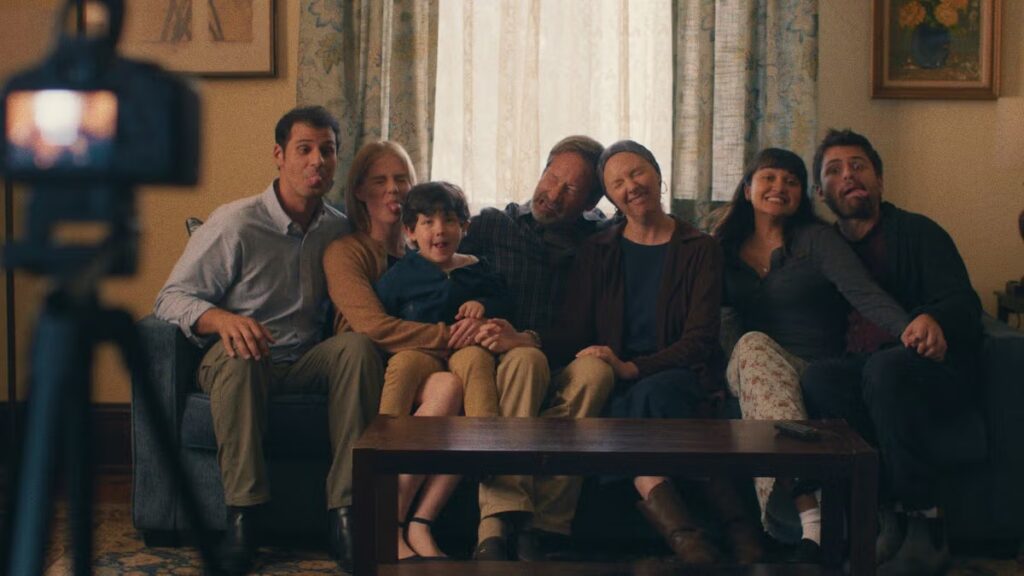
When we then flash forward to the future, we pick up with the now adult Aaron (Cooper Raiff). At least, he’s trying to be an adult but is having a hard time doing so now that his sister and best friend, Leah (Kaitlyn Dever), is gone. When he isn’t losing himself in the bottle, hanging out with his other sister, Emily (Lucy Boynton), bickering with his parents, (Hope Davis and David Duchovny) or pining over the girlfriend he ghosted (Ariela Barer), he’s losing himself in memories of Leah.
These memories are where the film takes its biggest swings, showing us when Aaron was at his happiest while out at a bar with Leah, only for a giant hole to open up in the ceiling à la “If I Had Legs I’d Kick You.” Only, this is all entirely in his head and not something that is actually happening. As Aaron refuses to go to therapy, these visions will only grow more painful and present in his life, leaving him spiraling until he’s at risk of hitting rock bottom. While his family can see he is struggling, they aren’t sure how to get through to him.
The film then becomes about these various characters and their respective coping strategies, while also remaining mostly focused on Aaron. In doing so, Duplass creates a gentle yet potent portrait of a family — this is where the “Ordinary People” comparison feels most apt. Of the two films at the festival drawing from a stand-up’s story and persona, this one is the funnier, more naturalistic winner.
The film effortlessly vacillates between comedy and drama, with scenes of the family discussing their disagreements about whether to have a funeral for Leah or bantering about something more silly as a distraction. Similar to Duplass’ previous film, last year’s “The Baltimorons,” its charms can be as plentiful as its pain.
While other elements of the film can feel more constructed, this core element ensures that the overall work remains an earnest one. There is a tension that comes from the humor clashing with the tragedy, but it’s a worthwhile one. Life is full of sudden loss and then also ridiculously funny moments. Capturing that authentically is no small feat, but Duplass does so with delicate care.
Time will only tell if “See You When I See You” will someday be held in the same esteem as “Ordinary People.” But, for now, it reveals that Duplass, like Redford, is still a filmmaker willing to take risks with their work. What a joy to have him back directing movies again.
Check out all our Sundance coverage here
The post ‘See You When I See You’ Review: Jay Duplass Enters His Redford Era With ‘Ordinary People’-esque Dramedy appeared first on TheWrap.