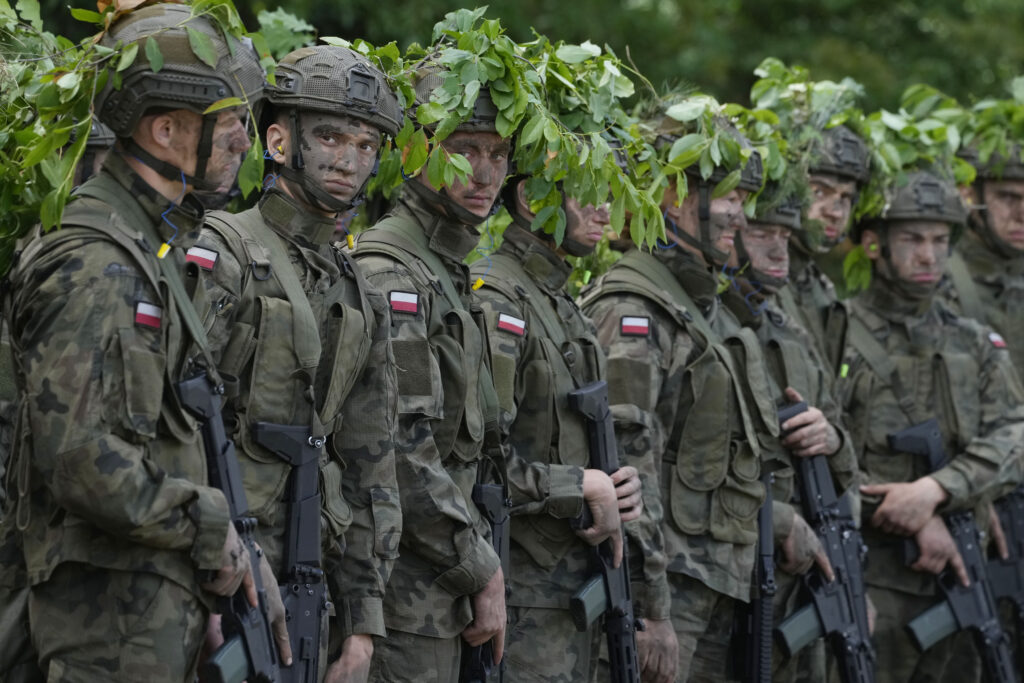
After Russia’s 2022 invasion of Ukraine, countries across Europe pledged to become more like Poland.
Governments began pushing to build up their militaries. Factories pivoted from civilian products to tanks and jets. Prodded by U.S. President Donald Trump, Europe’s NATO members last year committed to spending 5 percent of their gross domestic product on security, defense and related infrastructure.
While some countries struggled to meet an earlier NATO target of 2 percent of GDP on defense, Poland’s figure last year was 4.7 percent, the highest in the alliance. It’s the European Union’s fifth most populous nation and sixth largest economy, but it has the bloc’s largest standing army.
As Europe seeks to retool for the dual threats of Russian aggression and U.S. indifference, Poland is arguably already there. At least by the numbers. The challenge is that even as countries scrambled to build up their capabilities, the nature of the threat has changed.
Russian drone incursions into Polish airspace and the sabotage of a major rail line have highlighted the inadequacy of a conventional army — the type Poland has built up so successfully — to counter a new style of hybrid warfare. There is no doubt that Poland is a European model of militarization. It’s just not clear that it is the right kind of militarization for the rapidly changing risk landscape.
“We started to prepare ourselves for a more conventional kind of war,” Polish Deputy Defense Minister Pawel Zalewski said in an interview. “It turned out that cheaper means, namely drones, can be very successful and make very important tactical gains on the front line, especially in comparison to very expensive, more conventional armaments.”
On Monday, NATO Secretary General Mark Rutte delivered a sharp reality check to European leaders who have suggested that Europe must be able to stand alone, without the United States — saying it would be virtually impossible, especially without the deterrence capability of the U.S. nuclear arsenal.
“If anyone thinks here, again, that the European Union, or Europe as a whole, can defend itself without the U.S., keep on dreaming,” Rutte said in a speech to the European Parliament. “You can’t. We can’t. We need each other.”
“For Europe, if you really want to go it alone … you can never get there with 5 percent,” Rutte continued. “It will be 10 percent. You have to build up your own nuclear capability. That costs billions and billions of euros. You will lose then in that scenario, you would lose the ultimate guarantor of our freedom, which is the U.S. nuclear umbrella. So hey, good luck.”
That leaves European nations caught in the middle, short of the biggest most powerful weapons, and the newest, most nimble drone technology.
“You can’t scramble fighter jets every time to shoot down a few drones,” said Kai-Olaf Lang, a political scientist and Poland expert at the German Institute for International and Security Affairs. “That’s easy to say, but what do you do if you don’t yet have the defense systems?”
One of the biggest wake-up calls came late one night in September, when about 20 Russian drones entered Polish airspace. Polish and NATO forces responded by shooting down several of the drones in a confrontation that political leaders and analysts saw as a test of NATO defenses by Russian President Vladimir Putin. Since then, Poland has scrambled fighter jets multiple times in response to Russian missile and drone strikes in Ukraine, near the Polish border.
In November, a rail line through Poland used to deliver aid to Ukraine was blown up in what Prime Minister Donald Tusk called “an unprecedented act of sabotage.” Tusk’s foreign minister, Radoslaw Sikorski, accused Russia of “an act of state terrorism.”
Meanwhile, Polish social media has been flooded with disinformation seeking to sow division by convincing Poles that the drones were Ukrainian. Many of the posts appeared to come from Russian actors or bots, experts said.
Poland is working to bolster its defenses against hybrid warfare. After the September drone attacks, Zalewski said, “we understood that our air defense, including this lower layer against drones, required very quick development, which we are doing as quickly as possible.”
Whether these efforts are adequate is up for debate. Tomasz Szatkowski, who served as deputy defense minister and ambassador to NATO under Poland’s previous conservative government, worries that the current centrist government’s response has been too “makeshift, or improvised.”
“Even though we’re continuing broadly in the right direction, I’m increasingly convinced that it is high time for a more comprehensive analytical and planning effort on a strategic level,” Szatkowski said.
Poland’s defensive posture has deep historical roots. For centuries, Lang said, Poland was “a pawn of the great powers,” stuck between Germany (and earlier, Prussia) to the west and Russia to the east, which together periodically wiped Poland off the map.
After the fall of communism in Poland in 1989, the country set about ensuring that would no longer be dominated by big neighbors like the Soviet Union. “The goal was to work toward a situation where Poland would no longer be so easily targeted by aggression,” Lang said.
Between 2014 — when Russia invaded and illegally annexed the Crimean Peninsula from Ukraine — and 2025, Poland roughly doubled the size of its armed forces and tripled its military spending.
Poland’s allies, however, didn’t always share Warsaw’s belief that Russia posed a danger to Europe. “We had a unanimous perception of threats in Poland, which was not shared, unfortunately, by our closest allies,” Zalewski said.
That began to change in 2014, though it wasn’t until after Russia’s 2022 full-scale invasion — and particularly after Trump made clear that the U.S. couldn’t always be counted on defend Europe — that Poland’s European allies really sprang into action with anything approaching Poland’s sense of urgency.
But if Trump’s actions have spurred Europe to focus on defense, they have created a conundrum for Poland.
“The entire Polish security policy [has been] based on functioning transatlantic relations and very close security, defense and strategic cooperation with the United States,” Lang said. Many conservative Poles are wary of Germany and the E.U., preferring to look to the U.S. as Poland’s best ally and protector. But it is no longer clear how eager the Americans will ever be to jump to Europe’s or Poland’s defense.
It was jarring to many Poles when the U.S. Army announced last year that it was withdrawing its personnel and equipment from the Jasionka airport, near the eastern Polish city of Rzeszow, which since 2022 had been the main U.S. hub for military and humanitarian assistance to Ukraine.
“After three years at Jasionka this is an opportunity to rightsize our footprint and save American taxpayers tens of millions of dollars per year,” said Gen. Christopher Donahue, commanding general of U.S. Army Europe and Africa.
There are currently about 8,500 U.S. soldiers in Poland, Zalewski told a parliamentary defense committee last week, accounting for most of the roughly 9,900 troops from allied countries stationed in Poland. That’s down from about 10,000 U.S. troops in Poland at the start of 2025.
A bigger shock came when the Trump administration unveiled its national security strategy in December, which downplayed the Russian threat and instead focused on the risks posed to Europe by migration, warning that the continent faces “civilizational erasure.”
Zalewski sought to focus on the strategy’s upside for Europe, arguing that even if it highlighted disagreements, it demonstrated that the U.S. cares about European security and stability. But he added: “Of course Russia is the greatest security threat. I would call it an existential threat for Europe.”
For Poland to counter that threat, experts say, will require not just a strategic shift but also a financial one. Poland is heavily invested in legacy military systems that tie up much of the country’s funds, Lang said. The question, he said, is, “How can we continue with these and simultaneously move into modern, flexible technologies like drones?”
Although Ukraine has demonstrated that a smaller country can stand up to Russia, Poland’s leaders insist its aim isn’t to prepare for a one-on-one conflict with Russia, but to bolster its capabilities as part of the broader NATO alliance.
Still, said Zalewski, a strong Polish military could have a powerful deterrent effect. “Russians best understand the language of power,” Zalewski said, adding: “Russia attacks only those who are weak. They do not take risks.”
The post Poland built the E.U.’s biggest army, but the threat has changed appeared first on Washington Post.