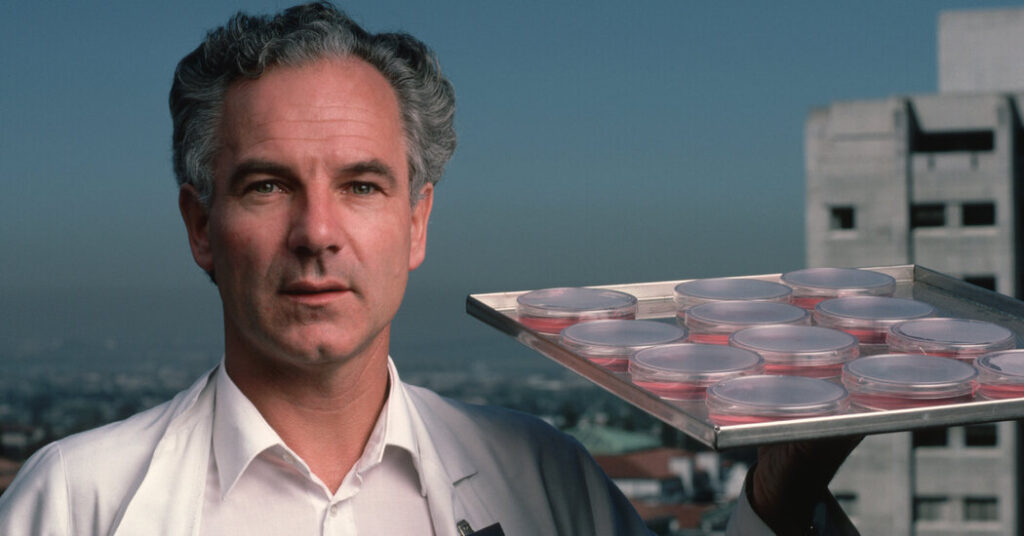
Peter H. Duesberg, a renowned molecular biologist who became famous for his pioneering work on the underpinnings of cancer but infamous for his assertion, in the face of evidence to the contrary, that H.I.V. does not cause AIDS, died on Jan. 13 in Lafayette, Calif. He was 89.
His death, at a care facility near his home in Oakland, was from kidney failure, his wife, Sigrid Duesberg, said.
In the late 1960s, when scientists had little understanding of what caused cancer, Dr. Duesberg studied a virus called Rous sarcoma, which had been associated with malignant tumors in chickens. In 1970, he published the results of his experiments, showing that the virus carried a gene, known as Src, that triggered cancer in the birds.
It turned out to be the first known cancer-causing gene, or oncogene.
Dr. Duesberg’s work, at the University of California, Berkeley, set the stage for other researchers who were able to show that normal cells in many animals, including humans, carry a version of this gene, known as a proto-oncogene. Modern cancer treatments are based in part on the understanding that those proto-oncogenes can turn into cancer-spawning oncogenes when damaged over time by carcinogens, radiation or random mutations.
Early in his career, Dr. Duesberg accrued some of science’s highest honors: He was named Scientist of the Year in 1971 by the California Museum of Science and Industry in Los Angeles (now the California Science Center); he was elected to the National Academy of Sciences in 1986; and, that same year, he received an Outstanding Investigator Award from the National Institutes of Health.
But he didn’t pursue his research on oncogenes. Instead, in his work at Berkeley and at the University of Heidelberg in Germany, where he held an appointment starting in 1997, he focused on the more established theory that cancer is caused by damage to the chromosomes, the structures that carry our genetic material.
And in a startling about-face, he inexplicably contradicted his own research, insisting that oncogenes didn’t, in fact, cause cancer; he even went so far as to heckle colleagues at scientific meetings if they supported that idea.
In the 1980s, Dr. Duesberg adopted another contrarian view, publicly rejecting the theory that the newly discovered disease known as AIDS was caused by human immunodeficiency virus, or H.I.V., a link that is widely accepted today. The theory he promoted was that AIDS was caused by poverty, malnutrition, the use of recreational drugs and azidothymidine, or AZT, an early antiviral drug used to treat the disease.
Dr. Duesberg insisted that H.I.V. was a harmless passenger virus — and his opinion carried weight.
“He was incredibly smart; he spoke well,” David Sanders, a Purdue University virologist who was a graduate student in Dr. Duesberg’s department at Berkeley in the 1980s, said in an interview for this obituary in 2021. “When H.I.V. was first coming along, he correctly pointed out that we didn’t fully understand how it caused disease.”
Throughout his life, Dr. Duesberg maintained his position that H.I.V. does not cause AIDS, a contention that raised questions about the perils of undermining public trust in established scientists during an epidemic.
Critics said his misleading advice to former President Thabo Mbeki of South Africa in the early 2000s was instrumental in persuading Mr. Mbeki’s government to adopt a policy against importing antiviral drugs, resulting in hundreds of thousands of deaths.
But Dr. Duesberg’s anti-establishment views also won him a popular following, in part through two documentary films about him and his 1996 book, “Inventing the AIDS Virus.” To some, he was the embodiment of a romantic ideal: the brilliant rebel who battles overwhelming opposition in the name of truth.
“Duesberg appealed to all sorts of different parts of our national psyche,” Dr. Sanders said.
He could be witty and charming, said Randy Schekman, who oversaw Dr. Duesberg’s lab in his capacity as chair of the department of molecular and cell biology at Berkeley. “He had this allure, and people were attracted to him,” Dr. Schekman added. “But he had a dark side.”
After staking out an unorthodox position on AIDS, Dr. Duesberg found himself marginalized by his peers, no longer invited to scientific meetings or asked to take part in discussions.
“The whole dissident idea attracts a lot of crazies,” he said in a 2009 interview with Newsweek. “And then all of a sudden, without realizing it, you’ve become one of them.”
Peter Heinz Duesberg was born on Dec. 2, 1936, in Münster, Germany. His mother, Hilde (Saettele) Duesberg, was an ophthalmologist. His father, Richard, was an internist who volunteered to serve as a medic for the German Army during World War II to avoid being forced into the Nazi Party.
Peter Duesberg attended the University of Würzburg in Germany and the University of Basel in Switzerland, earning an undergraduate degree in chemistry in 1959. He went on to do graduate work at Goethe University Frankfurt, earning a Ph.D in chemistry in 1963.
The following year, he moved to the United States to take a job at Berkeley, where he focused on one of the most riveting scientific mysteries of the time: what caused cancer.
He began studying the Rous sarcoma virus — a strange retrovirus that had been observed in a single chicken coop on Long Island by the pathologist Peyton Rous. In 1966, Dr. Rous shared a Nobel Prize for his work related to the retrovirus and for the discovery that viruses could cause cancer.
Dr. Duesberg set out to discover which part of the virus was causing cancer in the chickens.
Using a technique called oligonucleotide fingerprinting, he dissected the genetic material of the virus. Then he and a collaborator, Peter Vogt, showed that by removing a piece of the material, they could eliminate the virus’s ability to turn a normal cell into a cancerous one.
The piece they removed was the Src gene — the first known oncogene.
Across the bay, at the University of California, San Francisco, two of Dr. Duesberg’s competitors, Harold E. Varmus and J. Michael Bishop, advanced his findings by sequencing the Src gene and designing a special probe that could detect it in cells. That led to the surprise discovery that even normal cells carry a version of the Src gene.
Dr. Bishop and Dr. Varmus, who shared a Nobel Prize for their work in 1989, used a technology more powerful than oligonucleotide fingerprinting, allowing them to “race ahead” in the research, Robert A. Weinberg, a cancer researcher at M.I.T., said in an interview. (Dr. Weinberg’s lab later showed that mutations in proto-oncogenes could turn them into oncogenes and induce cancer without the involvement of a virus.)
In 1984, another of Dr. Duesberg’s scientific rivals, Robert C. Gallo, a virologist with the National Cancer Institute, came to public attention for his research on a new disease called AIDS, which was sweeping the gay community. Dr. Gallo believed it was caused by a retrovirus, which can insert genetic material into its host.
As recounted by Seth Kalichman in the 2009 book “Denying Aids: Conspiracy Theories, Pseudoscience and Human Tragedy,” Dr. Gallo initially expressed respect for Dr. Duesberg, telling an audience at a conference in 1984 that Dr. Duesberg’s “rare critical sense” often made other scientists “look twice, then a third time, at a conclusion that was thought to be foregone.”
But the relationship soon turned bitter, Dr. Kalichman wrote, with personal exchanges that bore “no resemblance to a scientific debate.”
By 1987, when Dr. Duesberg published his theory about AIDS in the journal Cancer Research, a consensus had formed around H.I.V. as the cause of the disease. Eventually, scientists figured out how H.I.V. caused AIDS — through the slow destruction of a white blood cell known as CD4, which is essential for the maintenance of the immune system. None of the factors Dr. Duesberg had proposed as the cause of AIDS led to this immune collapse.
Still, his ideas continued to draw attention for years.
In 1994, the journal Science published the results of an investigation that had received input from more than 50 experts, including Dr. Duesberg in an extensive interview. In 2006, he was cited in an investigative report in Harper’s Magazine about deaths in clinical trials of AIDS drugs; the article implied that mainstream science had the cause of the disease all wrong. In 2012, he was a guest on “The Joe Rogan Experience” podcast.
“He loved the limelight, and reporters would flock to him because of his outrageous attitude,” said Dr. Schekman, his former colleague at Berkeley.
Dr. Duesberg retired in 2022. In addition to his wife, he is survived by their four children, Nicola, Max and Susanne Duesberg and Sibyl Kamdar; two grandchildren; a brother, Hans; and a sister, Christa Noah Duesberg.
Over the years, Dr. Duesberg attracted allies among the religious right, promoters of alternative medicine and prominent AIDS denialists, including Christine Maggiore, who campaigned against using antiretroviral drugs to prevent the transmission of H.I.V. from mothers to children; she died of AIDS in 2008 after passing the virus to her 3-year-old daughter, who had died three years earlier.
Dr. Duesberg continued his cancer research, though he had difficulty securing funding and finding colleagues. In 2007, he published an article on cancer in Scientific American. It was accompanied by an editorial that ran under the headline “When Pariahs Have Good Ideas.”
The editorial described him as “the leading scientific torchbearer for the so-called AIDS dissidents,” but noted that “as wrong as Duesberg surely is about H.I.V., there is at least a chance that he is significantly right about cancer.”
Ash Wu contributed reporting.
The post Peter H. Duesberg, 89, Renowned Biologist Turned H.I.V. Denialist, Dies appeared first on New York Times.