At some point this year, you may be lucky enough to receive an invitation. Here is what it will say:
“You are invited to a cocktail party at the home of Duke Ellington. It will be a gathering of artists and intellectuals—the living luminaries of the Harlem Renaissance. I hope you will join me for this special afternoon.”
The invitation will come from August of 1972, and it will be signed by filmmaker William Greaves. RSVP immediately and without hesitation. It may well be the most thrilling event you attend all year.
Today, Greaves is probably best known as the director of the avant-garde meta-documentary “Symbiopsychotaxiplasm: Take One.” But he worked on nearly 80 films and earned four Emmy nominations. And still, he felt that the footage he captured on one bright day in 1972 was among the most important he ever shot. He wrestled with it for much of his life, and after he died in 2014, his son David, granddaughter Liani, and wife Louise Archambault Greaves (who died in 2023) continued the effort. “Once Upon a Time in Harlem,” directed by David and produced by Liani, is the extraordinary result of the family’s decades-long dedication.
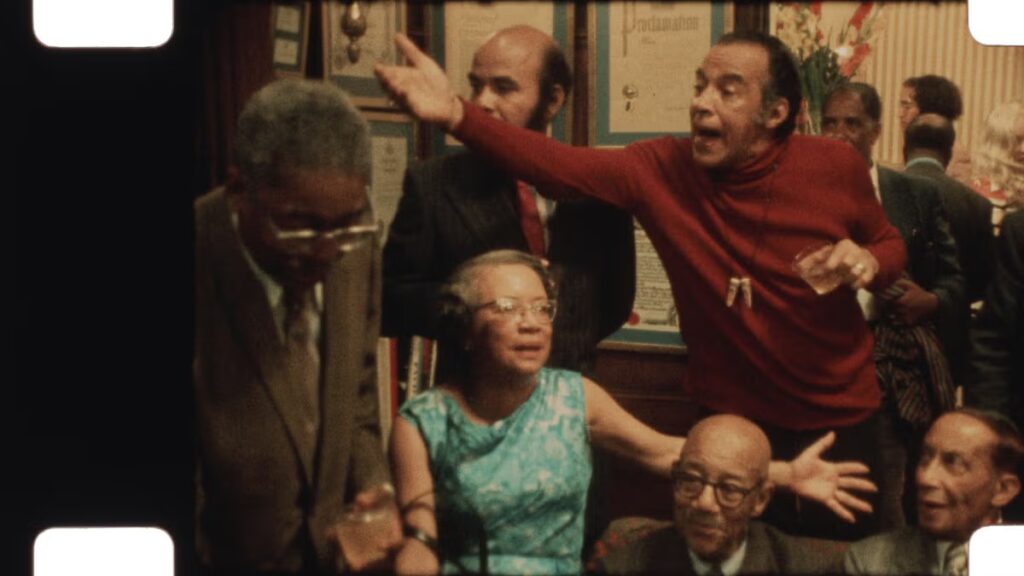
For his cinéma vérité cocktail salon, Greaves gathered every active participant of the Harlem Renaissance he could find. There were representatives from art, drama, music, journalism, history, academia, politics. And now we get to join them on and around the well-worn couches of Ellington’s elegant living room, as they discuss and debate, laugh and interrupt, chatter and smoke.
We hear Greaves often from behind the camera, as he asks questions to guide the group through their memories of the 1920s and 30s. Musician Eubie Blake, who is 86, understands the assignment perfectly: “All these things you have to explain. People don’t know,” he notes, as he talks about life as the 11th child of former slaves, and his early years as the piano player in “a house of ill repute.”
96-year-old actor Leigh Whipper also relates tales from his extraordinary life. His mother, Frances Rollin Whipper, was a trailblazing activist, and his father was a trial lawyer and a member of the South Carolina legislature. But when he was elected for a judgeship, the governor wouldn’t sign his commission, so he couldn’t serve. He also lived with death threats from the Ku Klux Klan and, as Whipper recalls, had to walk around with a pistol on each hip.
Blake and Whipper crossed paths on Broadway, and the interconnectedness of so many stories is thrillingly vivid. Irvin Miller, a theatrical producer (and director, and playwright — nearly everyone here is a multi-hyphenate), shares the history of his brother Flournoy Miller, who wrote the groundbreaking Black musical “Shuffle Along”…which was composed by Eubie Blake and lyricist Noble Sissle, who together inspire further discussion of the play’s young leads, Florence Mills, Josephine Baker, and Paul Robeson.
Throughout these recollections, the screen often splits: we see the speaker recounting a memory on one side, and gorgeous vintage footage or breathtaking photos — often taken by attendee James Van Der Zee — on the other. So when the painter Romare Bearden notes that the greatest artwork ever created about pilot Charles Lindbergh was the Harlem-born Lindy Hop, we see the dance and understand exactly what he means.
In more solemn moments, a single speaker fills the entire screen. Time seems to stop while civil rights activist Richard B. Moore recites Claude McKay’s chilling poem “If We Must Die” from memory: “Like men we’ll face the murderous, cowardly pack, Pressed to the wall, dying, but fighting back.”
About halfway through, activist and salon founder Louise Thompson Patterson firmly notes that, “What has been neglected so far this afternoon is recognizing some of the women.” She tells the story of sculptor Augusta Savage, and then talk turns to Zora Neale Hurston. (Van Der Zee’s sister, the visual artist Jennie Louise Van Der Zee, goes unnoted, but her pioneering presence is felt in his photos, as they often worked together.)
Archival consultant Ina Diane Archer and editors Lynn True and Anne de Mare have done absolutely extraordinary work in finding historical imagery that matches the unparalleled privilege the Greaves family has given us. And as the director, David Greaves has found the ideal way to share his father’s priceless footage.
“Once Upon a Time in Harlem” feels deceptively loose: as the camera roves Ellington’s crowded living room, with its beautiful leaded windows, plush velvet curtains, and award-filled walls, it truly feels as though we are at the party ourselves. But in actuality, this is as essential a historical document as you could ever hope to find.
It should be considered required viewing for every American who has the slightest interest in our nation’s history, politics, or culture.
And, come to think of it, also for those who don’t.
Catch up on all of our Sundance coverage here.
The post ‘Once Upon a Time in Harlem’ Review: Harlem Renaissance Doc May Be the Most Thrilling Party of the Year appeared first on TheWrap.