A new lawsuit against oil giants over their role in climate change is pursuing a novel strategy that may ring a bell. It’s focusing on high prices and affordability.
The federal antitrust lawsuit, filed Friday by Michigan’s attorney general, accuses the companies of creating a “cartel” and raising costs for people in the state by colluding to stifle renewables, such as wind and solar power, and to suppress information about the dangers of global warming.
“Michigan is facing an energy affordability crisis as our home energy costs skyrocket and consumers are left without affordable options for transportation,” Attorney General Dana Nessel said. “These out-of-control costs are not the result of natural economic inflation, but due to the greed of these corporations who prioritized their own profit and marketplace dominance over competition and consumer savings.”The lawsuit comes at a time when inflation and affordability are rising political and economic concerns in the country.
The use of antitrust law is notable. Over the past decade, roughly three dozen state and local governments have filed more straightforward lawsuits against oil companies, seeking damages for the effects of climate change or citing consumer protection laws, mostly in state courts. Only one other suit has made antitrust claims, but it took a different approach than Michigan did. (That lawsuit was dismissed and an appeal is pending.)
Michigan’s filing came despite significant opposition from the Trump administration, which argued the lawsuits were an attack on a critical industry. In April, the Justice Department sued Michigan and Hawaii in an unusual effort to pre-emptively block them from filing climate lawsuits.
Hawaii filed its suit the next day. The Justice Department’s lawsuit against the state is pending.
In a setback for the administration, a federal judge on Saturday threw out the Justice Department’s suit against Michigan. Judge Jane M. Beckering wrote in a 26-page decision that the lawsuit was too speculative to consider.
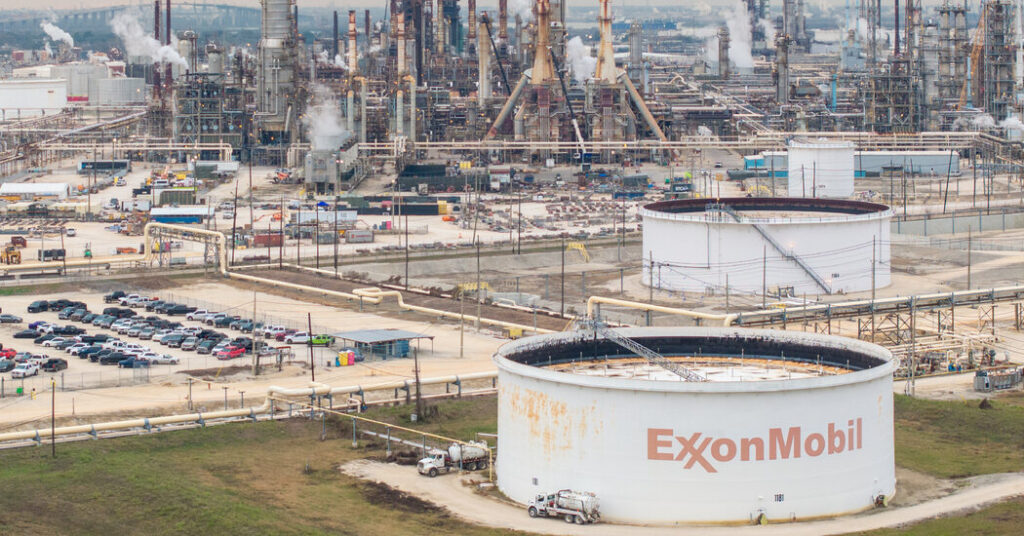
Michigan’s lawsuit cites federal and state antitrust laws, and names four of the world’s biggest oil companies as defendants, ExxonMobil, Chevron, Shell and BP, along with the industry’s main trade association, the American Petroleum Institute.
“This is yet another legally incoherent effort to regulate by lawsuit,” said Elise Otten, a spokeswoman for Exxon. “It won’t reduce emissions, it won’t help consumers, and it won’t stand up to the law.”
Ryan Meyers, senior vice president and general counsel for A.P.I., called the lawsuits a “coordinated campaign against an industry that powers everyday life, drives America’s economy, and is actively reducing emissions.” He said the group’s position was that energy policy should be set in Congress, not in “a patchwork of courtrooms.”
A.P.I., which is named in several of the lawsuits, said this month that ending the litigation was one of its top goals this year.
Trump Administration: Live Updates
Updated
- Breaking her silence, Eleanor Holmes Norton announces her retirement.
- Mark Carney rejected suggestions that he walked back his Davos speech to Trump.
- Philip Glass withdraws new symphony from the Kennedy Center over the venue’s ‘values.’
Theodore J. Boutrous Jr. of Gibson, Dunn and Crutcher LLP, the legal firm representing Chevron, pointed to federal- and state-court dismissals of some of the lawsuits around the country, saying they demonstrated the lack of merit in the cases. “This lawsuit also ignores the fact that Michigan is highly dependent on oil and gas to support the state’s automakers and workers,” Mr. Boutrous said. (Mr. Boutrous represents The New York Times Company in unrelated litigation.)
BP and Shell declined to comment.
Rachel Rothschild, a professor at the University of Michigan Law School who has provided pro bono legal advice to organizations that have worked on climate litigation, said the framing of the new lawsuit by the state attorney general was probably a reflection of local concerns about the cost of living.
“She’s representing people in a state that is purple,” she said of Ms. Nessel, Michigan’s attorney general, who is up for re-election this year. “I think the citizens of Michigan are very concerned about their energy costs, and framing this lawsuit as being about those energy costs, from a political perspective and speaking to the people of Michigan, it’s going to resonate more with the people of this state.”
Gary J. Mouw, a lawyer whose practice includes a focus on antitrust matters at the firm Varnum in Grand Rapids, Mich., said he expected the case would face significant challenges. “It’s really an attempt to stretch the antitrust law beyond its traditional boundaries,” he said.
The complaint describes decades of strategy, communications and investment decisions in alleging that the companies worked together to hinder the electric-vehicle industry and renewable energy. The judge will have to decide whether the allegations amount to collusion rather than routine business activity.
Michigan is the 11th state to file a climate lawsuit. Others were filed by cities, counties and tribes.
The industry and its allies have been pushing the Supreme Court to take up the issue of climate litigation. The court is expected to announce soon whether it will hear arguments over a petition by ExxonMobil and Suncor, a Canadian energy giant, in a lawsuit brought by the city and county of Boulder, Colo. The energy companies are hoping the Supreme Court will effectively throw out the Boulder lawsuit, and others like it, by ruling that federal law precludes climate lawsuits based on state laws.
Since the Michigan lawsuit revolves around different claims, it may be insulated from an adverse Supreme Court ruling in the Boulder case. Other lawsuits that focus on consumer-protection laws, like one brought by Massachusetts, may also be less vulnerable. Those argue that the oil companies engaged in disinformation campaigns designed to hide the risks of climate change from the public.
Then there’s the venue question. A vast majority of the climate litigation has been filed in state rather than federal court. That resulted in a yearslong tug of war that played out in courts around the country as the companies sought to move the litigation into federal courts, which are considered more favorable for them.
The energy companies argue that federal law governs interstate emissions and blocks related lawsuits based on state laws. Partly because of this procedural quagmire, none of the cases have gone to trial so far. Judges have generally sent the cases back to state court, where some have been dismissed while others are advancing.
In the latest development, Minnesota’s Court of Appeals on Monday upheld a lower court’s decision allowing that state’s lawsuit to continue.
David Uhlmann, a lawyer at Marten Law and former federal environmental official who represented Michigan in the lawsuit brought by the Justice Department, said a central question in the effort to thwart the climate lawsuits was the tension between the federal and state governments.
He said the Trump administration’s efforts went against the conservative tradition of supporting states’ rights. “For the longest time, Republicans have argued that the federal government should be deferring to states and not encroaching on state sovereignty,” he said. “Now we have the Trump administration that’s attacking states and trying to limit their authority.”
An effort to block the lawsuits with legislation is also afoot. In June, Republican state attorneys general urged the Justice Department to push Congress for a “liability shield” for the industry, similar to the one that protects gun manufacturers from lawsuits. In a recent congressional lobbying report, A.P.I. said it was working on “draft legislation related to state efforts to impose liability on the oil and gas industry.”
And in Utah and Oklahoma, state lawmakers have introduced bills that would protect energy companies from liability for emissions. The proposals resemble a model bill drafted by an advocacy group linked to the conservative activist Leonard Leo.
Karen Zraick covers legal affairs for the Climate desk and the courtroom clashes playing out over climate and environmental policy.
The post Michigan Sues Oil Giants, Saying They Collude to Make Energy Costlier appeared first on New York Times.