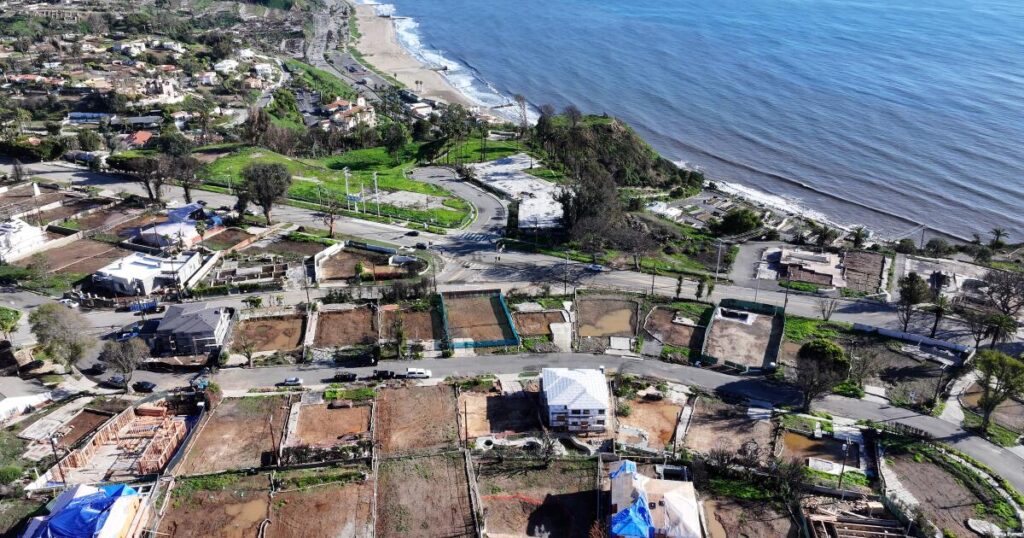
Amid a year dominated by talk of rebuilding in the wake of the Palisades and Eaton fires, 2025 was yet another year of vanishingly few new homes in Los Angeles. At just 8,714 residential permits issued by the city, housing production remains near a 10-year low — or roughly five times fewer per capita than in cities like Austin, Texas.
These numbers have real-world consequences. In Austin, rents have plummeted 21% in the last three years and are now back to pre-pandemic levels. In Los Angeles, rents are up 28% from March 2020. For many, that’s a difference between making ends meet and losing your home.
This year presents an opportunity to change course. And yet if Mayor Karen Bass and her chief antagonist Rick Caruso represent two poles along the continuum of political perspectives in L.A., their shared opposition to SB 79, a state law that legalized building more homes near major transit stops, hints at a deeper dysfunction in our body politic.
The simple truth is that L.A.’s chronic housing shortage is not for lack of technical capacity or earnest speeches. It’s due to our political leaders’ fundamental ambivalence toward the remedy. In spite of all the pain our lack of homes inflicts on ordinary Angelenos, our elected officials still hesitate to declare, unconditionally, that building more housing is good, actually.
This issue dates back decades to the late 1960s, when anti-growth attitudes became intertwined with progressive politics of the day. A Malthusian strain of environmentalism — “if we don’t build it, they won’t have children” — combined with a fear of dense urban environments and their predominantly Black and brown inhabitants following the riots that shook inner cities across the country. A powerful nationwide consensus took root that building fewer homes was better.
That consensus reshaped Los Angeles. Under leaders like Zev Yaroslavsky who championed ballot measures like Proposition U, the city moved aggressively to restrict growth, reducing its potential housing capacity from 10 million people to just 4 million.
Of course, babies were still born, jobs were created, more and more people moved to L.A. in search of opportunity — and anti-growth logic collapsed under the weight of reality. Rents soared. Homelessness exploded. Low income families were displaced to Bakersfield, Victorville, Las Vegas and Phoenix. City leaders began to acknowledge L.A. needed more homes — sort of.
L.A. needs more housing, we now hear our leaders claim — but only if it doesn’t strain infrastructure or cast shadows. Only if it doesn’t replace parking or force anyone to move. Only if it’s 100% affordable, and only if it preserves the “character” of existing neighborhoods (72% of which are zoned for just one home per parcel).
It’s no surprise, then, that our city’s systems to approve new homes are simultaneously designed to thwart them. After all, bureaucracies don’t invent priorities; they reflect them. In a city where Executive Directive 1, the mayor’s signature program to build affordable housing, has been systematically walked back and dismantled after it proved too successful at building affordable housing, the safest path for a civil servant reviewing your project is to just say no at every juncture. Delay is tolerated. Responsibility is shirked. Dysfunction abounds.
As famed management theorist Stafford Beer stated, the purpose of a system is what it does. Broadly, L.A.’s housing policies suffer from three fatal flaws that together make up a system you’d be hard pressed to design better if your goal was to completely stymie all home building:
Artificial scarcity. Zoning continues to constrain growth in the high-opportunity areas where demand to live is highest, driving up the price of the rare parcel of land where it’s legal and feasible to build. To go taller and denser, developers must pony up further by providing “community benefits” that ignore the fact that new homes themselves are of great benefit to the community.
Regulatory uncertainty. Even code-compliant projects face multiple layers of uncertain approvals and appeals. The average unit in L.A. takes a mind-boggling 1,784 days to get built. The higher the risk of delays and cost overruns, the higher the return demanded by investors. A Rand Corp. analysis indicates this is a top reason housing costs 250% moreto build in California as it does in Texas.
Punitive taxes. Our government taxes cigarettes heavily to discourage their use. In L.A., we apply similar logic to new housing through impact fees, transfer taxes and inclusionary mandates that deter desperately needed investment. Instead of collectively funding our infrastructure and affordable housing needs, we pin it all on new projects — and then wonder why they don’t get built.
The difference between Los Angeles and cities like Austin, Denver, Raleigh and Nashville that have made progress on housing isn’t the compassion or creativity of its residents. It’s the clarity and courage of its leadership.
Moments of genuine crisis — and we’ve all heard our politicians describe our housing and homelessness situation as such — require leaders willing to make tough choices. Cities that build housing do so because they declare it a top priority and align their institutions accordingly. Cities that hedge and delay quietly sabotage themselves.
The fundamental question facing L.A. in 2026 isn’t whether we know how to build more homes. It’s whether we’re finally willing to say yes to them — and mean it.
Jesse Zwick is the Southern California director of the Housing Action Coalition.
The post Los Angeles is sabotaging itself on housing appeared first on Los Angeles Times.