The leaders of the European Union and India announced a trade agreement on Tuesday after nearly two decades of negotiations, striking a deal that has become more urgent for both sides as President Trump continues to upend the global order and test longstanding alliances.
While the final free-trade agreement must still clear legal scrutiny in Brussels and New Delhi, the deal brings together the world’s largest economic bloc and India, the fastest-growing major economy, at a time when the United States is seen as a less-reliable economic partner and China is flooding the world with inexpensive goods.
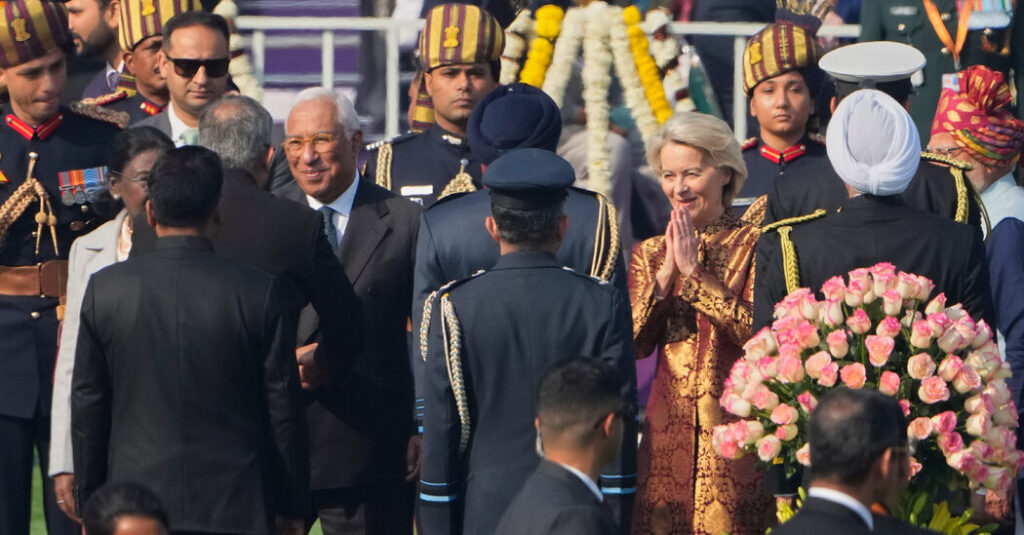
The announcement came after Ursula von der Leyen, the president of the European Commission, and António Costa, the president of the European Council, joined Prime Minister Narendra Modi of India in New Delhi on Monday as honorary guests for Republic Day, a ceremonial military parade that Indian leaders use to signal strategic priorities.
The pact includes an agreement to slash Indian tariffs on European cars to as low as 10 percent. India has one of the most protected domestic car industries, with tariffs on imported cars as high as 110 percent, effectively blocking the sale of most European cars there.
“We have concluded the mother of all trade deals,” Ms. von der Leyen posted to social media during a summit on Tuesday. She added that this agreement “created a free-trade zone of two billion people, with both sides set to benefit.” After a signing ceremony, she said the pact would provide “security to our people in an increasingly insecure world.”
Mr. Modi told reporters that “this is the biggest free-trade agreement by India so far,” affecting, he said, one-third of all global trade. Earlier, he said that the accord demonstrated India’s and Europe’s “shared commitment to democracy and rule of law.”
The agreement is expected to double the total value of goods that the European Union exports to India within the next six years. Most of India’s tariffs on machines, chemicals and drugs are set to be eliminated. India won concessions on tariffs affecting its garment exports and the promise of easier access for its high-tech service professionals to work in Europe.
The negotiations between the European Union and India began in 2007 but were paused for nine years, starting in 2013, as both sides grappled with concerns from their most sensitive members, especially farmers.
In a sign of the eagerness to get a deal done, some of the more contentious points of the negotiations were omitted. India agreed to lower tariffs on European wine, olive oil and confectionery, but more sensitive agricultural products such as beef, poultry, rice and sugar were excluded from the deal. The European bloc said it planned to help fund India’s efforts to reduce carbon emissions to ease concerns about Europe’s strict climate regulations.
The urgency for a deal became more acute in recent months, as India and Europe faced the threat of higher tariffs from President Trump to advance his diplomatic and economic agenda.
India has been unable to reach a trade accord with the Trump administration since the White House announced in April so-called “reciprocal tariffs” on dozens of countries. President Trump stunned Indian officials by slapping an additional 25 percent punitive tariff in August for purchasing Russian oil, raising the overall import duty on Indian goods to 50 percent.
Even though the European Union reached an agreement with the United States that lowered its tariff rate to 15 percent last year, President Trump threatened to impose an additional 10 percent tariff on a bloc of European nations opposed to his attempts to take over Greenland from Denmark. Mr. Trump backed off after reaching a “framework” deal on Greenland with European counterparts.
Both Europe and India have sought to lessen their dependence on the United States. The European Union recently agreed to a long-negotiated trade pact with four South American countries. Last year, India signed a trade deal with Britain, in which it also cut tariffs on British whisky and gin, and cars under a quota.
A trade deal with India could add more than $19 billion to European exports each year and offset nearly a quarter of export losses from higher American tariffs, according to Jasmin Gröschl, an economist at Allianz Investment Management.
In the Indian fiscal year ending in April, the total value of goods traded between India and members of the European Union was $136 billion — compared to $132 billion in India’s trade with the United States, its largest single-nation partner.
Ajay Srivastava, founder of the Global Trade Research Initiative, a New Delhi-based think tank composed mainly of former Indian trade officials, said the European economies could be more beneficial to India than the United States.
Europe’s principal exports to India include high-tech machinery, such as jet engines and industrial-control valves. In contrast, Mr. Srivastava said, U.S. imports were “so primitive,” including agricultural products such as corn and soybean as well as scrap, or recycled materials left over from construction or manufacturing.
India’s main exports to Europe include textiles and garments, as well as refined oil products. These export-dependent industries, along with polished gems, carpets and farmed seafood, have been hit hardest by American tariffs.
The European Union said India agreed to reduce or eliminate tariffs on 96 percent of European exported goods. As part of the agreement, the two sides said India will lower tariffs on up to 250,000 cars from the European Union.
Increasing access to India could help offer some relief to Europe’s car industry, which has been battered by rising costs, competition from Chinese automakers and sustainability requirements.
“European auto manufacturers are scrambling to offset a stagnating European market that has barely budged since COVID,” said Matthias Schmidt, a European auto industry analyst. They are “desperate to find new markets.”
The European Automobile Manufacturers’ Association said it supported a trade deal with India, where there was significant room for growth, as annual passenger car sales exceeded four million vehicles. Removing tariffs on auto parts would also support European carmakers who already manufacture in India, the industry body said.
The Volkswagen Group, Europe’s largest carmaker, Stellantis, BMW, Renault and Mercedes-Benz all operate manufacturing sites in India, though the industry’s growth has been constrained by high taxes and strict requirements on producing and assembling locally.
Last year, Volkswagen said it reached the milestone of producing 2 million cars in India across its brands, including Skoda and Audi, after 25 years in the country. The local production builds vehicles for the local market while also serving as an export hub to other regions such as Latin America and Africa.
Koba Ryckewaert, Suhasini Raj and Hari Kumar contributed reporting.
Alex Travelli is a correspondent based in New Delhi, writing about business and economic developments in India and the rest of South Asia.
The post In Trump’s Shadow, India and the European Union Expand Trade Ties appeared first on New York Times.