Iran’s mass protests in early January were seen by many as the most threatening yet for the regime. The crackdown was brutal: Thousands were killed by security forces.
Iran’s state-imposed internet blackout made it fiendishly hard for my colleagues to gather information. But they did. Today, as U.S. warships are in the region, my World colleague Parin Behrooz writes about the disturbing findings of a New York Times investigation.
How Iran crushed civilians with lethal force
by Parin Behrooz
Over the past three weeks, my colleagues and I have been working to figure out what really happened in Iran this month.
As protests spread throughout the country, Iran was plunged into a state-imposed communications blackout. By the time the government began its brutal crackdown, rumors quickly began to take the place of information. A.I.-manipulated videos and images flooded social media. Debates began raging online over how many thousands of people had been killed by government security forces.
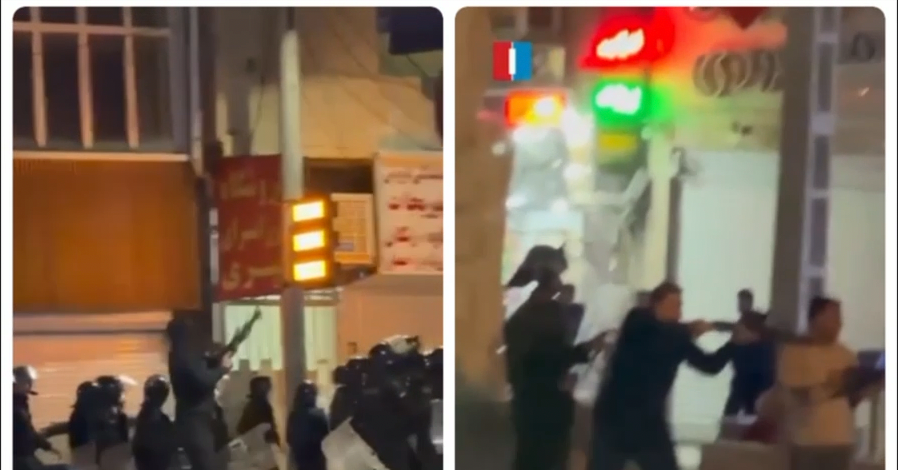
But some in Iran managed to evade the restrictions, which allowed me and my colleagues to begin collecting and verifying the witness accounts and videos trickling out of the country. What we found was disturbing.
We learned from Iranian officials familiar with security matters that on Jan. 9, Iran’s supreme leader, Ayatollah Ali Khamenei, ordered the Supreme National Security Council to crush the protests by any means necessary.
Security forces opened fire on protesters in at least 19 cities, according to verified videos. Hospitals were overwhelmed by protesters coming in with gunshot and pellet wounds to the torso, head and eyes — an injury pattern consistent with lethal force, not crowd control. One doctor told us that injuries had changed from limb fractures and tear gas inhalation to “skull fractures and gunshot wounds.”
We obtained photographs of more than 300 bodies taken to Tehran’s main morgue. A majority of the bodies showed severe head trauma and collapsed eye sockets. Other colleagues reported on corpses being dumped at Tehran’s largest cemetery.
Within four days, the protests had largely been crushed.
We may never fully know the extent of what happened. Most independent monitoring groups agree that the number of deaths is in the thousands.
But we can say that the government responded to these protests with more lethal force than we’ve seen in many decades. That tells us something about how it views the stakes of the protests, which called for the downfall of Khamenei and his regime.
“Everyone I speak to inside Iran knows a family member, a friend or a colleague who has been killed, wounded or imprisoned,” said Omid Memarian, a New York-based Iran analyst and journalist who has reported from inside the country. The repression has been “on a scale without precedent.”
A history of violence
Iran has seen multiple waves of protests in the last two decades, each with different triggers and government responses. The 2009 Green Movement, which followed a contested presidential election, was large and organized. It demanded reforms, not the overthrow of the regime. Iran’s government deployed violence against the demonstrators, resulting in dozens of deaths, but the protests were largely stopped through mass detentions and pressure campaigns on reformist leaders.
During economic protests from 2017 through 2020, demonstrators called for a more radical overhaul of the political system, and the government was even more willing to use violence. During one crackdown, more than 300 people were killed. In 2022, large protests took place after the death of a woman who was in the custody of the country’s morality police for violating the hijab law, which mandates that women and girls cover their hair and bodies. The state again responded to those protests by killing hundreds of people.
The latest demonstrations began with shopkeepers from the bazaars who were exasperated over economic problems, but quickly spread across the country, including to rural and impoverished areas far outside of Tehran.
The government at first tried to mollify the protesters, promising to distribute the equivalent of a few dollars a month to all Iranians. But street demonstrations explicitly calling for an end to the regime, with chants like “This year will be the year of blood, Ali [Khamenei] will be overthrown,” grew larger, leading up to Khamenei’s order. The crackdown that followed was in a different category: Not dozens or hundreds of killings, but thousands.
Analysts saw the response as proof that Iran’s leaders feared for their very existence.
“If it hadn’t been as serious, they wouldn’t have cracked down the way they did,” said Sanam Vakil, director of the Middle East and North Africa program at Chatham House. The protests “showcased that more people than ever are at a breaking point.”
Fragility and ferocity
There is only one moment in Iran’s post-revolutionary history that compares, analysts said.
In the 1980s, the newly founded Islamic Republic was consolidating power as it faced internal opposition on a number of issues, including protests over the hijab and the suppression of Iran’s Kurdish minority. The dissent came to a head in 1988 when the supreme leader at the time, Ayatollah Ruhollah Khomeini, ordered the mass execution of what is estimated to be thousands of political prisoners behind closed doors. The killings took place in the shadow of the deadly Iran-Iraq war.
Now, once again, the Islamic Republic is seeing external and internal threats converge. At home, it faces a profound legitimacy crisis. Abroad, it’s confronting the weakening of its regional proxies and the prospect of more attacks from the United States and Israel. The Islamic Republic is at its most fragile geopolitical moment in years, and perhaps ever.
History and the January crackdown show us what the Iranian regime is willing to do when its survival is threatened. When it feels weak, it seems to grow more ferocious.
Read our full visual investigation here.
Farnaz Fassihi, Sanjana Varghese and Malachy Browne contributed reporting.
MORE TOP NEWS
The E.U. and India signed a major trade deal
The E.U. and India struck what officials called “the mother of all trade deals” yesterday, after nearly two decades of negotiations. The urgency for a deal had become more acute in recent months, as both entities faced the threat of higher tariffs from President Trump and sought to reduce their dependence on the U.S.
The pact includes an agreement to slash Indian tariffs on European cars to as low as 10 percent, and is expected to double the total value of E.U. goods exported to India within the next six years.
In other trade news:
-
Prime Minister Keir Starmer of Britain flew to China for a high-stakes visit. He will seek new trade and investment deals but hopes to do so without angering Trump.
-
Trump raised tariffs on South Korean exports back to 25 percent, saying that the country had not implemented a previous trade deal quickly enough.
Spain gave migrants a way to stay
The Spanish government passed a decree yesterday that will allow hundreds of thousands of undocumented migrants to apply for temporary residency permits, giving them a path out of legal limbo.
The Socialist-led government described it as crucial for Spain, where migrant labor plays a critical role in agriculture, tourism and more. The move put Spain at odds with other Western countries, which have grown increasingly tough on illegal immigration.
OTHER NEWS
-
The total number of Russian and Ukrainian casualties is on track to reach two million by the spring.
-
Trump promised an “honest” inquiry as he blamed a Minnesota protester for carrying a legally permitted gun before he was fatally shot by federal agents.
-
A draft resolution revealed some of the plans for Trump’s Board of Peace, including handing him sweeping powers over Gaza.
-
ICE agents will accompany the U.S. delegation to the Winter Olympics next month. Italians are outraged.
-
Mette Frederiksen, Denmark’s prime minister, said that she didn’t know how long the U.S. would remain an ally.
SPORTS
Tennis: Coco Gauff was eliminated from the Australian Open in a loss to Ukraine’s Elina Svitolina.
Skiing: Mikaela Shiffrin left Beijing in 2022 without a medal. Now she has another shot at Olympic glory.
AMBASSADORS OF THE DAY
Panda twins
— Thousands of people flocked to a Tokyo zoo for a final glimpse of the panda twins Xiao Xiao and Lei Lei before they returned to China yesterday. The furry envoys were on loan as part of Beijing’s longstanding panda diplomacy program, but rising regional tensions mean they probably won’t be replaced.
MORNING READ
How bad are A.I. delusions? My colleagues interviewed more than 100 therapists and psychiatrists to find out. They learned that the number of people susceptible to psychological harm and even psychosis is far higher than most people understand.
Chatbots, experts said, frequently pull people away from human relationships, condition them to expect agreeable responses and reinforce harmful impulses. One psychologist said the bots could tip people without a history of mental illness from having eccentric thoughts into full-on delusions: “It was like the A.I. was partnering with them in expanding or reinforcing their unusual beliefs.” Read more.
AROUND THE WORLD
What they’re staying up all night for … in Myanmar
Five years after the military seized power in Myanmar, the junta is trying to project a veneer of legitimacy, in part by allowing some traditional musicians to return to the stage.
U Than Zaw Htwe, known by his stage name San Yay Moe, performs zat pwe (pronounced zat-PWAY), or “story show,” an opera-like art form that dates back to the 1800s. His shows, which go from 10 p.m. to 6 a.m., are fully booked until April. “People are feeling mentally suffocated,” Than Zaw Htwe said. “They need happiness.”
Sui-Lee Wee, our Southeast Asia bureau chief, stood in line with hundreds of people to watch a zat pwe performance. Take a look.
RECOMMENDATIONS
Read: In George Saunders’s “Vigil,” an oil tycoon on his deathbed is visited by an angel.
Watch: “Wonder Man,” a new Marvel mini-series, features struggling actors who would rather play heroes than be heroes.
Dress down: Thinking about wearing a sweatshirt to work? Read this first.
RECIPE
Kitchri is a popular South Asian savory porridge made with rice and lentils. This version is inspired by kuku paka, an East African coconut-milk-based curry, and is served with jammy eggs for added protein.
WHERE IS THIS?
Where are these dogs?
TIME TO PLAY
Here are today’s Spelling Bee, Mini Crossword, Wordle and Sudoku. Find all our games here.
You’re done for today. See you tomorrow! — Katrin
Parin Behrooz was our guest writer today.
We welcome your feedback. Send us your suggestions at [email protected].
Katrin Bennhold is the host of The World, the flagship global newsletter of The New York Times.
The post How Iran Crushed an Uprising appeared first on New York Times.