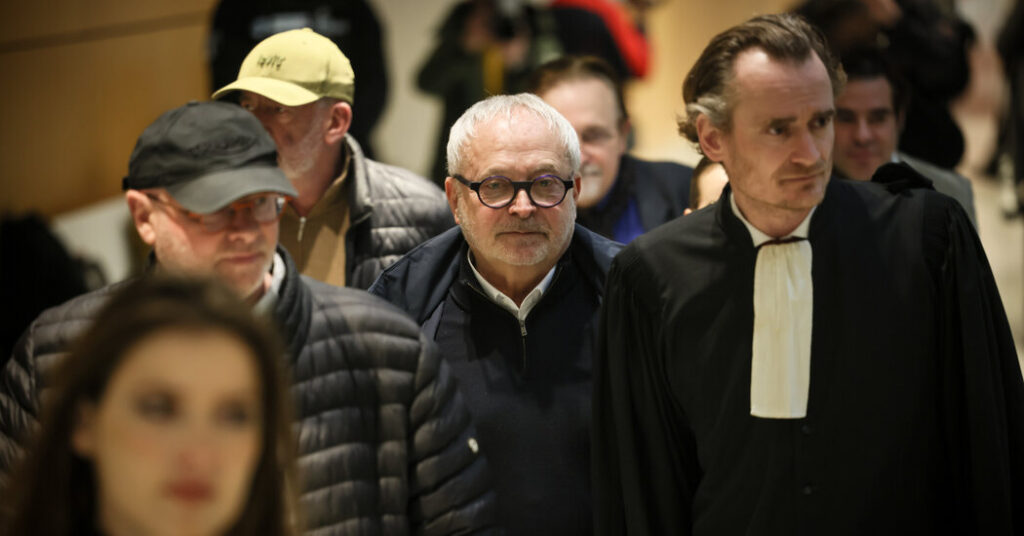
A former French senator was found guilty on Tuesday of slipping a drug into champagne he served to another lawmaker with the intent to sexually assault her.
Joël Guerriau was convicted of administering a judgment-altering substance, identified by the prosecutor as ecstasy, to Sandrine Josso, a member of the National Assembly, without her knowledge in order to commit assault. He was also found guilty of illegally possessing narcotics.
He received a four-year jail sentence, with 30 months suspended, and a 5-year electoral ban. He was also ordered to pay Ms. Josso 9,000 euros, about $11,000, in damages. The court rejected Mr. Guerriau’s defense, that the drugging had happened “inadvertently.” Mr. Guerriau’s lawyer told reporters outside the courthouse on Tuesday that Mr. Guerriau would appeal the verdict, which puts the sentence on hold.
“I hope other victims will be able to repair themselves a little bit too,” Ms. Josso told reporters in the courthouse. She added that the verdict came as a “huge relief.”
The court’s verdict also requires Mr. Guerriau to undergo psychological or psychiatric treatment and prohibits him from contacting Ms. Josso.
The trial found deep resonance in a country still brimming with debates about rape culture and the use of drugs in sexual abuse, a year after a court found Dominique Pelicot and dozens of other men guilty of raping Mr. Pelicot’s ex-wife, Gisèle Pelicot, while she was sedated.
According to French news outlets, Mr. Guerriau, who resigned from his position as senator in October 2025, admitted in court on Monday to possessing the substance but said he did not know it was ecstasy, and he denied knowingly drugging Ms. Josso. He also denied any intent to sexually assault her.
Over the two-day trial, Mr. Guerriau and his lawyers have argued, according to French news outlets, that he had placed the drug in a glass for his own use the day before but did not take it. He then forgot that he had left the substance at the bottom of the glass when he poured champagne in it for Ms. Josso.
Mr. Guerriau has not commented publicly on the case.
The accusations against Mr. Guerriau date back to November 2023, when Ms. Josso recounted the incident in an interview with the French TV channel France 5, just days after it took place.
The week before, she said at the time, Mr. Guerriau, a longtime friend, invited her to his apartment to celebrate his re-election. She said she drank some champagne and soon started feeling unwell.
“He was in the kitchen, and he put a white bag back in a drawer under the counter,” Ms. Josso said. “And then I understood, I thought to myself, ‘What is this bag?’”
Ms. Josso said she then managed to leave, calling a taxi to take her back to the National Assembly. She spent the night in the hospital and filed a complaint with the police the following morning. “I thought I was going to die,” she said.
The experience, she told France 5, was a wake-up call about how widespread this method of sexual assault might be: “The doctors and nurses told me, ‘Madam, people like you come in every day, three times a day.’ I said ‘That’s not possible.’”
Ms. Josso has since frequently alerted people to what is known in France as “chemical submission,” or drugging someone with malicious intent.
She attended and offered support to victims in two major cases in France involving this crime: the trial of Dominique Pelicot and dozens of other men, and the trial of Joël Le Scouarnec, a French surgeon who was found guilty of raping and sexually assaulting 299 people over 25 years, most of them children, often when they were under anesthesia.
She has joined nonprofit associations like “Don’t Put Me to Sleep,” created by Gisèle Pelicot’s daughter, Caroline Darian, to publicize the dangers of drug-facilitated crimes.
Ms. Josso also successfully pushed for the creation of a parliamentary commission to investigate the issue in France.
Last December, France’s health minister, Stéphanie Rist, decided to follow a recommendation by Ms. Josso and the commission to offer reimbursement for medical tests to detect drugs without the need to file a police complaint beforehand. Three regions of France began offering the reimbursement this month, as a temporary measure, and it will be available for the next three years.
In an interview with France Info, a radio station, on Monday, Ms. Josso said she developed chronic back pain and dental problems because of the stress of being victimized, and was still struggling to rebuild her life.
“Psychological trauma is like being frozen,” she said. “Your brain is still stuck on the day of the ordeal.”
Calling for “genuine government policy” to address drug-related crimes, Ms. Josso said she wanted the trial to be “educational.”
“What I really want is for victims in France to stop being invisible and socially isolated,” she said.
Ségolène Le Stradic is a reporter and researcher covering France.
The post Former French Senator Convicted of Drugging a Colleague, Intending to Assault Her appeared first on New York Times.