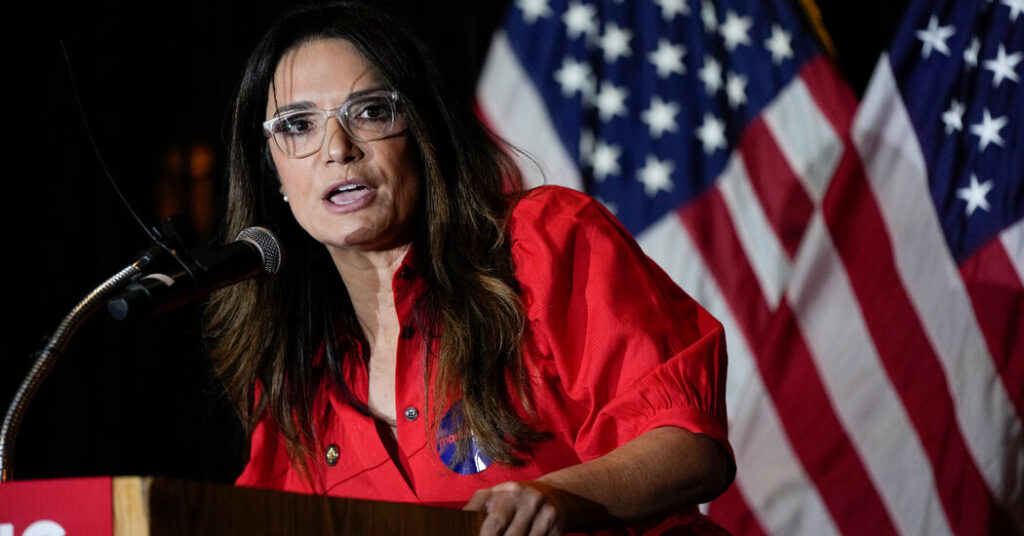
The Trump administration’s immigration crackdown over the last year has gone from uncomfortable to untenable for Ileana Garcia, a Republican state senator in Florida.
A Transportation Security Administration officer at the Tallahassee airport overheard her speaking Spanish and asked whether Ms. Garcia, who was born in Miami, was an American citizen. She worried for the first time that Immigration and Customs Enforcement agents might stop her son, a young adult, because he looks Hispanic. Constituents have asked her for help finding immigrant relatives arrested by ICE.
Ms. Garcia, 56, has had enough. The Republican Party is in trouble, she said in an interview, predicting that it will lose this year’s midterm elections if the White House does not soon reconsider its harsh immigration enforcement tactics.
“We should not be afraid as a party to speak up, to course correct,” she said. That was before Saturday, when Border Patrol agents shot and killed Alex Pretti, a 37-year-old I.C.U. nurse who was protesting in Minneapolis, and federal officials sought to portray him as a “domestic terrorist.” Ms. Garcia said she was “dumbfounded.”
“It’s gone too far,” she said. “What happened Saturday was abhorrent.”
What a little-known state senator in a state that no longer appears to be a political battleground thinks might seem of little consequence. But Ms. Garcia, who is Cuban American, was once such a true believer in President Trump that she went all-in on his 2016 campaign, leaving her career in Spanish-language media to co-found “Latinas for Trump,” a national organization that drew attention at the time.
She then moved to Washington to work for Mr. Trump’s first administration, in the public affairs office of the Department of Homeland Security, which enforces immigration laws.
Back then, Mr. Trump was focused on closing the U.S.-Mexico border and building a border wall, both policies she supported. Now he has gone much further, Ms. Garcia said. She blamed Stephen Miller, the president’s deputy chief of staff for policy and homeland security adviser, for tactics that include yanking people out of cars and trying to remove children who crossed the border on their own from foster care homes and deport them.
“I do think that he will lose the midterms because of Stephen Miller,” she said of Mr. Trump.
The White House did not respond to a request for comment on Monday about Ms. Garcia’s assertion but pointed to remarks by Karoline Leavitt, the press secretary, about Mr. Pretti’s death.
“Nobody in the White House, including President Trump, wants to see people getting hurt or killed in America’s streets,” she said, claiming that the killing “occurred as a result of a deliberate and hostile resistance by Democrat leaders in Minnesota.”
Ms. Garcia said she knew Mr. Miller during the president’s first term and did not like him then, either. But he had less power than he does now, she said. Was she blaming Mr. Miller for the administration’s immigration policies but absolving Mr. Trump?
“I’m not absolving him,” Ms. Garcia said. “I’m not justifying the things that we’re seeing.”
But, she was quick to add, “There’s no perfect administration.” She remembered being a guest at Mr. Trump’s Mar-a-Lago estate in Palm Beach in late 2023 and talking to him about immigrants who were brought into the country illegally as children, known as Dreamers. She found Mr. Trump receptive to the argument that they should be allowed to stay, and she still likes him, she said.
Ms. Garcia’s blunt criticism is unusual even among Florida’s Hispanic lawmakers. Representative María Elvira Salazar, one of Miami’s three Cuban American Republicans in Congress, has disagreed with the Trump administration on immigration and other policies, but her comments have tended to be more conciliatory than Ms. Garcia’s.
Last year, Ms. Garcia voted for an immigration enforcement bill in the Legislature that created a new state board of immigration enforcement. But she opposed another bill that made it a state crime for unauthorized immigrants to enter Florida and ended a policy allowing Florida residents who had been brought into the country illegally as children to pay in-state tuition at public universities.
“Most people will come in and whisper in my ear, ‘Aren’t you afraid they’re going to primary you?’” said Ms. Garcia, who is up for re-election this year. “No, I’m not.”
“I’m afraid of someone stopping my son,” she added. “That’s what I’m afraid of.”
Ms. Garcia has been speaking out for months in social media posts and statements to local news outlets. She received death threats in June after condemning the Trump administration’s mass deportations as “unacceptable and inhumane.”
She discussed her unease over lunch last month in Coral Gables, an upscale Miami suburb in her district, which stretches across central Miami-Dade County to Miami Beach, and again by phone in mid-January. Miami voters elected their first Democratic mayor in nearly 30 years in December, and Ms. Garcia agreed with those who credited Eileen Higgins’ resounding victory in part to voters’ disgust over the immigration crackdown.
“Republicans stayed home — I wonder why?” Ms. Garcia said. “I think they’re embarrassed. I think that they feel that they might have gotten the wool pulled over their eyes. And this was their way of pushing back.”
Ms. Garcia is well aware of critics who say that Republicans like her should have foreseen the second Trump administration’s aggressive immigration tactics. She thought the White House would focus on limiting border crossings, vetting new immigrants and removing criminals, all of which she supports.
She has been especially offended by the deportations of Cubans who had committed nonviolent criminal offenses but had been in the country for decades and of Venezuelans and other immigrants from politically unstable countries who had been granted temporary permission to live and work in the United States.
To go after people like that “doesn’t make sense,” Ms. Garcia said, adding that it has wreaked havoc on families and communities and is “inhumane.”
She has been disappointed not only with regards to immigration. The Trump administration, she said, is also “gaslighting” Americans on the economy.
“In 2016 to 2020, the rhetoric matched the reality,” she added. “The economy was good. People were working. People were happy. But now, they are saying the economy is better. I am sorry, respectfully: I shop for my parents, and I count coupons.”
She sees herself as a truth-teller within her party. Too many of her fellow Republicans are scared to say how they feel, a self-censorship that frightens her. “It’s almost like the stories that my mother would tell me of what she lived in Cuba, and we’re seeing it here,” she said.
She rejected any suggestion that she could afford to speak out because redistricting has made Florida legislative elections less competitive than they once were. (She won her first election in 2020 by a mere 32 votes.)
“I don’t know if anybody is really safe anymore, at least in Miami-Dade County,” she said. “There are so many mixed feelings.”
When she started criticizing the Trump administration last year, she said, a man she knows told her that she had gone too far. “‘I can’t believe you jumped over to the dark side,’” she recounted him saying.
She has since heard back from the same man, she said. This time, he told her she was right.
Patricia Mazzei is the lead reporter for The Times in Miami, covering Florida and Puerto Rico.
The post Florida Republican Says Immigration Crackdown Has ‘Gone Too Far’ appeared first on New York Times.