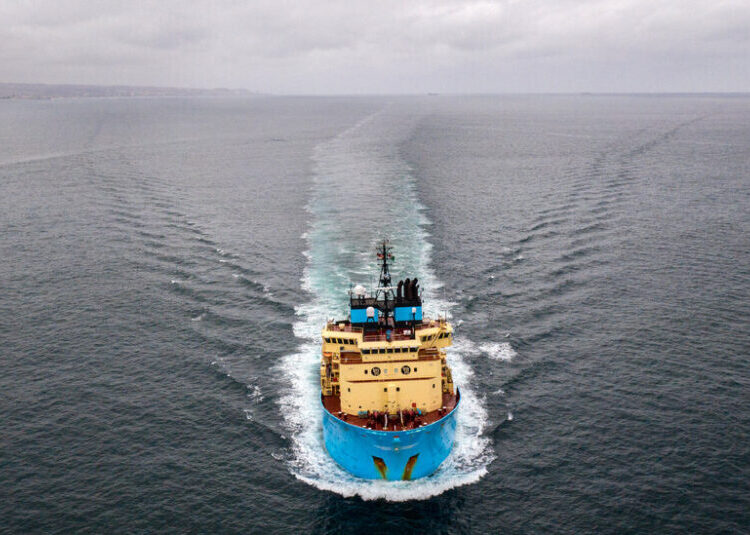
On the 12th day of their Antarctica cruise, a group of passengers aboard the Scenic Eclipse II helicoptered into the McMurdo Dry Valleys, the largest ice-free area on the frozen continent. Hours later, they found themselves in the polar opposite situation.
Sea ice had surrounded the luxury cruise ship, hindering its passage to open water. According to the U.S. Coast Guard, the Australian-owned ship rang for help around 11 p.m. local time.
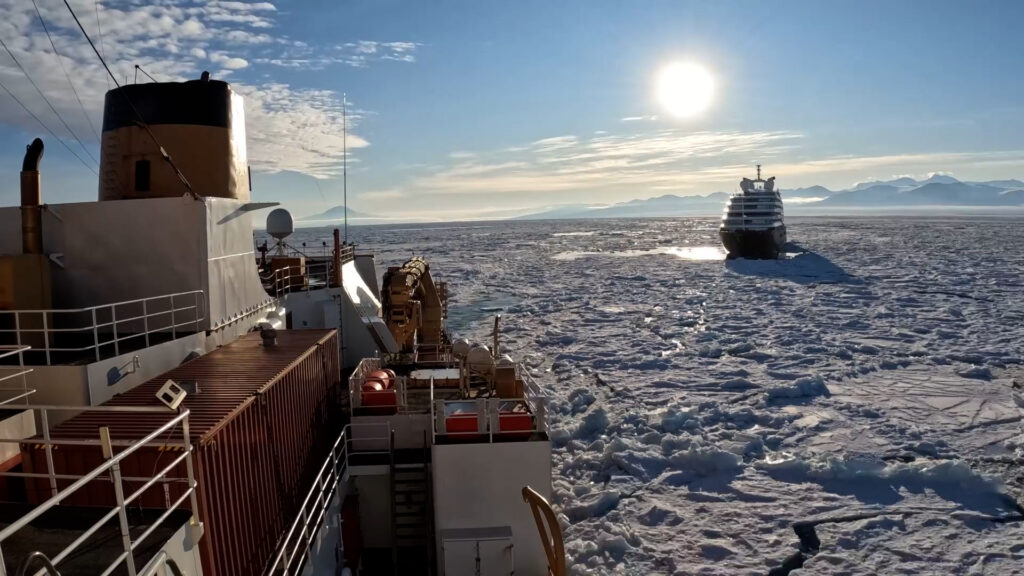
Polar Star, the U.S. military’s only active heavy icebreaker, took two “passes,” or laps, around the 551-foot cruise ship, slicing through the ice slabs as easily as a knife in soft butter.
“It was just a happy coincidence that she was there and it happened to be the ship’s 50th birthday as well, which was a pretty cool coincidence,” James Griffiths, general manager of ocean operations at Scenic Group, said from New Zealand, the cruise’s endpoint. “It was a great experience, and our guests loved it.”
An unexpected show
On a danger scale of 1 to Endurance, the Scenic Eclipse II’s predicament was low-risk, according to Griffiths. The ship’s ice-strengthened hull is categorized as 1A Super, the strongest of the Swedish-Finnish ice classes. The vessel can maneuver through ice; however, it can’t chop through dense blocks with the same force and speed of an icebreaker like Polar Star, which the Coast Guard describes as the world’s most powerful nonnuclear icebreaker.
“Sea ice can be three feet thick, or two or three times that if it’s accumulated over multiple years,” said Robert Sherrell, an associate professor in the Department of Marine and Coastal Sciences at Rutgers University in New Jersey. “It takes raw power to break through ice.”
Polar Star has been stationed in Antarctica since November in its 29th year with Operation Deep Freeze, a multi-armed-forces mission that provides operational and logistical support to the National Science Foundation’s U.S. Antarctic Program. One of the ship’s primary duties is to maintain a navigable channel by blasting through miles of ice as thick as 21 feet, according to the Coast Guard. An unobstructed path is critical to transporting fuel and supplies to scientists working in research stations and in the field.
Griffiths said Polar Star was visible, within 10 nautical miles, when the cruise captain asked for assistance. The cruise ship, he said, could have pushed through the ice but at a much slower pace, possibly delaying the 24-day itinerary from Tasmania to the South Pole to New Zealand.
“It took an hour, whereas without them, it might have taken five hours,” Griffiths said. “It made our life a little easier and allowed us to keep to the schedule we had in mind.”
Under the midnight sun, passengers gathered on the bow and the bridge to watch Polar Star in action. Crew members served champagne, and the expedition staff provided commentary. A few Americans, inspired by the icebreaker’s U.S. flag, sang the national anthem. Griffiths said about 50 of the 191 passengers stayed up late to observe the event.
According to the Coast Guard, Polar Star escorted the cruise ship about four nautical miles to open water.
“It’s a great example of cooperation in polar regions, and we are very grateful they were there,” Griffiths said. “It highlighted what a wonderful place Antarctica is and has given a little bit of visibility to the cooperation between everyone down there.”
The Scenic Eclipse II will wrap up its “Antarctica’s Ross Sea: Majestic Ice & Wildlife” journey in Timaru, New Zealand, on Thursday. After a quick turnover, the ship will set sail for its last Antarctic cruise of the season. The full fare starts at $73,710 per person, or $29,805 on sale.
‘Ice is unpredictable’
Antarctica cruising season generally runs from November to March, the continent’s austral summer. January is peak travel time, when the warm temperatures melt the icy formations.
However, wind and storms can blow sea ice — slabs of frozen seawater, which are different from icebergs — and create pack ice. With little warning, a football field of pack ice can hem in a ship.
“Ice is unpredictable, especially with limited observations in the Southern Ocean,” Ellen Buckley, an assistant professor in the University of Illinois’ Department of Earth Science and Environmental Change, said from a research vessel in Antarctica. “Because satellite and in situ measurements are limited, unavoidable conditions arise that are challenging to navigate.”
Adriane Lam, an assistant professor in the Earth Sciences Department at Binghamton University, State University of New York, who is also on the 30-day research trip, said their ice-capable vessel encountered ice that was much thicker than anticipated.
Sherrell said a single piece of sea ice, or floe, can measure 10 feet to more than a mile across. Pushed together by wind, the slabs can form a stretch of ice extending for miles.
“It looks like you’re driving your ship through a winter cornfield in Nebraska,” he said.
A ship can free itself by repeatedly backing up and accelerating forward, ramming the ice. However, this tactic can be extremely slow and burns a lot of fuel, Sherrell said.
“Cruise ships are not meant to do that,” Sherrell said. “They’re meant to stay out of trouble and gently push some ice floes away.”
The post Coast Guard called to help luxury cruise stuck in Antarctica appeared first on Washington Post.