ST. PAUL — A Trump administration lawyer assured a federal judge Monday that investigators have preserved body-camera footage and other evidence from the fatal shooting of Minnesota resident Alex Pretti, but he stopped short of promising to share that evidence with state investigators.
State officials have asked U.S. District Judge Eric C. Tostrud to extend an emergency order he issued Saturday prohibiting the government from destroying or altering evidence after the Border Patrol shot Pretti.
Justice Department lawyer Friedrich A. P. Siekert said the Trump administration opposes extending the order.
“We don’t have to worry” about the evidence being compromised, Siekert told the judge. “We’re preserving it.”
“We don’t want the court to get involved in micromanaging an ongoing federal matter at this point.”
Siekert said body-camera footage had been uploaded to Customs and Border Protection, which must secure it for 75 years, according to its rules. He did not say how many agents were wearing cameras.
Other evidence also was preserved, he said, as it would have been in any criminal or immigration investigation.
Siekert said, however, that he did not know if the federal government would preserve evidence once the federal investigation ended so that officials could share it with Minnesota investigators.
“I don’t know the answer to that,” he told the judge.
“Seems like that’s the most important question,” Tostrud said.
Minnesota Attorney General Keith Ellison and other officials have alleged “serious irregularities” with the evidence-gathering process in Pretti’s death. Ellison has said the state has not ruled out filing criminal charges against the agents involved. After an earlier court hearing Monday, he said federal officials “haven’t told us anything” about the evidence.
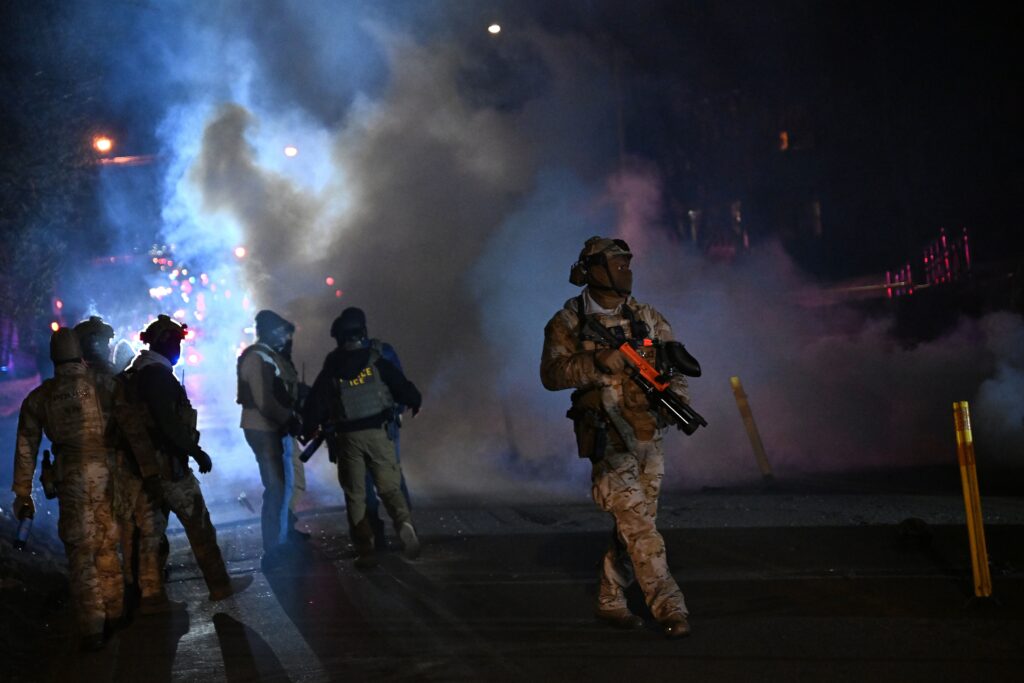
The hearing in Tostrud’s courtroom was one of two Monday that saw courts wrestle with the turbulent events that have roiled the Twin Cities since federal officials launched their biggest immigration enforcement operation yet on a state with far fewer immigrants than previous targets such as Chicago and Los Angeles.
In the other hearing, Monday morning in Minneapolis, state lawyers urged U.S. District Judge Katherine Menendez to order the federal government to dramatically curtail its operations.
“We’ve had the National Guard activated. We’ve had another person killed. We’ve had local law enforcement resources that are exhausted … and we’ve had continuing statements by the administration of coercion and pressure,” Minnesota Deputy Attorney General Brian Carter told the judge.
“Relief is appropriate now, and it should be granted now,” he said.
He added: “If this is not stopped right here, right now, I don’t think anybody who is seriously looking at this problem can have much faith in how our republic is going to go in the future.”
Administration officials say they are making street arrests because state officials will not aid their mass-deportation effort. Critics say the enforcement is sweeping up law-abiding residents and frightening and harming the community.
Menendez on Monday did not immediately rule on the state’s request to effectively end the actions, dubbed “Operation Metro Surge.” Although she noted “we are in shockingly unusual times,” she repeatedly expressed skepticism that she had the authority to broadly constrain the administration’s decision to deploy thousands of federal agents to the state.
It is clear Minnesota has “one set of values” while the administration has another, Menendez said. “We’re at risk of asking me to decide who is right here.”
Still, Menendez, an appointee of President Joe Biden, questioned whether a letter Attorney General Pam Bondi sent to Minnesota Gov. Tim Walz (D) on Saturday, which demanded the state repeal its “sanctuary city” policies and share public assistance data and voter rolls with the federal government, was the equivalent of a ransom note.
The letter appeared to link an end to the federal surge to Bondi’s requests. ““Is the executive trying to achieve a goal through force, which it can’t achieve through the courts?” Menendez asked.
Menendez said she intended to issue a decision as quickly as possible.
“If I had a burner in front of the front burner, this would be on it,” she said. Later in the day, she gave the administration until Wednesday to respond to state officials’ arguments.
At the hearing before Judge Tostrud, state lawyer Peter Farrell said the administration’s investigation into Pretti’s death has taken unusual turns. He noted that Immigration and Customs Enforcement’s Homeland Security Investigations unit is leading the probe, investigating the actions of the Border Patrol, which is another Homeland Security agency. Farrell told the judge he was unaware of HSI ever handling such an investigation, which is typically handled by the Justice Department’s Civil Rights Division.
Federal officials blocked state crime investigators from gathering evidence at the scene of Pretti’s death, he said, and he expressed concerns that Pretti’s firearm, a key piece of evidence, was “not handled properly” after agents seized it, based on photos of the alleged weapon on social media.
Farrell added that some administration officials have used inflammatory language to suggest that Pretti, an ICU nurse who cared for military veterans, was a “domestic terrorist,” raising questions about the federal commitment to neutral fact-finding.
Investigators at the state bureau “would never put public statements out into the world like that,” Farrell said.
“Your order should be a no-brainer here,” he told the judge.
It is unclear how many federal agents present at Pretti’s shooting wore cameras. But Ellison said earlier in the day that all officers and agents should wear and use them.
“Of course it should be mandatory,” he said.
The Washington Post reported Saturday, shortly before Pretti’s death, that the White House opposedmaking the body-worn cameras mandatory for immigration and border officers. Increased funding for the body-camera program which was included in a recently passed House budget bill did not require them.
Most agents did not have body cameras, as of the most recent data, from last year.
Speaking to reporters Monday, White House press secretary Karoline Leavitt said President Donald Trump wants to “let the facts” lead the investigation into Pretti’s death.
In the hours immediately after the shooting, however, several top administration officials asserted that Pretti was a “domestic terrorist” and “would-be assassin” who “wanted to do maximum damage and massacre law enforcement.”
A Washington Post analysis of videos that captured the incident from several angles showed Pretti stopping to help a woman who had been knocked down by Border Patrol agents before his shooting. Federal agents wrestled him to the ground and had secured a handgun he had in his possession before shooting him multiple times, the Post’s analysis showed.
Federal officers and agents have been involved in three shootings in the span of a few weeks, two being fatal. Minneapolis resident Renée Good, 37, was shot and killed in her SUV on Jan. 7.
The post Body-camera footage of shooting being preserved, U.S. officials say appeared first on Washington Post.