President Trump would have sweeping powers over the future governance of the war-ravaged Gaza Strip and the well-being of its people, under a plan drafted by the new international group he leads, laying out how it would operate.
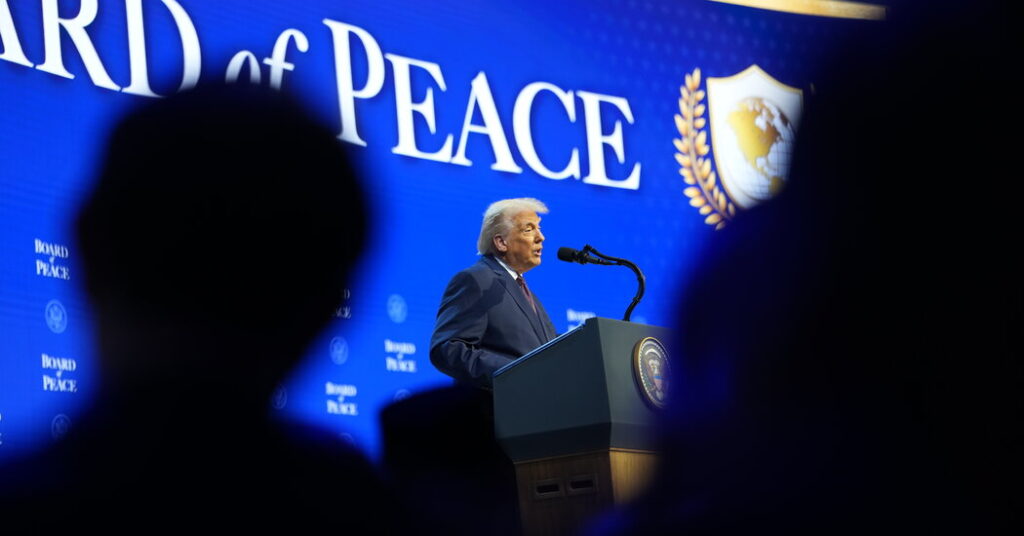
The group, the Board of Peace, met for the first time in Davos, Switzerland, last week, as member states including Azerbaijan and Qatar, signed its founding charter, which calls for securing “enduring peace in areas affected or threatened by conflict.”
Much about the Board of Peace has so far been unclear, but a draft resolution, a copy of which was obtained by The Times, would allow the chairman, Mr. Trump, to nominate senior officials who will help administer Gaza, and assign responsibilities.
Those officials include a “high representative” for Gaza, tasked with overseeing a Palestinian body administering the enclave, and the commander of an international stabilization force, which is intended to help provide security. Mr. Trump would also have the power to approve resolutions and suspend them in urgent cases.
The resolution is dated Jan. 22 — last Thursday — and has not been signed by Mr. Trump, which would bring it into force, according to three officials who were briefed on the resolution and verified the authenticity of the obtained copy. They spoke on condition of anonymity to discuss internal deliberations, adding that the resolution was currently under discussion.
It was not clear whether the draft was the final text of the resolution.
The document resembles a United Nations Security Council resolution, and appears to be an effort by the Board of Peace to formalize some of its plans for Gaza.
The notion of establishing a Board of Peace for Gaza was first set out in Mr. Trump’s 20-point plan, announced last September, for ending the 2-year war between Israel and Hamas that devastated the Palestinian enclave.
In November, the U.N. Security Council granted the Board of Peace a mandate as part of U.S.-led efforts to sustain the cease-fire in Gaza.
The assumption was that the board would focus solely on Gaza, but the Trump administration said this month that it would address conflicts elsewhere, although the scope of that remains unclear.
Though some countries have enthusiastically joined the new international organization after being invited by Mr. Trump, others, including close U.S. allies like France and Britain, have refused. Spain’s prime minister, Pedro Sánchez, said his country would not join because the board excluded the Palestinian Authority and because the body was “outside the framework of the United Nations.”
Trump Administration: Live Updates
Updated
- Mark Carney rejected suggestions that he walked back his Davos speech to Trump.
- Philip Glass withdraws new symphony from the Kennedy Center over the venue’s ‘values.’
- ICE agents will join the U.S. delegation to the Winter Olympics in Italy.
Leaders of nations that signed onto the project would make up the Board of Peace, with Mr. Trump as chairman, with the power to name his successor, and below that would be an executive board.
On Jan. 16, the White House announced the names of seven people who would make up the executive board, including Jared Kushner, Mr. Trump’s son-in-law, and Tony Blair, the former British prime minister. The board is tasked with helping implement the 20-point plan for Gaza.
Yet the draft resolution said that Susie Wiles, the president’s chief of staff, and Martin Edelman, a New York-based real estate lawyer, would also be part of the executive board. It is the first time their names have been mentioned publicly in relation to the Board of Peace.
The draft resolution “makes clear the United States is in charge of Gaza, with all other countries and entities playing a support role,” said Michael Ratney, a former U.S. consul general in Jerusalem.
Mr. Ratney described the resolution as having “uncertain legal standing,” but went on to say that “Gazans are desperate and anything that stands to improve their lives, including the 20-point plan, is worth pursuing.”
According to the draft resolution, the Board of Peace will coordinate the reconstruction of Gaza, an immense project that is expected to cost tens of billions of dollars and take years, and facilitate the delivery of humanitarian aid there. It also calls for the establishment of “humanitarian zones” in the enclave where people would be able to safely access relief.
The draft resolution refers to some of the complicated challenges facing Gaza.
For instance, it stipulates that people and organizations with “a demonstrated history of collaboration, infiltration or influence” with Hamas would not be involved in administering or rebuilding Gaza.
Tens of thousands of civil employees and security officers have served in the Hamas-run government, including medical professionals, rank-and-file police officers and rescue workers.
The draft resolution also details the role of Nickolay Mladenov, a former U.N. envoy to the Middle East peace process, who was named by the White House as the first high representative for Gaza.
According to the resolution, Mr. Mladenov will closely supervise the National Committee for the Administration of Gaza, a body of Palestinian technocrats appointed to administer the territory and oversee the police force, and direct all of its “day-to-day activities.”
Adam Rasgon is a reporter for The Times in Jerusalem, covering Israeli and Palestinian affairs.
The post Board of Peace Set to Hand Trump Sweeping Powers Over Gaza appeared first on New York Times.