President Trump is heading to Iowa on Tuesday to once again try to convince Americans that he is focused on “affordability.” He will have some explaining to do.
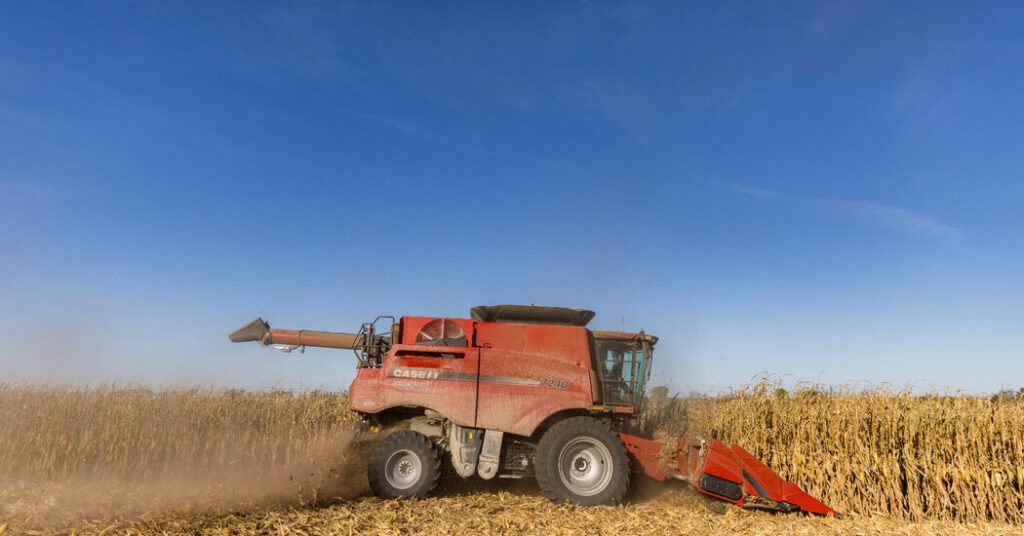
Iowa, a state whose economy is heavily reliant on farming, has been struggling under the weight of Mr. Trump’s economic policies, particularly his approach to trade. The president’s barrage of tariffs last year increased the cost of machinery and materials that many Iowan farmers rely on. The price of the metal bins used to store crops soared, along with the cost of tractors as the president’s tariffs took hold.
After Mr. Trump hit China with tariffs, Beijing swiftly retaliated by halting purchases of American farm products, a move that cut off Iowa soybean exporters from their biggest buyer. That put the squeeze on the entire state’s economy.
The president is expected to deliver a speech on the economy and affordability in Des Moines on Tuesday afternoon.
“It is a dire time for American farmers, particularly the Midwest soybean and corn farmers,” said Kirk Leeds, the chief executive of the Iowa Soybean Association. “The chaos, the uncertainty — right now we have so many unknowns that there’s not a lot of clarity about where we’re going.”
Iowa is of particular importance to Mr. Trump. The state helped propel his political career a decade ago, when he had a strong showing in the 2016 Republican caucuses. He won the state in all three of his general election campaigns. Perhaps more important to Mr. Trump now is that the state could prove pivotal in this year’s midterm elections, as Republicans try to retain their majority. Senator Joni Ernst, Republican of Iowa, is retiring, and the race to replace her is expected to be close.
Senator Chuck Grassley, the veteran Iowa Republican who has been critical of Mr. Trump’s tariffs, welcomed the president’s visit to the state this week and said he would continue to work with the Trump administration to improve affordability for Iowans.
But Mr. Trump’s trade wars have in many respects been a drag on the state, which for years has lagged behind the rest of the country in economic growth.
China has long been a big buyer of U.S. soybeans and other crops that are grown in Iowa. That changed last year after Mr. Trump increased tariffs on imports from China, triggering a monthslong tit-for-tat trade fight.
Despite negotiations and temporary traded truces, China continued to use farm purchases as leverage and Beijing’s refusal to buy American agricultural products for most of 2025 dealt a blow to Iowa’s soybean industry, one of the largest in the United States.
Mr. Trump and Xi Jinping, the Chinese leader, eventually agreed in late October to a one-year truce that ended China’s boycott of farm products, including millions of tons of soybeans. The Trump administration also unveiled a $12 billion aid package for farmers, but for many farmers the relief was insufficient and too late.
“We’re losing money on every bushel we produce on our two main things that we grow,” said Aaron Lehman, the president of the Iowa Farmers Union, referring to corn and soybeans.
Administration officials have said that China fulfilled its initial commitment to Mr. Trump to buy 12 million metric tons of soybeans. It has also pledged to purchase 25 million metric tons per year for the next three years. The 25 million tons were in line with the 25 million to 30 million it had purchased in recent years.
Treasury Secretary Scott Bessent said last week that he encouraged his Chinese counterpart to buy additional soybeans during a meeting on the sidelines of the World Economic Forum in Davos, Switzerland.
Crop receipts in Iowa were on track to fall 4 percent in 2025 to $666 million from last year and they are projected to hold steady this year, according to a report published last October by the Rural & Farm Finance Policy Analysis Center. There were 18 farm bankruptcies in the state through last October, the highest total since 2020.
America’s rural economies have been struggling in recent years, and Iowa is no exception. Since 2021, Iowa’s economy has grown at an annual rate of about 1 percent while the United States has grown at an average annual rate of 2.5 percent.
Since retaking the White House last year, Mr. Trump and his advisers have said that the administration’s policies will usher in a new “golden age” for America. Mr. Lehman said such suggestions feel out of touch to Iowa farmers.
“The policy leaders are not understanding the situation on the ground,” Mr. Lehman said.
Other Trump administration policies have also created challenges over the last year.
Budget cuts to the Department of Agriculture and the Supplemental Nutrition Assistance Program, which buys food from American farmers, have been hard on Iowa’s agriculture sector, Mr. Lehman added. The lapse of Affordable Care Act subsidies is leading to higher health care costs. And immigration restrictions have made it harder for farmers to find workers in a state where the population has been shrinking.
The trouble in the farm economy has spread to other sectors in Iowa.
John Deere, the agricultural machinery company, said last September that it would cut more than 140 jobs at two plants in Iowa because of decreased demand for equipment. Case New Holland, a construction equipment manufacturer, said this week that it was cutting about 200 jobs at a plant in Burlington. Overall, the state lost 1,300 manufacturing jobs in 2025.
Peter Orazem, an economist at Iowa State University, noted that the state’s manufacturing industries are closely tied to how farmers are faring. He said that forecasts for 2026 remain murky because of uncertainty over trade policy and whether government support for farmers will continue.
“Restrictions on trade makes your market less lucrative,” Mr. Orazem said. “You’re getting squeezed on the demand side and getting squeezed on the supply side. That doesn’t bode well for firm profit.”
Alan Rappeport is an economic policy reporter for The Times, based in Washington. He covers the Treasury Department and writes about taxes, trade and fiscal matters.
The post As Trump Heads to Iowa to Trumpet Economy, Many Residents Feel Pain appeared first on New York Times.