Six years ago, the National Symphony Orchestra commissioned the renowned composer Philip Glass to write a symphony honoring Abraham Lincoln for the 50th anniversary of the John F. Kennedy Center for the Performing Arts in 2022. Glass missed that deadline, but his Symphony No. 15 was set for its world premiere by the orchestra this June.
On Tuesday, Glass informed the Kennedy Center that he did not want his symphony, based on Lincoln’s 1838 Lyceum Address, performed on its stage. “Symphony No. 15 is a portrait of Abraham Lincoln, and the values of Kennedy Center today are in direct conflict with the message of the symphony,” he wrote in a letter asking that the orchestra not play his work. A copy of the letter was shared with The New York Times.
The withdrawal of work by Glass, 88, who received a Kennedy Center Honors award in 2018, is the latest blow for the center — and particularly for the increasingly isolated National Symphony Orchestra and its music director, Gianandrea Noseda.
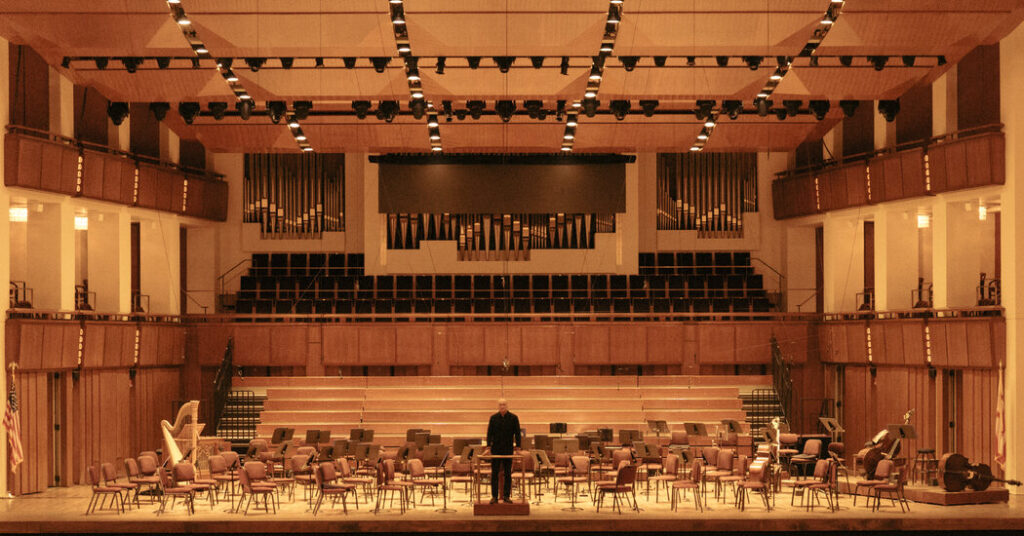
While much of the arts community and many Kennedy Center patrons have rebelled against President Trump’s efforts to remake the center in his name, the orchestra’s leaders have soldiered on, staring down empty seats, cancellations by artists like Glass and the celebrated soprano Renée Fleming, and comparisons with the Washington National Opera, which moved its shows out of the center.
“We are going to make this work,” Joan Bialek, the chair of the National Symphony Orchestra board, said last week. “I was born in Washington, grew up with the Kennedy Center, grew up in the N.S.O., and I can’t let it disappear. We will make it through this.”
She added: “Our biggest challenge now is to try to get more people back into the concert hall. We’re working hard on that.”
Noseda, 61, said the National Symphony would not leave the center as did the opera, which Bialek called “like a sibling” of the orchestra. Noseda, who is Italian, said he was trying to ignore the turmoil and following the advice a friend gave him nearly a decade ago when he was dealing with management upheaval at the Teatro Regio Torino in Italy.
“He said not to make speeches, but to be present,” Noseda said. “Your presence speaks. Go to the core of the business of making music. Not talk too much: Do the work.”
Jean Davidson, the orchestra’s executive director, said that its finances were too entangled with the Kennedy Center to even consider trying to set out on its own.
“This has been our home for 55 years,” she said. “We are not leaving.”
A premiere by Glass, one of the most famous and prestigious composers in the country, had been an eagerly anticipated event for the orchestra. The decision by Glass came as a surprise to executives at the center and at the symphony. “We have great admiration for Philip Glass and were surprised to learn about his decision at the same time as the press,” Davidson said.
The campaign by the president to put his imprint on the center has put the orchestra in an increasingly difficult position. At a concert the other night, there were patches of empty seats, and the nearby Opera House was empty. Those who came to hear a program of Brahms, Vivaldi, Bach and Schumann were greeted by the new sign on the center’s front: “The Donald J. Trump and the John F. Kennedy Memorial Center for the Performing Arts.” The news about Fleming came hours before the orchestra assembled for the second evening of a three-night stand.
While attendance is down about 50 percent compared with the season before President Trump returned to office, the annual fund-raising gala this year brought in about $3.5 million, a record, reflecting an effort by the president’s allies to bolster the orchestra as other donors have stepped away.
Trump Administration: Live Updates
Updated
- ICE agents will join the U.S. delegation to the Winter Olympics in Italy.
- Trinidadian families file a wrongful-death suit over a U.S. military boat strike.
- The transportation safety board is set to declare the cause of the midair plane-helicopter crash.
“They are in a bind, because they need everyone’s support,” said Béla Fleck, the banjo player and 18-time Grammy Award winner, who pulled out of three performances with the orchestra. “A symphony can’t be red or blue. They need an audience that loves the music, above all. Half an audience isn’t enough.”
In an interview in his dressing room before the concert, Noseda — speaking in English, interspersed with phrases in Italian and Latin — argued that his most urgent task was to build and inspire the orchestra. Noseda said he did not think his decision to continue playing while colleagues have left could be seen as validating what has taken place at the center since President Trump took office for a second term.
“I cannot make everybody happy,” Noseda said. “I know why I am here — to serve the art, the music and the community. Music belongs to everybody and I think is also part of the life of this community. Someone will always say, ‘Oh, he’s associated with this administration.’ Someone else will say, ‘No, he is free-spirited.’ I am free-spirited.”
Deborah Borda, who has served as president and chief executive of the New York Philharmonic and the Los Angeles Philharmonic, said the upheaval confronting Noseda and his orchestra was “a microcosm of what’s happening in the country today, with things being politicized that weren’t politicized before.”
“One of the things we hope for,” she said, “is that music is the humanistic flame that can bring us together.”
The orchestra is in a much different position from the Washington National Opera, which last month announced it was seeking an amicable end to its affiliation agreement with the Kennedy Center. Under an affiliation agreement with the orchestra, signed in 1986, the Kennedy Center contributes about $10 million a year to the orchestra’s $42 million budget, nearly five times the subsidy it paid to the opera under its agreement. The orchestra, which gives about 180 performances per year, is made up of 100 people and has one of the largest orchestral payrolls in the country, reflecting how well-paid its players are.
Gary Ginstling, the former executive director of the National Symphony Orchestra, who now runs the Houston Symphony, said, “For the National Symphony to go off on its own would have such financial implications and physical space implications that it would be hard to see how that would be possible.”
Noseda and Bialek both said that there had been no interference in their decisions about musical programming by the Trump White House or Richard Grenell, whom the president installed to run the center. “At this point, we have been masters of our own programming,” Bialek said. (This season was already in place when President Trump took over the center; Noseda said he was now finalizing what the orchestra would play next year.)
But Grenell has said that he wants productions at the Kennedy Center to be revenue neutral — that is, the cost of a performance should be paid for by ticket sales and contributions. That requirement was a reason cited by the opera for leaving.
Noseda said that in an “ideal world” that would happen. “But if you talk about opera, if you’re talking about music,” he added, “let’s say it is difficult.”
Bialek said the biggest task for the orchestra was to convince patrons who had stopped attending to return.
“We need to make sure they understand that by not coming, they are missing out on this extraordinary experience and they’re essentially not doing the musicians a favor,” she said. “So what we need to do is get our message out that the musicians need to play to a full concert hall, not a half-full concert hall. We want to keep them alive.”
For his part, Noseda has focused on building the orchestra, continuing to find new players — he has hired 28 of its members — and recording music, most recently, a release of Mahler’s Symphony No. 7 in December. He has also lent members of the orchestra instruments — eight violins, a viola and a cello — from his collection of Italian-made instruments. “We try to really live the life of the musician believing that music can heal wounds,” he said.
Last year Noseda, the orchestra’s music director since 2017, extended his contract through 2031. He said he wanted to be with the orchestra, which was founded in 1931, when it celebrates its centennial.
“I’m really trying to stay focused and to underline the value of the music,” he said. “Because that is what matters.”
Adam Nagourney is the classical music and dance reporter for The Times.
The post As Philip Glass Withdraws, the Kennedy Center’s Symphony Tries to Play On appeared first on New York Times.