ISLAND AT THE EDGE OF THE WORLD: The Forgotten History of Easter Island, by Mike Pitts
In 1868, crew members of H.M.S. Topaze, a British Navy frigate, acquired an imposing stone monolith known as Hoa Hakananai’a on the remote South Pacific island of Rapa Nui. The Admiralty gave the statue to the British Museum, where it caused a sensation.
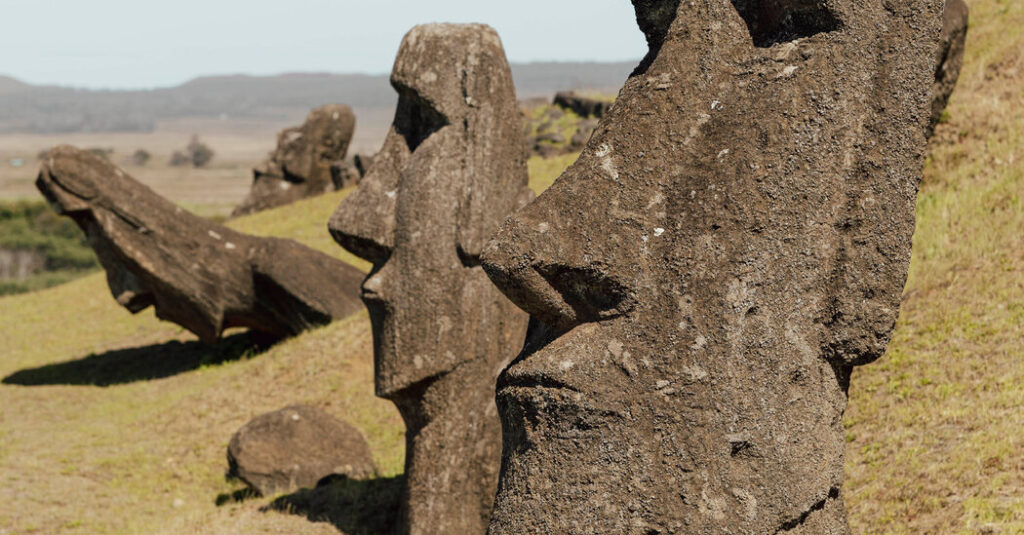
Eight feet tall, with an elongated face, heavy brows and flattened nose, the ancient totem, or moai, testified to the aesthetic power of its creators. It also presented a mystery. How could such objects — and there were, the sailors claimed, nearly a thousand of them — have emerged from a windswept, treeless and nearly unpopulated wasteland?
Some scholars posited that Rapa Nui was a vestige of an Atlantis-like submerged civilization, and that the original population of “pre-Aryan giants” had been replaced by a race of “swarming savages.” Others contended that the inhabitants had driven themselves to near-extinction by war and cannibalism. In the 1960s, one Swiss pseudoscientist claimed the statues had been constructed with the help of extraterrestrial beings.
“Island at the Edge of the World” is Mike Pitts’s compelling attempt to set the record straight. A British archaeologist long fascinated by enigmatic megaliths, Pitts directed excavations at Stonehenge before finding his way to Rapa Nui in 1994, where he watched a Japanese team raise 15 giant statues that had been knocked over by a tsunami. Pitts became caught up in the riddle of their origins and began looking for clues, drawing on DNA studies, undeciphered glyphs and the research of a forgotten archaeologist who might have settled the matter a century ago, he argues, if tragedy hadn’t overtaken her.
Pitts has gone deeper than any other writer in cutting through the miasma of misperceptions that shrouds the island, even if his work sometimes bogs down in numbing detail, and he leaves important questions unanswered.
The first European visitors to Rapa Nui were struck by the islanders’ rich culture and agricultural resourcefulness. (Although the island was probably settled a thousand years ago by navigators from Polynesia, it didn’t acquire its local name until the 19th century; the Dutch explorer Jacob Roggeveen arrived on Easter Sunday in 1722, and called it “Easter Island.”)
In the 1860s, a new wave of foreigners devastated Rapa Nui society. Slave traders kidnapped 1,000 islanders and sold them in Peru. European entrepreneurs confined those who remained in a corner of Rapa Nui, tore up their plots and turned the land over to sheep ranching. Disease and emigration caused the population to fall from thousands to 110 by the time the crew of H.M.S. Topaze came ashore. Most statues had toppled over through neglect and the severe weather that battered the island.
Then came Katherine and Scoresby Routledge, seasoned English archaeologists addicted to the itinerant life. In 1913, with support from the British Museum, the Routledges set sail for Rapa Nui. Trapped there by war in Europe, the couple spent 17 months interviewing elders, studying glyphs carved on planks of wood and grappling with the complex cosmology. The work, said one scholar, represented “a milestone in Easter Island ethnography and an event of historic magnitude.”
Back in England, Katherine Routledge wrote a well-received book, but her marriage fell apart and many of her papers vanished. Overtaken by mental illness, she wound up committed to a psychiatric institution, where she died in 1935. Her abbreviated project, Pitts argues, opened the way for more distortions of the islanders’ history by everyone from the explorer Thor Heyerdahl to Boris Johnson, Jared Diamond and Kevin Costner, who produced a 1994 bomb called “Rapa Nui” that posited civil strife and environmental collapse.
Pitts deftly picks up where Routledge left off. He retraces the original islanders’ journey from Polynesia (a stupendous feat recognized in the 1770s by Capt. James Cook), debunks archaeological “evidence” of a warlike culture and makes a solid case that the inhabitants practiced “eco-nurturing” rather than “ecocide.” He argues convincingly that the population produced and raised its moai over several centuries and that individual clans each contributed a share.
And he delves into the meaning of the monoliths, meant to summon the protective spirits of Rapa Nui’s ancestors and guide the inhabitants on their life journeys.
As moai culture died out, a new belief system arose centered on the “birdman” cult. Each year the islanders engaged in an extraordinary competition to collect the first sooty tern egg from a nearby islet and bring it to Rapa Nui, there to reign for a year as a kind of demigod, or tangatu manu. The cult was ended by European missionaries in the 1860s.
Some of this is slow going. Pitts ventures deep into the weeds, with many pages devoted to arcana such as rock mulching and Polynesian and South American botany. There’s a bit too much throat clearing, which can make the book at times feel more like an academic treatise than a popular history. And Pitts left me confused about Routledge’s research. He never makes it clear what was lost, where it went and how much harm was done by its disappearance. It feels like he’s reaching to build her story into a tragedy and mystery.
But Pitts’s wonder comes through on nearly every page. He ends by returning to Hoa Hakananai’a, the subject of a long-running ownership dispute between the British Museum and island elders and the alluring glyphs engraved on the monolith’s back. The representations of bird beaks, fledglings, paddles and vulvas were hidden for decades until the statue was relocated to an open gallery.
The shift restored to public view the vibrancy and complexity of Rapa Nui’s society — a process that Pitts’s magisterial history now completes.
ISLAND AT THE EDGE OF THE WORLD: The Forgotten History of Easter Island | By Mike Pitts | Mariner | 346 pp. | $34
The post A Definitive History of the Mysteries of Easter Island appeared first on New York Times.