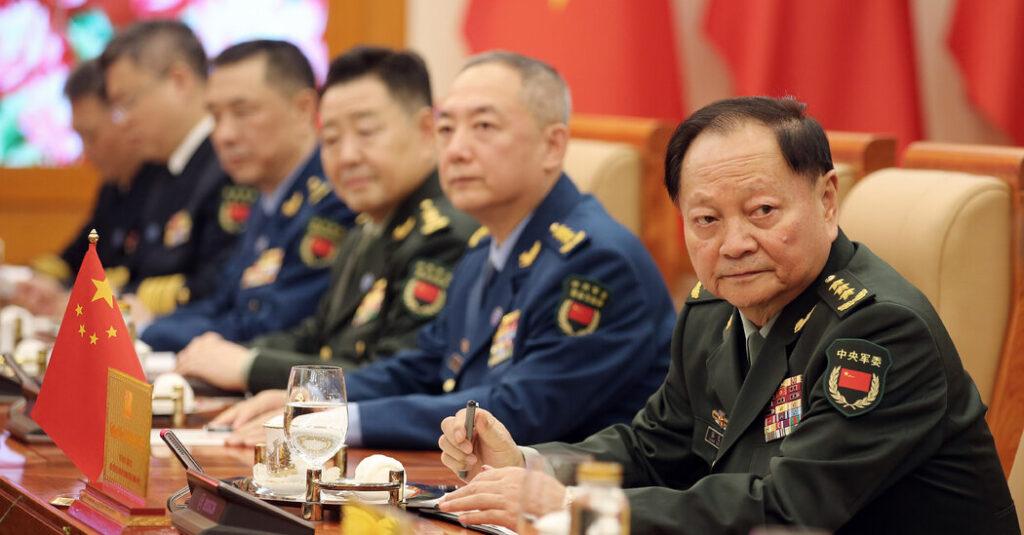
Chinese politics is often a black box. Foreign leaders struggle to gauge what Beijing is thinking, be it about A.I. or Taiwan. So when it emerged this weekend that President Xi Jinping had pushed out the most senior general in the Chinese military command structure, it caught many by surprise. Today, my colleague Chris Buckley in Taipei writes about the fallout from Xi’s military purge — and how it might affect potential plans for a Taiwan invasion.
The downfall of a Chinese general
By Chris Buckley
Dozens of generals have been toppled in President Xi Jinping’s unrelenting campaign against perceived corruption and disloyalty over the past three years. But this weekend’s downfall of Gen. Zhang Youxia, who had been the Chinese president’s chief deputy in the military, was of a different order of magnitude.
Xi’s decision to oust Zhang and another top general means the Central Military Commission, the small committee that commands China’s armed forces, has only two members left: Xi himself and the officer he has used to oversee the purges.
This move “represents the total annihilation of the high command,” said Christopher K. Johnson, a former C.I.A. analyst who follows Chinese elite politics.
At 75, Zhang was old enough that Xi could have ushered him into retirement. Instead, Xi made him a public pariah.
China’s defense ministry announced that he was under investigation for unspecified breaches of laws and political discipline. An editorial in the military’s official newspaper, the People’s Liberation Army Daily on Sunday hinted that Zhang was being accused of corruption, and, perhaps more important, of disloyalty to Xi.
What prompted Xi to finally turn against Zhang is now a topic of fevered speculation in Beijing and beyond. Some believe Xi may have come to see him as too powerful, after the general’s own rivals were toppled in previous purges. Others believe Xi concluded that systemic corruption was so deep that he needed drastic surgery to clear the way for a new generation of commanders.
Still other allegations are more serious: The Wall Street Journal reported on Sunday, citing anonymous sources, that Zhang had been accused of leaking nuclear secrets to the United States.
What does seem clear is that Zhang’s purge — the most dramatic in a wave of military purges that has unfolded since 2023 — has raised questions about China’s strategy toward Taiwan, at a time when China’s military has been severely diminished by Xi’s anti-corruption campaign.
Investigations and disappearances
After Xi became China’s leader in 2012, he moved quickly to shake up the military, which was rife with corruption and organizationally stuck in the past. Zhang was one of the commanders Xi picked to help lead this overhaul.
But after a decade in charge, Xi seemed to conclude that some of his own handpicked protégés had been infected by the military’s corruption, and a new cycle of investigations and purges began.
Since 2023, waves of top commanders and officers in the Chinese military, and executives for arms manufacturers, have been removed from office and placed under investigation — or, in some cases, have disappeared from view without explanation. Investigations have taken down admirals, regional military commanders and members of the Central Military Commission.
The investigations’ toll on the military was visible at a meeting last year of the Communist Party’s Central Committee, a council of top officials. Of the 44 uniformed officers appointed to the committee in 2022, 29 — roughly two-thirds — had been purged or were missing.
Zhang had long seemed to be spared scrutiny. Xi kept him in office past retirement age, and made him his top vice chairman of the Central Military Commission — Xi’s eyes and ears in running the People’s Liberation Army’s forces day to day.
A lack of operational experience
Zhang being pushed out is especially significant because he was a celebrated war veteran, in a nation where few active commanders have experienced real combat. Zhang fought in China’s last war, a border conflict with Vietnam that began in 1979 and lasted years.
Xi seems to have calculated that in the longer term, his shake-up will make the military less corrupt, more loyal and more effective in pursuing his goals. But the disruptions caused by the purges could leave Xi less confident that his commanders are ready for combat, analysts say.
“There’s no one right now at the highest level who has operational experience or who is in charge of training and exercises,” said Shanshan Mei, a political scientist who studies China’s armed forces. “This is going to cut very deep.”
But it’s also not clear that the changes will lead to more restraint. Another former U.S. government official shared his worries about the potential consequences of purging one of the people who could speak candidly to Xi.
Zhang “could assess U.S. and Taiwan military capabilities objectively and explain to Xi Jinping what the military risks and costs of an operation to take Taiwan would be,” Drew Thompson, a former Pentagon official, wrote on Substack. “I worry about the consequences of someone other than Zhang Youxia providing Xi Jinping with military advice.”
MORE TOP NEWS
Trump changed tactics in Minnesota
Struggling to contain the fallout from his administration’s deadly actions in Minneapolis, President Trump sent a new official to oversee the immigration enforcement operation there and backed off his attacks on Minnesota’s governor, Tim Walz.
Following a phone call between the governor and the president, Walz’s office said the governor got Trump to agree to talk to federal officials about ensuring an independent investigation into the killings this month of Alex Pretti and Renee Good. Trump also agreed to look into reducing the number of federal agents in Minnesota, the governor’s office said.
David Guttenfelder, a New York Times photographer based in Minneapolis, was at the scene after Pretti’s killing on Saturday. Watch the video.
Israel recovered the body of the last Gaza hostage
The Israeli military said yesterday that it had recovered the remains of Master Sgt. Ran Gvili, an Israeli police officer whose body was the last one held in Gaza. The retrieval closes a painful chapter for Israelis and also paves the way for the next phase of the cease-fire.
Israel announced that it would reopen the border between the Gaza Strip and Egypt within days. The move would allow Palestinians who fled the enclave during the two-year war to return home for the first time.
OTHER NEWS
-
Officials in the Middle East are increasingly worried that the U.S. will strike Iran in the coming days.
-
The U.S. faced dangerous cold after a heavy snowstorm that disrupted travel and killed at least 21 people.
-
A large ferry sank in the southern Philippines, killing at least 18 people.
-
Gunmen in Mexico opened fire on a crowded football field, killing 11 people. The shooting occurred in an area fought over by drug cartels.
-
The E.U. will investigate Elon Musk’s X social media platform over A.I.-generated sexualized images.
-
Gold reached a record high as investors sought shelter from geopolitical uncertainty.
SPORTS
Football: Who is the most important person at each Premier League club? Our reporters share their thoughts.
Tennis: Madison Keys, the defending Australian Open champion, lost to a fellow American, Jessica Pegula.
Cycling: Two kangaroos caused a major crash at the Tour Down Under race in Australia.
MORNING READ
During the early years of the war in Ukraine, fighting slowed in the winter. Snow and mud made it more difficult for armored vehicles to get around. Now, as drone attacks dominate, the pace of fighting is intense year round, and the winter has unexpected effects.
Trees are bare, their leaves no longer providing camouflage. Footprints in the snow are easy to spot from above. Lower temperatures make thermal cameras on drones more effective. So tactics have changed.
TREND OF THE DAY
Rejection spreadsheets
— An influencer set herself a goal of collecting 1,000 rejections for auditions and job applications, recording each “no” in a notebook. Now, rejection spreadsheets are popping up across social media. No rejection is too big or too small.
AROUND THE WORLD
How a tech start-up is innovating … in Afghanistan
Afghanistan is better known for its repressive Taliban government than for tech innovation. But a crypto start-up there is building online payment tools that could transform humanitarian aid.
An app, HesabPay, allows instant transfers between digital wallets, bypassing banks and the Taliban. The U.N. has used it to deliver nearly $25 million to vulnerable Afghans returning home.
The idea is proving useful in other countries shattered by conflict. People in Syria are now receiving aid money in cryptocurrency through the app, and programs for Sudan and Haiti are in development. Read more.
RECOMMENDATIONS
Watch: In the new season of “Bridgerton,” a fan favorite will step into the spotlight.
Exercise: Forget about muscle mass as you age; focus on strength.
Repair: These are the essential tools to have in your home.
RECIPE
Bacon-and-egg pie is a rustic specialty from New Zealand, here zipped up with a mixture of sriracha and cream. It’s close in feeling to steak-and-kidney pie, that sturdy pub staple, and makes for terrific picnic fare.
Also: Scale your recipes up or down with this helpful new tool and tips from New York Times Cooking.
WHERE IS THIS?
Where are these islands?
TIME TO PLAY
Here are today’s Spelling Bee, Mini Crossword, Wordle and Sudoku. Find all our games here.
You’re done for today. See you tomorrow! — Katrin
Chris Buckley was our guest writer today.
We welcome your feedback. Send us your suggestions at [email protected].
Katrin Bennhold is the host of The World, the flagship global newsletter of The New York Times.
The post Xi’s Purge of the Chinese Military appeared first on New York Times.