President Trump has received multiple U.S. intelligence reports indicating that the Iranian government’s position is weakening, according to several people familiar with the information.
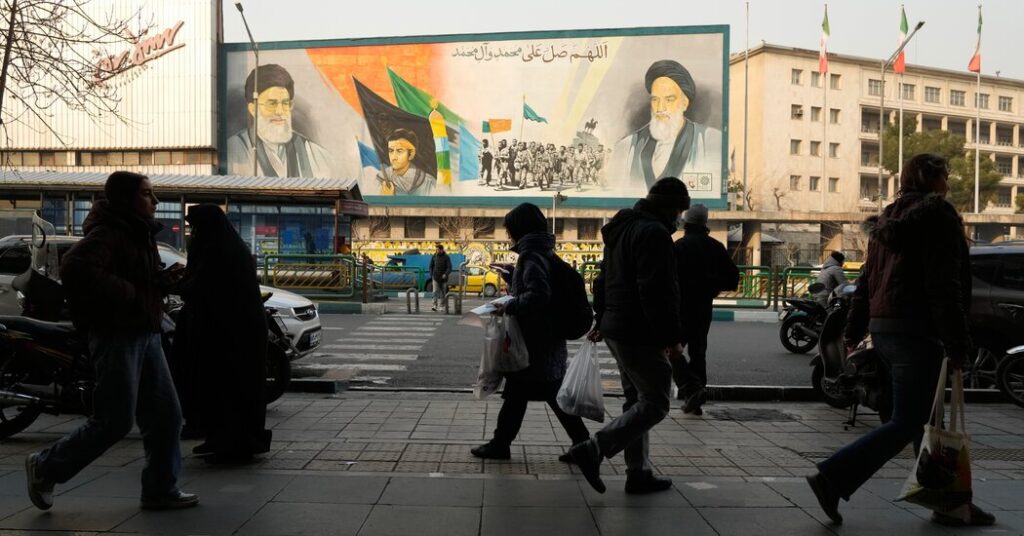
The reports signal that the Iranian government’s hold on power is at its weakest point since the shah was overthrown in the 1979 revolution.
Protests that erupted late last year, according to the reports, shook elements of the Iranian government, especially as they reached into areas of the country that officials thought were strongholds of support for Ayatollah Ali Khamenei, Iran’s supreme leader.
While the protests have died down, the government remains in a difficult position. Intelligence reports have repeatedly highlighted that in addition to the protests, Iran’s economy is historically weak.
Economic hardship ignited sporadic protests in late December. As the demonstrations spread in January, the Iranian government found it had few options to ease the financial difficulties families were feeling. Officials resorted to a heavy handed crackdown that further alienated wide swaths of the population.
The U.S. military has been building up its forces in the region, but it is not clear what steps the Trump administration may be considering.
“President Trump is consistently briefed on intelligence matters around the world,” Karoline Leavitt, the White House press secretary, said in a statement. “It would be a dereliction of duty as commander in chief if he were not regularly briefed on these matters. With respect to Iran, President Trump continues to closely monitor the situation.”
Mr. Trump warned that he could strike Iran as the government’s bloody crackdown on the protests expanded. Still, his advisers have been divided on the benefits of strikes, particularly if they were simply symbolic strikes against elements of the government involved in the crackdown.
Mr. Trump then seemed to back down on any sort of immediate strike in support of the protests after the Iranian government called off a planned execution of a protester. Prime Minister Benjamin Netanyahu of Israel had also asked Mr. Trump to postpone an attack on Iran, according to a senior U.S. official.
But a broader campaign may have more appeal to some of Mr. Trump’s most hawkish aides and allies who see an opportunity to force out the country’s leadership. And Mr. Trump continues to hold out the threat of force, describing his buildup of naval forces in the region as an “armada.”
Mr. Trump has also mused aloud about Iran’s nuclear program, delivering warnings and reminding the Iranian government of the strikes he ordered last year against its most heavily fortified research sites.
Senator Lindsey Graham, Republican of South Carolina, said that he had spoken with Mr. Trump in recent days about Iran and that he expected the president to fulfill his promise to help Iranians who had been protesting their government.
“The goal is to end the regime,” Mr. Graham said in a brief interview. “They may stop killing them today, but if they’re in charge next month, they’ll kill them then.”
As of Monday, the aircraft carrier Abraham Lincoln, accompanied by three warships equipped with Tomahawk missiles, entered the U.S. Central Command’s area of responsibility in the western Indian Ocean, said a U.S. official who spoke on the condition of anonymity to discuss those details.
If the White House were to order a strike on Iran, the carrier could, in theory, take action within a day or two, military officials said.
The United States has already sent a dozen additional F-15E attack planes to the region to strengthen strike aircraft numbers, according to U.S. officials. And the Pentagon has dispatched more Patriot and THAAD air defenses to the region to help protect American troops there from any retaliatory strikes by Iranian short- and medium-range missiles.
Long-range bombers based in the United States that could strike targets in Iran remain on a higher-than-usual alert status. The Pentagon heightened the alert status two weeks ago, when Mr. Trump requested options to respond to the crackdown on protests in the country.
Pentagon officials have also stepped up consultations with regional allies in recent days. Adm. Brad Cooper, the head of Central Command, visited Syria, Iraq and Israel over the weekend to confer with U.S. military officers and counterparts there.
The main point of Admiral Cooper’s trip was to visit American troops and detention sites in northeast Syria, a senior U.S. military official said. The U.S. military began transferring Islamic State prisoners to Iraq from northeastern Syria last week amid growing concern that thousands of former fighters and their family members could escape from detention as the Syrian government takes control of much of the area from Kurdish-led forces.
But U.S. officials have also delivered a message to Iraqi officials: In the event of rising tension with Iran, should Shiite militias in Iraq fire on U.S. bases or troops, the United States would retaliate against them.
American officials have also been consulting with regional partners on Iran. In addition to conversations with Israeli officials and meetings in Baghdad, Trump administration officials have held talks with Saudi and Qatari officials, according to a U.S. official.
Tyler Pager is a White House correspondent for The Times, covering President Trump and his administration.
The post Trump Briefed on Intelligence Saying Iran’s Government Is Weaker appeared first on New York Times.