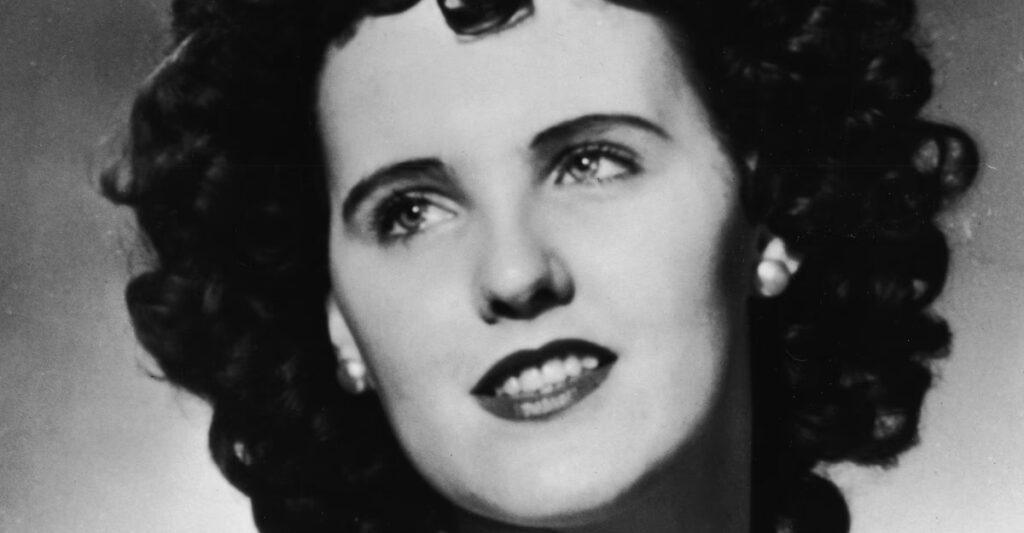
Elizabeth Short liked to wander. Sometimes this wandering was merely in her mind, watching movies and dreaming of a life far beyond her hometown of Medford, Massachusetts. Many times, it was physical; she’d land in a new city—Miami, Jacksonville, Chicago, Long Beach, San Diego, Los Angeles—and explore its streets on foot. Sometimes her travels revolved around family, as when she tracked down her long-lost father and lived with him for a time—until he cast her out. On January 9, 1947, Short, who was 22, told a gentleman friend to drop her off at the Biltmore Hotel in downtown Los Angeles, where her sister was supposedly waiting. She was never seen alive again.
A contemporary version of Elizabeth—dreamy, elusive, independent, and canny—might be called a flaneuse, someone curious about the world. But we’ll never know what kind of life she would have led; by the time her bisected body was found in a vacant lot, six days after she left the Biltmore, Elizabeth had ceased to be a person. From then on, she became “The Black Dahlia,” an archetype, a myth, a riddle that countless people have attempted to solve in books, films, television shows, podcasts, websites, internet-message boards, and social-media posts.
“After we are dead, the pretense that we may be protected against the world’s careless malice is abandoned,” Janet Malcolm wrote in her book The Silent Woman. She was referring to the poet and novelist Sylvia Plath, another beautiful young woman who died too soon, after which her life and words became grist for the biographical mill. But Malcolm’s words apply equally, even eerily, to the afterlife of Short—one of America’s most famous murder victims, and certainly among the most persistent subjects of the true-crime industrial complex.
From the moment Short’s killing became headline news, sensation was the prime directive. With every new lead, confession, and suspect, the actual Elizabeth receded further. It didn’t help that she was an enigmatic character in life, prone to embellishment and even lies. She recounted tales of woe to paramours only to ask them for money, exaggerated her prospects in missives to her mother, told friends about a dead husband and a child who probably didn’t exist—all without letting on about her actual precarious straits. Short avoided the spotlight, but over the nearly 80 years since her death, it has wholly consumed her.
This kind of flattening happens all too often with murder victims, particularly young women and girls who die at the hands of a serial killer, usually male. (Never mind that more marginalized women, especially women of color, are less likely to merit any attention at all.) In Short’s case, the flattening is particularly egregious, because the inchoate facts of her life are shoehorned into the obsessions of amateur sleuths who continue to get those facts wrong.
[Read: A provocative argument about what creates serial killers]
William J. Mann’s new book, Black Dahlia: Murder, Monsters, and Madness in Midcentury Hollywood, attempts a different approach: to weave the fragments we have into a narrative whole that prioritizes Short, in all of her contradictions, and tries to debunk decades’ worth of accumulated myths. Although Mann’s effort stands apart from the overlong run of books about the case, it, too, is undercut by the need to name a likely suspect, playing into the true-crime imperative it aims to leave behind.
Mann begins Black Dahlia in late July 1946, several months before Short’s murder and not long after her arrival in Long Beach, California. Over the ensuing period, Short befriends women and dates men; wears sophisticated clothing, ankle-strapped high heels, and flowers in her hair; and comes across as “a very modest girl who never cursed or acted sexy,” in the words of one friend. The reader comes to understand why fascination has proved more appealing than facts: We know very little about her life. Short defied norms and customs. She seemed innocent in the ways of men but savvy enough to keep her dates at a respectful distance. The two women who knew her best during this time, Marjorie Graham and Anne Toth, whom Mann renders more fully than any author before him, still had trouble understanding what made Short tick.
Mann starts the story, however, from the vantage point of Tod Faulkner, who says he first spotted Short in a two-piece bathing suit, walking alone toward the beach, and saw her again several more times that summer. Faulkner was 11 at the time, and says he never forgot her. Yet after growing up to become a journalist, he was the one who immortalized the erroneous middle name “Ann,” in a 1971 article for the Los Angeles Times. Faulkner’s error would propagate in numerous articles, books, and films before being codified in the 1975 TV movie Who Is the Black Dahlia?, which starred Lucie Arnaz (the daughter of Lucille Ball and Desi Arnaz) as Short. Already we have the conflict between truth and myth, and we’re only on page four.
From there, Mann situates the known facts about the last few months of Short’s life in postwar Los Angeles, whose rising murder rate led to an even sharper spike in fear. From 1945 to 1946, “while the homicide rate for men grew by 26.8 percent, the number of women murdered in that same period shot up by 52.9 percent,” Mann points out. Over the next few years, the increase in violent deaths of women, seemingly at the hands of strangers, was reflected in the growing genre of film noir and in novels including Dorothy B. Hughes’s In a Lonely Place, which was published less than a year after Short’s murder.
Fear also sold newspapers, as any tabloid journalist at the time could tell you. And tell people they did, particularly in the early days and weeks after Short’s death, when the tiniest new detail about the “Black Dahlia” investigation—even, or especially, if that detail wasn’t true—could boost circulation. Mann calls out many instances of “sexing up the news” (a phrase he uses multiple times): the description of the block where Short’s body was discovered as a “lover’s lane”; invented testimony from witnesses and family members (including Short’s grieving mother, Phoebe); exaggerations in the memoirs of the L.A. newspaper editors Agness Underwood and Jimmy Richardson, early chroniclers—and shapers—of the murder narrative.
[Read: Can a murderer earn redemption?]
The errors and suppositions would multiply over the decades—most of them cataloged by the former L.A. Times reporter and historian Larry Harnisch. Was Short a sex worker? Blame John Gregory Dunne’s otherwise terrific 1977 novel, True Confessions, which gave its Short stand-in the moniker “The Virgin Tramp” along with a past career in pornography. (Without True Confessions, James Ellroy probably wouldn’t have written his own The Black Dahlia novel in 1987, which led to a 2006 film adaptation.) Did she have sexual dysfunction? That’s an invention of a former Examiner reporter, Will Fowler, bolstered by John Gilmore in his supposedly nonfiction 1994 account, Severed, which includes information from a detective, “Herman Willis,” who doesn’t seem to have existed.
False suspects also proliferated. Was George Hodel the killer? So his son Steve Hodel keeps insisting, first in his 2003 book, Black Dahlia Avenger, then in a later book that also puts George forward as the Zodiac Killer (oy). Janice Knowlton, too, believed that her father murdered Elizabeth: Read about it in Daddy Was the Black Dahlia Killer. Piu Eatwell’s Black Dahlia, Red Rose initially convinced me that Leslie Dillon was the culprit, but Mann’s account definitively rules Dillon out. Eli Frankel’s Sisters in Death, published just last year, strains (and, to my mind, fails) to connect Short to an unsolved murder in Kansas City. And a new podcast hosted by Michael Connelly, Killer in the Code, also tries to connect the Black Dahlia and the Zodiac Killer, with the help of a “cold-case consultant” who bases his “smoking gun” on a deathbed sketch that better resembles fan art.
Shiftiness, con artistry, and even violence toward women don’t add up to hard, incriminating evidence. Mann, too, succumbs to the temptation, perhaps reluctantly; he spends precious pages explaining why one of Elizabeth’s Long Beach boyfriends, a military veteran named Marvin Margolis who died in 1993—the same suspect in Connelly’s podcast—can’t be ruled out as the killer. (The original detectives crossed him off the list early in the investigation.) Even Mann seems dissatisfied when he mulls the prospect that a stranger killed Short: “She was simply a vulnerable young woman who came face-to-face with someone with severe and violent psychopathology who decided, either on impulse or deliberation, to kill her, to use her body to express rage and resentment at the world.”
After so much time has passed, no one is likely to be satisfied with any identification of Short’s killer. If the lead detective, Harry Hansen, is to be believed, the Los Angeles Police Department never once interviewed the actual killer despite interrogating scores of suspects—including all of those mentioned in prior books, and now Mann’s. Any outcome would likely resemble the identification last September, via investigative genetic genealogy, of the man responsible for the 1991 quadruple homicide in Austin, Texas, known as the “Yogurt Shop Murders.” In that case, pinning down the murderer didn’t erase the 34 years of anguish and damage sustained by the girls’ families and the young men wrongfully convicted—including one who had been on death row. After decades of pain and exploitation, solving the case feels like an anticlimax.
“Solving” the Black Dahlia case, most likely through genetic genealogy, may bring an answer, but it would only generate many more questions. Harnisch, the historian, who knows more about the case than almost anybody (and has a credible theory relegated to a footnote in Mann’s book), put it best in a 2020 interview: “This is a story that fades to conjecture. This is a story without an ending.”
Look past the need for narrative and there, out on the horizon, is Elizabeth Short, walking down a California boulevard, trying to create a better story for herself. She didn’t have to remain forever a girl wounded by her father’s rejection, too proud to admit the truth about her life to her mother and sisters, yet resourceful enough to survive, for a time, in a world that couldn’t care less. Her luck ran out, and we don’t know why, or who killed her. But the brutality of Short’s death shouldn’t supersede her life any more than myth should overshadow a larger truth: that her murder will never truly make any sense.
The post The Woman Who Became the Black Dahlia appeared first on The Atlantic.