Times Insider explains who we are and what we do and delivers behind-the-scenes insights into how our journalism comes together.
I report on stories from America’s large and diverse disability community. It’s a beat I’m relatively new to — my one-year fellowship with The New York Times was created to address the lack of disability media coverage. A few months ago, I worked with the audience team to create an open callout form for readers to share article ideas with me.
Several people who answered the callout said I should talk to Alex Green, a researcher and advocate who teaches at Harvard and has focused much of his work on the history of institutions for disabled people.
One person recommended I read his book, “A Perfect Turmoil: Walter E. Fernald and the Struggle to Care for America’s Disabled,” a biography about the superintendent of the Walter E. Fernald State School, in Waltham, Mass., one of the first public institutions for people with developmental disabilities. Another reader suggested I look into the commission he helped create, which cataloged Massachusetts’ more than 10,000 unmarked graves for people who had been institutionalized and found the state had mishandled patient records. I studied history in college, and have always believed it is an important tool for understanding the present. I wanted to write an article that could help readers understand this dark moment in history, especially as some disabled people have expressed fears of being institutionalized as their access to home care diminishes.
So I reached out to Mr. Green. He told me that his interest in this work stemmed from his own struggles with depression and anxiety — he had a weeklong inpatient stay in 2001. He also told me that over the years, he had worked with dozens of people who wanted to learn more about loved ones who died in institutions like the Fernald, which closed in 2014.
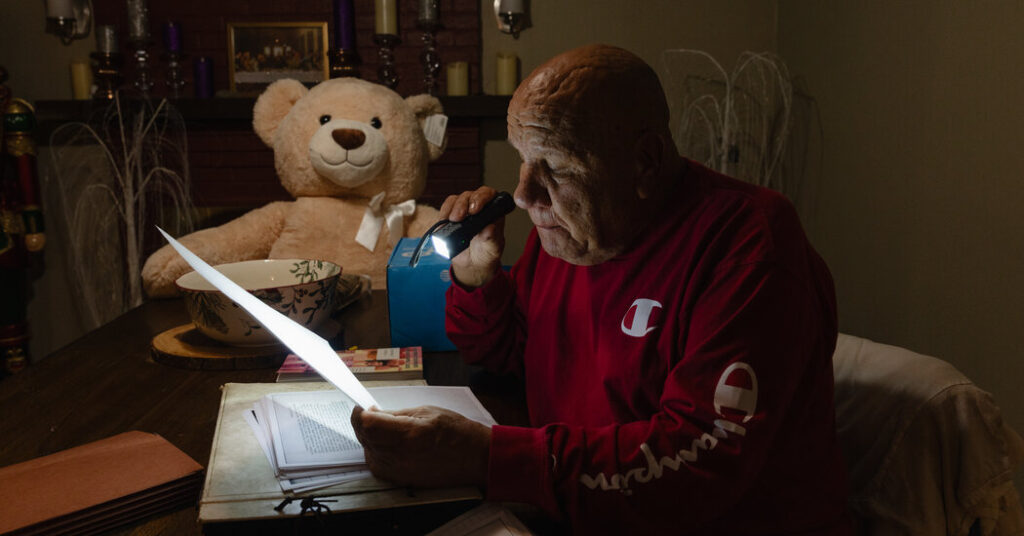
That is how I met David Scott, a retired garbage collector in Brockton, Mass. His oldest brother, John, had been taken to the Fernald when he was 18 days old and died there when he was 17. Mr. Scott, who was 7 when John died, didn’t know anything about who he was, or where he was buried, until a few years ago, when he stumbled upon a website Mr. Green had created that listed the names of 296 people buried near the Fernald.
From the moment Mr. Scott and I first spoke on the phone, I knew the story had to revolve around him. His desperation for more information about John was personal — his adult son, Michael, whom he raised as a single parent, has cerebral palsy.
Initially, strict state privacy laws prevented him from getting John’s patient records. So last year, he made an impassioned plea to the governor, Maura Healey, at a public forum at the Boston Public Library. “The atrocities that occurred at that school, what my parents had to endure by having him taken away, the whole thing, it’s really affected me,” he said, his son by his side. A few days later, he was granted access to the records. (The privacy laws were loosened in November after years of advocacy from Mr. Green and others.)
I spent many hours, at first over the phone, and then in-person in Massachusetts, with Mr. Green, Mr. Scott and his son Michael.
I visited John’s grave with Mr. Scott. It was emotional to see the gravestone, a cement block smaller than my foot marked with the characters “C-154,” which indicated John was Catholic and the 154th person to be buried in the cemetery. Mr. Green gave me several photos from a memorial service he organized for John at the cemetery in 2021, including one of Mr. Scott holding his Bible and red carnations. I spoke to people who knew John, including a former teacher and someone who had lived in the building he had.
We spent hours poring over John’s patient records. I wanted to see them through his younger brother’s eyes — what from those 70 pages stuck out the most? That turned out to be a progress report from just after John’s 12th birthday that read, “John discovered girls this year and can be quite a flirt.”
All of this resulted in a 2,500-word article that was a New York Times Great Read in November. As soon as it was published at 5 a.m., my email inbox and the comments section began to overflow with messages from readers who had similar, heartbreaking anecdotes. Many people mentioned cousins, siblings or other family members they knew who, like John, had been lost to institutions. Others had personal connections to the Fernald, and shared memories of working there or visiting on field trips as children.
I had a family friend, a neurologist in Boston, reach out to tell me he had worked at the Fernald during his medical school residency. Each anecdote I heard emphasized to me how recent this history is and just how many people it touched.
One former Fernald employee said over email that she used to see John regularly and did not recall him showing signs of a cognitive disability. She asked to be put in touch with Mr. Scott. After I connected them, they spoke over the phone for an hour.
A woman in San Francisco commented that her great-uncle, who had Down syndrome, lived his whole life at the Fernald and died at 18 years old in the late 1950s. She didn’t know his first name or when he was born.
“He was whisked away immediately after birth — his mother was not allowed to see him,” she wrote. “I’d love to get his information as this loving brother has.”
Mr. Green responded to the comment and asked her to send him an email.
Sonia A. Rao reports on disability issues as a member of the 2025-26 Times Fellowship class, a program for early-career journalists.
The post Searching for Memories of a Brother Lost to an Institution appeared first on New York Times.