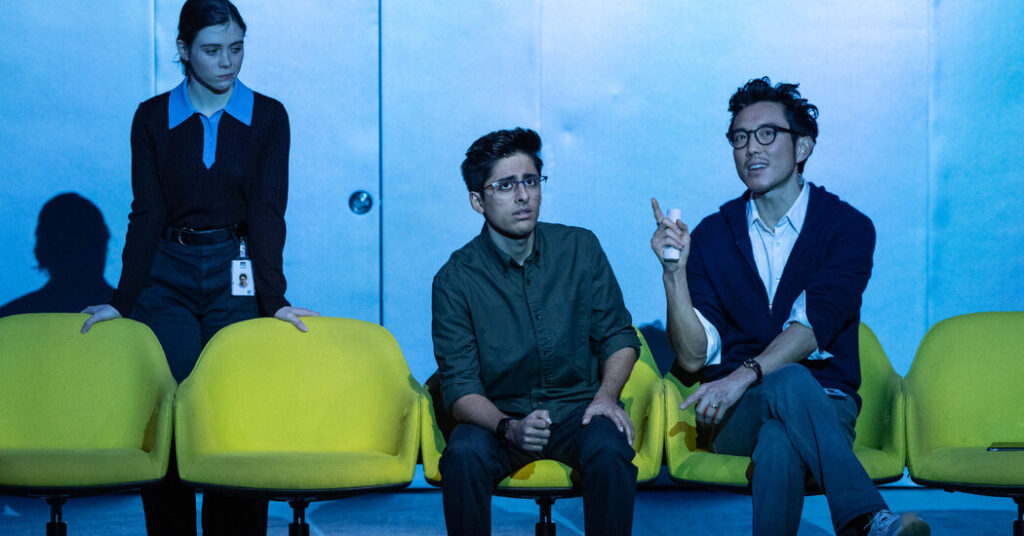
Sometimes plays aren’t just ripped from the headlines, they are happening in real time alongside them. So it is with Matthew Libby’s “Data,” directed by Tyne Rafaeli, in which a brilliant young computer programmer, Maneesh (Karan Brar), finds himself at the center of one of the most contentious issues of the moment — immigration — and an unnamed American government’s determination to harness the latest artificial intelligence surveillance technology to curtail it and to accelerate the deportation of those it considers undesirable.
The play, first performed at Arena Stage in Washington in 2024 and now playing Off Broadway at the Lucille Lortel Theater, is a darkly on-point dramatic mirror of present-day events, from the immigration policies of the Trump administration and actions of ICE in cities like Minneapolis, to the practices of tech companies like Palantir which are producing technology to aid ICE in tracking undocumented immigrants. Libby’s work, which he started writing in 2018, also had a digital presentation in 2021.
Alex (Justin H. Min), the soft-spoken antagonist in “Data,” is the team lead in the data analytics department of the fictional Athena Technologies, which is so impressed by an algorithm that Maneesh created as a student — around predicting the likelihood of rare events in baseball — that Athena wishes to co-opt it as the central technological plank to service the government’s policies.
Alex is an enigmatic figure, with Min playing him as a kind of tabula rasa villain — a techie not guided by ideology, but by an abdication of moral responsibility; a manager who claims to be motivated only by his desire to provide the best product. How it might be used is nothing to do with him, Alex stoutly maintains.
Also in the mix: Riley (Sophia Lillis), a fellow data analytics programmer, who is outraged both at being treated poorly in this male-dominated industry and by the bigotry and prejudice embedded in the A.I. program she is helping to oversee. She wants to blow the whistle on the corporation to a journalist (from The New York Times), and enlists Maneesh’s help in doing so.
Brandon Flynn (“Kowalski”) is excellent as the bro-ish Jonah, officially a mentor to Maneesh in the user experience department where they both work, and a devoted table tennis sparring partner. (Flynn, a welcome provider of comic relief in the show, and Brar recite screeds of dialogue during long rallies at the table.) But Jonah is not as gifted as Maneesh, and his routes to promotion seem limited. Later, however — when workplace push comes to shove — Flynn shows that his muscly, smiling doofus exterior hides some nasty talons.
Athena’s workplace of technical innovation and malign intent is imagined on a stark, blank stage designed by Marsha Ginsberg (echoes of “Severance”), an atmosphere of paranoia amplified by the heightening and softening of Amith Chandrashaker’s lighting, and Daniel Kluger’s electronic sound design and music.
Slick as it looks and as well-acted as it is, in sketching out Maneesh and Riley’s efforts to expose Athena, “Data” can also feel sometimes hampered by predictability — its twists and character turns a little too telegraphed, its bigger themes, important as they are, a little too repetitively chewed over. The play’s best moments are personal ones — such as Maneesh’s questioning his role in developing a technology that, had it been operational at the time, would have denied his Sikh parents’ immigration to the United States from India.
Brar plays Maneesh as a serious-minded nerd, who has deliberately placed limitations on himself because of family tragedy and a desire to placate and please his parents. Becoming a co-conspirator with Riley means disturbing the narrow lanes of engagement with the world he has constructed for himself. What would it mean to be active in channeling the outrage he feels about the potential uses of his invention?
The production’s late-flowering central question — around the power and need for citizens to stand up — has an inescapable immediacy echoed in the immigration crackdown and resulting shooting deaths of Renee Good and now, Alex Pretti, in Minneapolis, and in Barack and Michelle Obama’s statement that Pretti’s death should be “a wake-up call to every American, regardless of party, that many of our core values as a nation are increasingly under assault.”
Maneesh reaches a similar conclusion in “Data,” and the play’s most powerful moment is in its closing tableau — beautifully acted by Brar and directed by Rafaeli. On his face, in his whole being, we see Maneesh’s irreversible awakening — passivity shaken to action. Libby may have intended to write a slick thriller. But right now, “Data” feels all-too present, all-too raw and indisputably somber.
DATA
Through March 29 at the Lucille Lortel Theater in Manhattan; lortel.org.
The post Review: How ‘Data’ Channels the Shock of Right Now appeared first on New York Times.