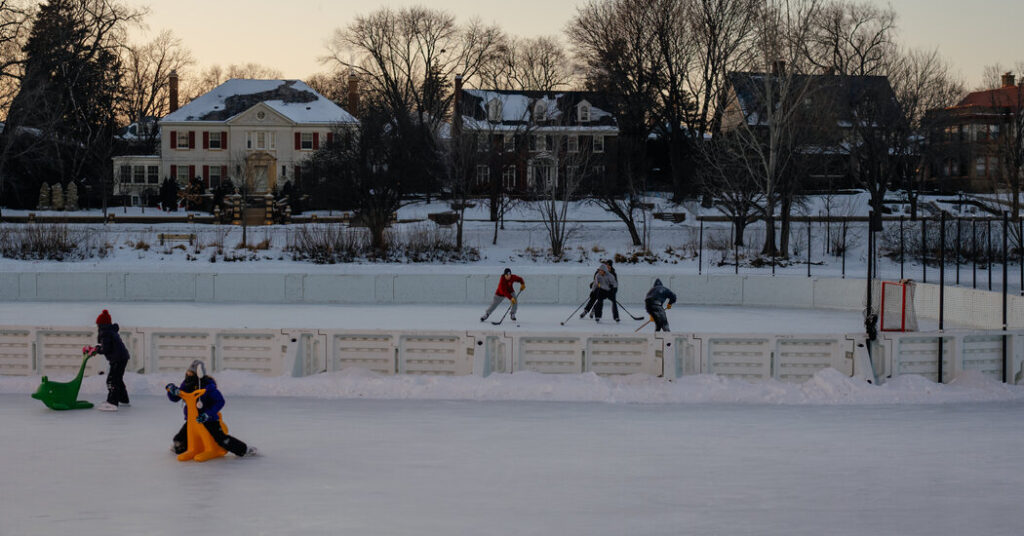
A crowd of dozens cheered when the final buzzer sounded at the U.S. Pond Hockey Championships on Sunday, an event that had drawn teams from 20 states to a frozen lake in a city that remained in the throes of a contentious immigration crackdown.
Hockey players and fans bundled up to their eyes chatted around the empty rinks, or filtered back to their cars hauling oversized duffel bags. Just a day earlier in Minneapolis, several miles across town, the streets had been littered with tear gas canisters and crowd control munitions, after a second fatal shooting by federal law enforcement agents touched off a wave of unrest.
But even at the hockey tournament, removed from the conflicts that have left pockets of the Twin Cities resembling war zones, the clashes were at the top of everyone’s mind.
“People are trying to get out there as much as I think they can, yet still feeling scared, and I think still feeling really helpless,” said Mark Holloway, 48, of Minneapolis.
As escalating clashes between federal agents and residents continue to rattle Minneapolis, life elsewhere in the city — in its parks, its downtown core, its quiet neighborhoods — has continued. But several people who spoke to The New York Times across Minneapolis over the weekend said that the issue had overshadowed daily life, if only as an undercurrent of fear, and was a constant subject of conversation.
Mr. Holloway was among the spectators heading to the parking lot as the hockey tournament wrapped up on the shores of Lake Nokomis on the city’s south side. He said the immigration sweep had directly touched his family and his community. Immigration and Customs Enforcement agents had shown up on the grounds of his son’s high school, he said, and his neighbors who feared they could be profiled as immigrants based on their appearance had started carrying passports for fear of being detained.
“I’m a 48-year-old white guy,” Mr. Holloway said, his breath turning to vapor in the subzero temperatures. “And I don’t feel really safe.”
Several visitors to the city — who had flown in from as far as Colorado, Utah and Texas — said that recent events had been top of mind for them when they arrived. But their trips, so far, had been largely without disruption.
Standing around a fire pit beside the rinks, Nate Jackson, 40, and Casey Donovan, 39, visiting hockey players from Texas, said they had arrived in Minneapolis expecting to find a city in chaos. So far, though, they hadn’t seen any signs of unrest.
Watching from afar, the two men said that though they supported law enforcement, they felt the conflicts were unnecessary.
“I think it’s all parties involved, on that one,” Mr. Donovan said. “There’s not a single person to point a finger at.”
“Cooler heads could prevail, but it just seems like that’s not even an option,” Mr. Jackson added.
As they left the event, many attendees drove past the intersection of Cedar Avenue and East Minnehaha Parkway, where protesters held signs denouncing ICE. Kyle Ness, 56, of Minneapolis, was among them. He said he had been protesting on and off for some time, but was compelled to be even more involved in the demonstrations after federal agents shot and killed a 37-year-old Minneapolis resident, Alex Pretti, on Saturday morning.
“The collateral damage that’s coming from their extreme anger toward people exercising their rights, like in the case of Alex — that’s what really got me mad,” Mr. Ness said of the federal agents in Minneapolis.
The impacts of the immigration crackdown resonated even more deeply in the Cedar-Riverside neighborhood, known by locals as Little Mogadishu for its high concentration of residents of Somalian heritage. Few pedestrians were out early Sunday afternoon.
At Afrik Grocery African Market, the co-manager Mohamed Ahmed said the crackdown had left his store quieter than ever, as his customers were afraid to go out shopping. Even the suppliers who kept his shelves stocked were affected.
“The suppliers don’t have drivers,” said Mr. Ahmed, a native of Somalia who said he had lived in Minneapolis for more than 20 years. His shelf that usually holds injera, a staple of Ethiopian cuisine, sat empty on Saturday.
In Minneapolis’s downtown core later Saturday afternoon, protesters toted signs as they dispersed through the quiet streets. On the floor of the city’s convention center, visitors toured lavishly outfitted pontoons on display at the Minneapolis boat show. Khaleel Thompson, 26, stood by the doors waiting to meet a friend.
Mr. Thompson said he had steered clear of the protests, knowing how quickly things could escalate, and had not followed events in the city very closely. Aside from glimpses of the demonstrations, he had not felt the impacts of the immigration enforcement operation on his daily life.
But after the deaths of Renee Good, the 37-year-old woman killed by an ICE agent in Minneapolis earlier this month, and Mr. Pretti on Saturday, he felt it would best if the agents left Minneapolis.
“Those people didn’t have to die,” he said.
Chris Hippensteel is a reporter covering breaking news and a member of the 2025-26 Times Fellowship class, a program for journalists early in their careers.
The post Parts of Minneapolis Carry On, but Talk of Killings Is Everywhere appeared first on New York Times.