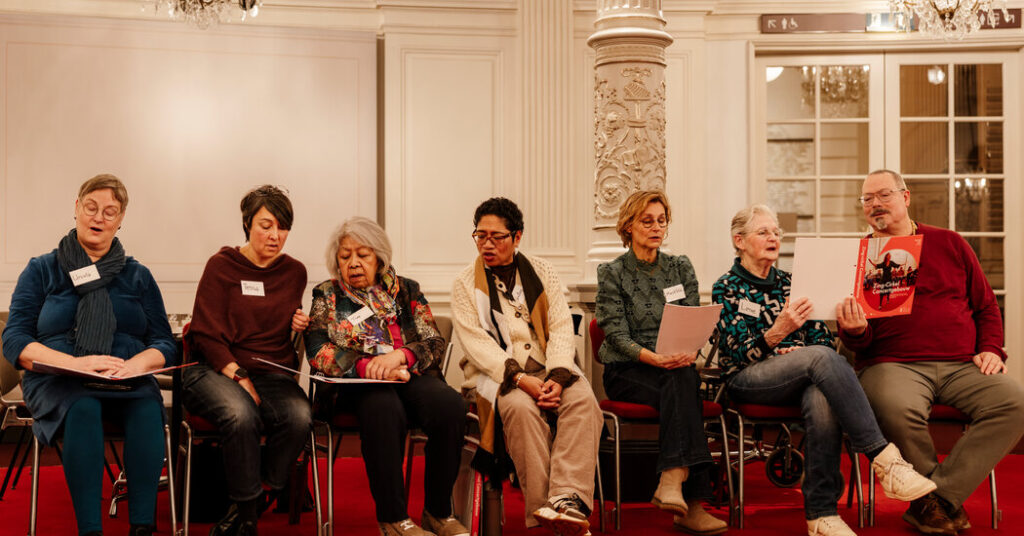
On a freezing but sunny afternoon last week, around 50 people filed into a mirrored room in the Concertgebouw, Amsterdam’s leading concert hall, and took seats in a circle of chairs.
Marcel van der Kruk arrived with his wife, Tonny, 62, who has early-onset dementia. Barbara Cruz came with her mother, Idelma, 88, who has Alzheimer’s disease. And Dennis Leydecker, a home health care worker, brought Helga de Ruiter, 78; Corry Busker, 78; and Esther Magliano, 85; who all struggle with cognitive decline.
They had come to the Concertgebouw for Singing Circle (“Zing-Cirkel”), a monthly program for people with brain diseases or injuries, or other troubles linked to memory or speech. Many of them face daily challenges to make sense of the world around them. But their objective here is simple: All they have to do is sing.
The program is run by Maartje de Lint, a former opera singer, who has been running another initiative called Singing for Health for about 15 years. She began offering the Singing Circle program at the Concertgebouw in October 2024, with a few sporadic trial sessions. This year, the Concertgebouw plans to host it once a month.
The theme for last week’s session was “Traveling in 2026,” which de Lint chose, she said later in an interview, “because many people with brain problems can’t travel anymore, sometimes because the only place they really feel safe is at home.” By singing music from other countries and in other languages, she added, “we travel in the songs.”
The participants opened their song books, which included lyrics to 10 songs, in Dutch, English, Indonesian and Surinamese, accompanied by color photographs. De Lint asked participants to turn to a Dutch song called “Dreamland” (“Droomland”), whose chorus goes: “Dreamland, dreamland, oh, I long so for dreamland / There’s always peace there, so come along with me.”
De Lint asked the participants to imagine their personal dream land as they sang.
Yvonne Driessen, 78, wearing a fuzzy vest and Ugg boots, waved her hands while singing, but her eyes filled with tears. De Lint stopped and knelt in front of Driessen, taking her hands. “What’s making you emotional?” she asked.
Driessen pointed to a photo in the song book of a woman holding a baby, and said that it reminded her of being held by her mother as a child. “That’s what felt like home to me,” she said.
De Lint, who spent years singing in various companies in Italy and Spain and in the chorus of the Dutch National Opera, argues that singing can enhance brain activity in the moment and in the long run. Some singing activities, like singing in rounds or in different languages, can serve as a form of “brain training,” she said.
Recent research on music and cognition seems to back her up. Borna Bonakdarpour, the director of the music and medicine program at Northwestern University in Chicago, said by phone that there was a growing body of scientific literature supporting music as a treatment for neurocognitive disorders.
“With neurological diseases like dementia, a lot of patients do have anxiety, because of feeling lost,” Bornakdarpour said. “Music can help regulate emotions. After listening to music, the brain slows down, and it goes from a chaotic situation into an alpha rhythm, which is more meditative, and more receptive.”
Bas Bloem, a Dutch neurologist who specializes in Parkinson’s disease, said that scientific data was increasingly validating the “many healing powers associated with music and dance,” including the production of dopamine, which reduces stress and anxiety and sometimes improves motor coordination.
Bloem said that music tapped into the neocortex, “the part of the brain where we make memories and plans.” He added that “people can often remember music when they can’t recognize faces or voices or other persons.”
The Netherlands has been one of the leading nations for research and programs on the effects of music on brain health, according to Daniel J. Levitin, a neuroscientist, musician and author of the best-selling books “I Heard There Was a Secret Chord: Music as Medicine” and “This Is Your Brain on Music.”
In November, he participated in a symposium hosted by Queen Máxima of the Netherlands at the Royal Palace in Amsterdam called “Music and Mind, Music as Medicine.” The queen is a supporter of music programs in the country’s classrooms.
Group singing is “an especially poignant and distilled version of a range of music therapies,” Levitin said. “Its evolutionary origins are ancient” and can be traced to the earliest hunter gatherers, he added. “When we sing together it releases dopamine, which is part of the pleasure network, and it releases oxytocin, which helps us feel bonded and connected to one another.”
At Singing Circle, Mimi Kroonenberg, 93, who came with her daughter, Miriam van Praag, said she loved the event’s sense of “gezelligheid,” a Dutch word for coziness and conviviality. “The important thing is that you’re doing it with other people,” she said.
For the penultimate song of the session, de Lint invited everyone to get up and dance. Van der Kruk took his wife’s hand and they started a slow waltz. Driessen, who had been moved singing “Dreamland,” turned to her son Yuri Koster-Kartoidjojo, who stood up with her to dance. Together, they swayed and smiled.
“My mom and I have a lovely time together when we’re singing,” Koster-Kartoidjojo said later. “She asks me all the time when we’re going to sing again. For her, it’s a real moment of joy — and she remembers it, and she’s very happy the whole day afterward.”
The post Memory and Speech Are Their Everyday Struggles. Then They Get to Sing. appeared first on New York Times.