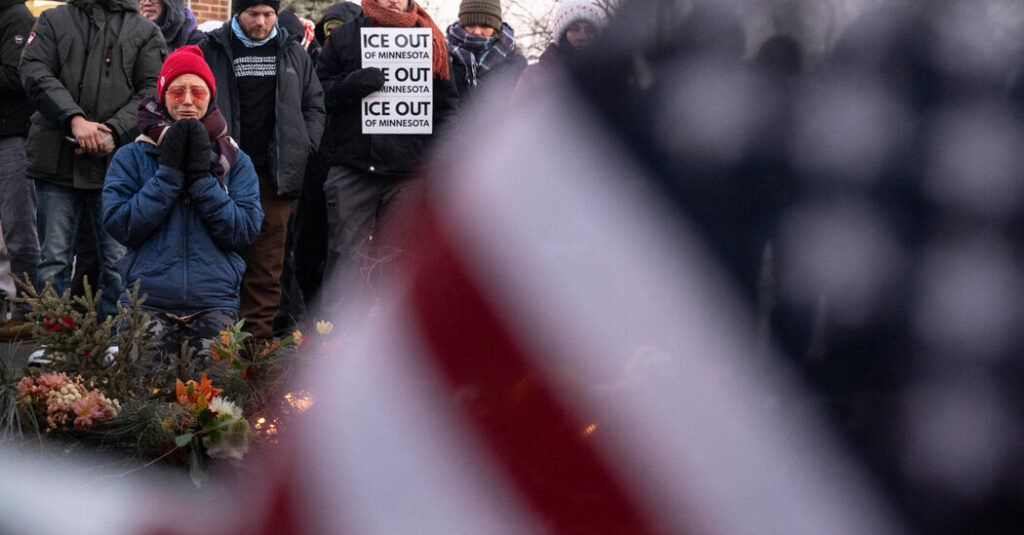
In the wake of another fatal shooting by federal immigration officers in Minneapolis, many people are wondering what can be done. The answer has been right in front of us all along.
Despite the incredulity with which some legal observers meet the idea, state and local prosecutors can prosecute federal officials for violating state criminal laws. Prosecutors should be gathering and securing evidence and seriously considering filing charges — sooner rather than later.
Not every prosecution will succeed, and all will face obstacles that are built into our legal system. But critically, bringing these state and local prosecutions could produce deterrent effects that are so desperately needed now.
U.S. law, at least theoretically, provides a range of options for holding government officers accountable; the problem is that many of those options are unavailable in practice where federal officers are concerned.
Consider, for instance, federal criminal prosecution — which should be an option for federal officers who commit murder. As recently as 2019, the first Trump administration told the Supreme Court that federal criminal prosecution would be the appropriate remedy in cases in which an officer used lethal force without justification.
But the current administration didn’t investigate the Jan. 7 killing of Renee Good, and it has already stated that the Department of Homeland Security (which has no experience investigating law enforcement shootings) will run the investigation into the killing of Alex Jeffrey Pretti. A future president could potentially pursue charges for an offense — like the recent shootings of Ms. Good and Mr. Pretti — that has no statute of limitations. But that assumes President Trump won’t first pardon the responsible officer(s).
What’s more, a series of decisions by the Supreme Court has made it all but impossible to hold federal officers liable for damages in federal lawsuits for violating our constitutional rights — such as in a February 2020 decision involving a Border Patrol agent who shot and killed an unarmed teenager without provocation.
Instead, the historical backstop for a lack of federal accountability, going all the way back to the founding, has been state law. States prosecuting federal officers for crimes committed in the course of their federal duties would certainly face complications, but those hurdles would not be insurmountable.
One such complication: The federal officer charged by state prosecutors for a crime committed while on duty could move any such case to a federal court. But that would simply change the courthouse (and the judge and the jury pool). State prosecutors would still be seeking to enforce state law — which, among other things, means that any conviction would not be subject to the president’s pardon power.
A second potential hurdle to clear: A federal officer defendant could argue that he’s entitled to what’s known as “Supremacy Clause immunity.” Vice President JD Vance, Homeland Security Secretary Kristi Noem and the White House deputy chief of staff, Stephen Miller, have all claimed that this immunity is absolute, but they’re all wrong. As highly regarded (and conservative) former Judge Michael McConnell wrote on behalf of the Denver-based federal appeals court in 2006, “a federal officer is not entitled to Supremacy Clause immunity unless, in the course of performing an act which he is authorized to do under federal law, the agent had an objectively reasonable and well-founded basis to believe that his actions were necessary to fulfill his duties.”
In other words, the ability to prosecute federal law enforcement officers who commit state crimes in the course of their duties would turn on whether a reasonable officer in their position would have believed that their actions were necessary to fulfill their duties. That standard may be appropriately strict, to maintain federal authority when it is needed (think of federal protection for civil rights protesters in the 1960s), but at least based on the videos so many of us have seen, it should not be impossible.
Nor should state and local prosecutors think this power to bring charges under state law exists — or should exist — only when the offense results in a death. Every day, Americans are seeing an unending stream of videos showing federal officers destroying property, pepper-spraying individuals on a whim and using what at least appear to be excessive degrees of force. Many, if not most, of these acts are potential violations of state criminal laws. If those crimes are not “reasonable and well-founded” in light of federal duties, the officers can be convicted and penalized, even jailed.
What prosecutors should be doing now is what Minnesota prosecutors did after the murder of Renee Good: establishing online portals to which individuals can upload their videos and other evidence. Will there be a flood of evidence? Yes. Will it all justify prosecution? No. Will some offenders be charged? We can’t say for sure, but it looks to us like the answer ought to be yes, and that’s true even if the final result is not a conviction. (That, after all, is why we have trials and juries.)
If federal officers understood that they could and might well be held liable for outrageous conduct, they might think twice before engaging in it. The ultimate goal is bringing to justice those who have engaged in blatantly unlawful and unconstitutional conduct. But what is needed immediately — urgently — is deterring such conduct from happening going forward. Federal officers who are wearing masks to obscure their faces (and those who aren’t) must understand that they will be held accountable if and when they break the law.
We are arguing only for compliance with the Constitution. No one should disagree with that. As history teaches, that requires more than just the good graces of the executive branch.
In the future, a better solution would be for Congress to legislate a comprehensive and robust scheme of civil remedies for federal officers who break the law. But until and unless that happens, the alternative can’t be nothing.
And so it falls to state and local governments to build the record for criminal indictments in cases in which they are warranted — and to be the last line of defense for holding the federal government accountable, just as they’ve been since the founding.
Barry Friedman, a law professor and faculty director of the Policing Project at New York University School of Law, is the author of “Unwarranted: Policing Without Permission.”
Stephen I. Vladeck is a professor of law at Georgetown University Law Center, writes the One First Supreme Court newsletter, and is and author of “The Shadow Docket: How the Supreme Court Uses Stealth Rulings to Amass Power and Undermine the Republic.”
The Times is committed to publishing a diversity of letters to the editor. We’d like to hear what you think about this or any of our articles. Here are some tips. And here’s our email: [email protected].
Follow the New York Times Opinion section on Facebook, Instagram, TikTok, Bluesky, WhatsApp and Threads.
The post Local Prosecution Is the Answer to Federal Lawlessness appeared first on New York Times.