A federal judge in Minnesota asked a lawyer for the Trump administration on Monday whether the surge of federal officers to the state was really just about immigration enforcement, or whether it might also be motivated by political retribution and coercion.
But the judge, Kate M. Menendez of the Federal District Court, also had pointed questions about the state government’s request that she issue a sweeping order blocking the surge of agents.
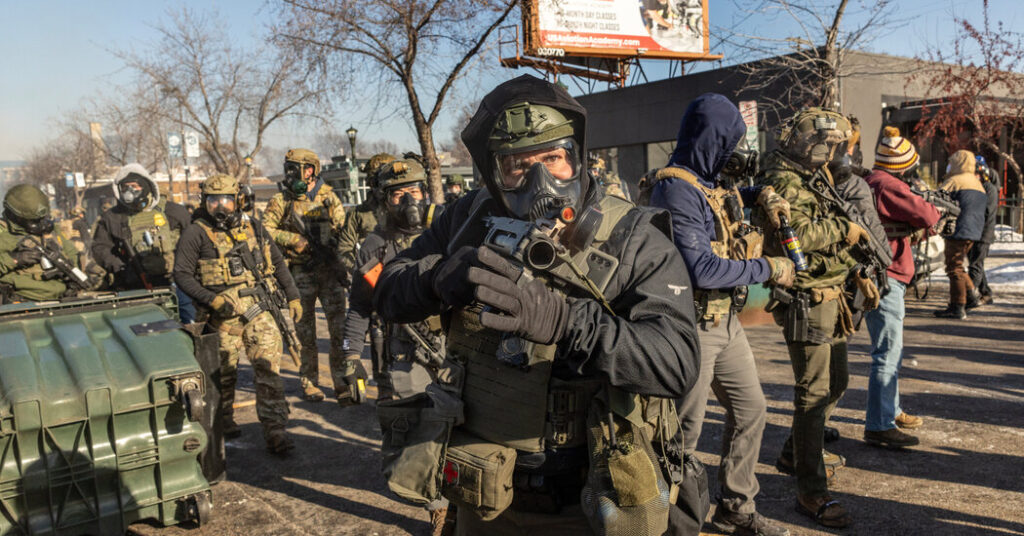
Minnesota, along with the cities of Minneapolis and St. Paul, filed a lawsuit two weeks ago claiming that the Trump administration’s campaign, called Operation Metro Surge, violates state sovereignty under the 10th Amendment and should be blocked. The surge has brought some 3,000 federal agents to Minnesota, resulting in thousands of arrests, three shootings and tense protests.
Judge Menendez, who was nominated to the bench by former President Joseph R. Biden Jr., did not rule from the bench on Monday and did not provide a timeline for issuing a written decision. She indicated that she would move quickly.
“If I had a burner in front of the front burner, this would be on it,” the judge said as the hearing ended.
Here are some takeaways from the hearing:
Minnesota officials pushed for immediate action.
For two weeks, lawyers for the state and the cities have pressed Judge Menendez to immediately issue a temporary restraining order blocking the surge. But the judge has moved more slowly, giving the Trump administration time to reply to the lawsuit in writing, and then scheduling oral arguments.
Since her first hearing on the case, federal agents have shot two people in Minneapolis, including the nonfatal shooting of a Venezuelan man accused of resisting arrest and the killing on Saturday of Alex Pretti, a U.S. citizen and nurse. An earlier fatal shooting, of Renee Good, also a U.S. citizen, took place days before the suit was filed.
Lindsey Middlecamp, a lawyer for the state, reiterated the call for swift action on Monday, asking the judge to stop what she called an “invasion” of federal agents. She called on the judge to “issue a temporary restraining order today. Not tomorrow. Not next week. Today.”
Sara Lathrop, a lawyer for the city of Minneapolis, said on Monday that the events over the weekend showed that the “situation is absolutely untenable.”
But Brantley Mayers, a lawyer for the Trump administration, described the request for an order blocking the surge as “a pretty staggering remedy.”
Judge Menendez asked where the line should be.
Judge Menendez said in court that “I think it goes without saying that we are in shockingly unusual times.” But she pressed lawyers for the state to explain when, in its view, the federal government deploying federal agents to enforce federal law could become a constitutional affront.
“How do I decide when a law enforcement response crosses the line from a legitimate law enforcement response to a response that violates the 10th Amendment?” the judge asked.
The state has not sought an end to all immigration enforcement in Minnesota, only a return to the levels seen before the surge. But its lawyers were reluctant to provide a specific number of agents or amount of enforcement that they believed tipped the scales into unconstitutional behavior.
“This is so far beyond the pale of legality,” said one of the state’s lawyers, Brian Carter.
The judge also expressed some concern about the sweeping nature of the lawsuit, and asked whether some of the claims of unconstitutional behavior might be better addressed through separate, more focused lawsuits, like one she is hearing on agents’ actions toward protesters.
“It seems that part of the solution for this set of wrongs that you describe is to bring cases about those wrongs,” Judge Menendez said, “rather than to say all of these things together means the federal government has to leave the state of Minnesota.”
The Trump administration defended the surge.
Mr. Mayers, the federal government’s lawyer, argued that immigration agents were “here enforcing federal law” and were acting within their authority.
He noted that Congress had passed immigration laws and that President Trump had campaigned on a promise to crack down on illegal immigration. Judge Menendez said that might be true broadly, but that the surge of thousands of “troops to the state of Minnesota has not been vetted in any democratic forge, so to speak.”
Mr. Mayers said the administration had found that Minnesota officials were not doing enough to help with immigration enforcement, and that more federal enforcement was needed “to address the law enforcement vacuum.”
Mr. Mayers argued that was not allowable for a state “to use the 10th Amendment as both a sword and a shield.” His point was that Minnesota officials were choosing not to cooperate with aspects of federal immigration enforcement, and then also objecting when the federal government decided to devote more resources to that issue in the state.
Judge Menendez noted that the state of Minnesota “has one set of values” around immigration enforcement, and the Trump administration has another. She told a lawyer for the state that “we’re at risk of asking me to decide who’s right there.”
The judge asked about possible ulterior motives.
State and city officials claimed that the motives for Operation Metro Surge reached beyond immigration enforcement and were part of a broader campaign of payback against the president’s perceived political enemies.
Mr. Carter said that “it is personal animosity, it is retribution” that was motivating the Trump administration’s campaign in Minnesota. He also accused the administration of trying to strong-arm the state into changing its policies on immigration.
“The federal government is attempting to bend the state’s will to its own,” Mr. Carter said, “and that is not allowed under the Constitution.”
Judge Menendez referred to a social media post by President Trump that mentioned Minnesota and said “THE DAY OF RECKONING & RETRIBUTION IS COMING!” She also asked repeatedly about a letter sent over the weekend by Attorney General Pam Bondi to Gov. Tim Walz that outlined several policy demands for the state related to immigration enforcement, welfare programs and a request to hand over voter rolls.
Ms. Middlecamp, a lawyer for the state, had referred to Ms. Bondi’s letter as “a ransom note.”
Pressed on those issues, Mr. Mayers, the federal government’s lawyer, insisted the operation was about enforcing immigration laws.
“There is nothing to back up this claim that we’re here for another reason,” he said.
There is limited precedent.
While other states have brought 10th Amendment lawsuits against the federal government over the years, lawyers for both sides struggled to find direct parallels for the claims being made in this case.
Mr. Carter said that “this situation is unprecedented in the 250-year history of our country.” He claimed the deployment of immigration agents — which he called “essentially an army” — was intended to “basically stir the pot with conduct that is pervasive and includes widespread illegal violent conduct.”
Mr. Mayers countered that it was well within the president’s rights to deploy federal law enforcement agents within the country as he saw fit.
Fred Smith Jr., a Stanford law professor, said in an interview that Minnesota’s lawsuit “makes novel claims,” but that the “central government is doing novel things, and so there’s not a lot of precedent.”
A ruling in favor of Minnesota, Mr. Smith said, could “open up a door to kind of a new area of 10th Amendment jurisprudence, where the federal government in the future would have to be mindful about acting in ways that unduly interfered with states’ ability to carry out their own laws.”
On the same day that Minnesota officials sued, Illinois officials filed their own 10th Amendment case asking another judge to block U.S. Customs and Border Protection “from conducting civil immigration enforcement” in the state without “express congressional authorization.” An order has yet to be issued in that case.
Ernesto Londoño and Bernard Mokam contributed reporting.
Mitch Smith is a Chicago-based national correspondent for The Times, covering the Midwest and Great Plains.
The post Judge Asks Pointed Questions, but Does Not Rule, in Hearing Seeking Block to ICE Surge appeared first on New York Times.