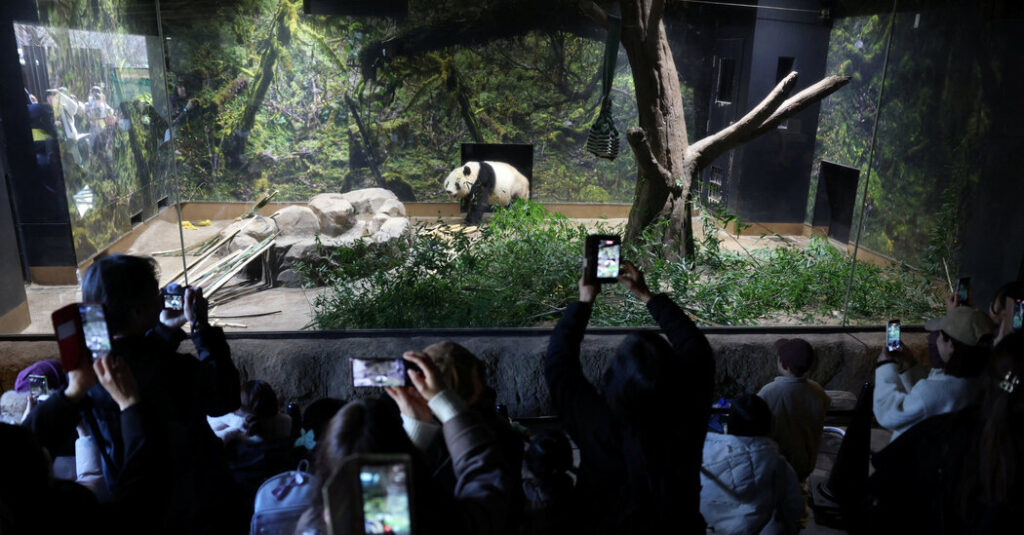
Lucky lottery winners got one minute to bid goodbye to Xiao Xiao and Lei Lei, twin pandas set to leave Japan on Tuesday amid mounting tensions with China.
Getting in to the Ueno Zoo in Tokyo for a last look at the beloved Chinese diplomats was not easy, but visitors came in droves.
Since December, when the pandas’ imminent departure was announced, about 4,800 people per day — nearly 200,000 in total — have flocked to the zoo. To score a slot, they filled out online applications, braved crowds and long lines, and most recently competed in a lottery.
Xiao Xiao and Lei Lei were born at the Ueno Zoo in 2021, and remained on loan there as part of China’s longstanding global panda diplomacy program.
Though their departure had been planned previously, negotiations over potential replacements stalled after comments in November by Japan’s prime minister, Sanae Takaichi, that Tokyo could intervene militarily if China were to attack Taiwan. China regards the self-governing democracy as part of its territory.
Ms. Takaichi’s comments prompted Beijing to urge Chinese tourists to avoid Japan, and to restrict Japanese seafood imports and increase military patrols.
There are signs that Japan may remain panda free for the foreseeable future.
On Monday, China’s Foreign Ministry reiterated the government’s warnings against travel to Japan, and several major Chinese airlines extended cancellation policies announced in the wake of the spat.
Panda diplomacy has a long history in China, dating back more than 1,300 years. Historical records show that the Empress Wu Zetian of the Tang Dynasty sent a pair of pandas in cages gilded with red flowers to the Emperor Tenmu in Japan around 660 A.D. The bears were accompanied by animal trainers and imperial guards.
Centuries later, in 1972, pandas, an endangered species, again played a role after China and Japan normalized ties following a 35-year rupture. China announced that it would give two bears to Japan to mark the establishment of diplomatic relations between the nations.
Since the arrival of those two bears, Kang Kang and Lan Lan, furry, bamboo-chewing ambassadors have gained legions of fans in Japan and drawn millions of visitors to Japanese zoos.
The departure of Xiao Xiao and Lei Lei on Tuesday will mark the first time that Japan has been without pandas in more than half a century, though there is hope for those devastated by the looming absence. Pauses in panda diplomacy have happened before. In 2024, Washington welcomed two pandas to the National Zoo after nearly a year without one.
Some experts have suggested that the departure of Xiao Xiao and Lei Lei now is intended to bypass policymakers and send Japan’s citizens a pointed message. What effect that might have is unpredictable.
Nancy Snow, a former professor of public diplomacy at Kyoto University, wrote in Nikkei Asia on Monday that “the panda decision, far from softening attitudes, may reinforce perceptions of China as transactional and punitive.”
Ephrat Livni is a Times reporter covering breaking news around the world. She is based in Washington.
The post Japanese Panda Fans Bid Farewell to Furry Ambassadors appeared first on New York Times.