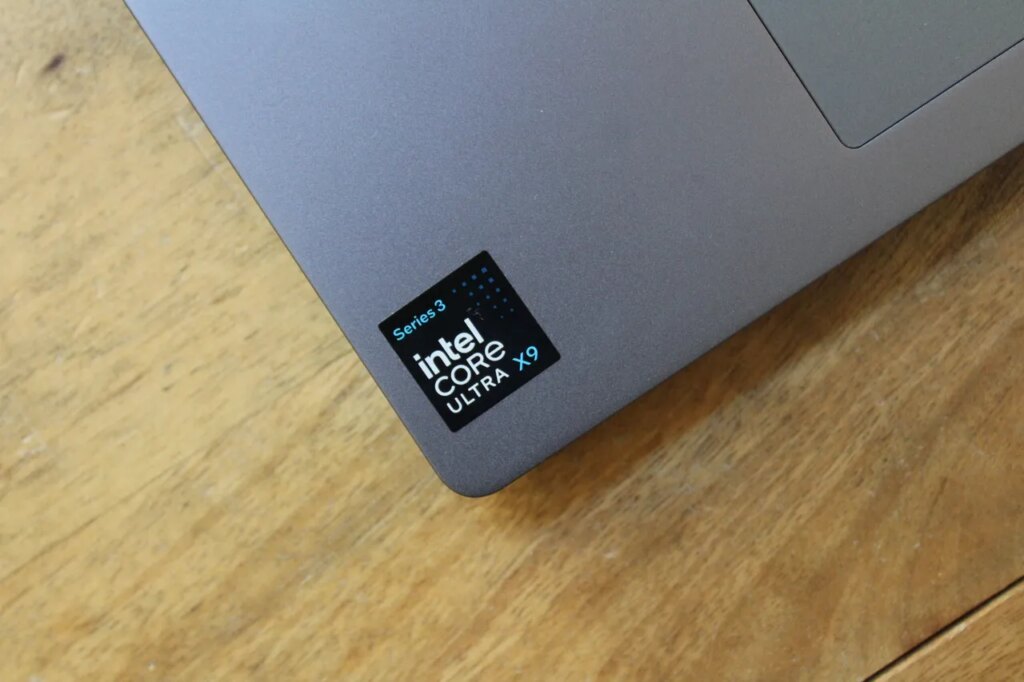
This isn’t just another Intel chip launch. Far from it. For years, most updates to Intel’s laptop chips have been nothing more than modest performance increases over the previous year. That’s not the case with the long-awaited arrival of Panther Lake.
It’s a chip design announced almost five years ago as a part of the company’s ambitious rescue plan to get back on track. Intel CEO at the time (and mastermind of the grand plan), Pat Gelsinger, called the technology the “cornerstone of the company’s turnaround strategy.” Now, I have a laptop in front of me with these Panther Lake chips inside, officially known as the Intel Core Ultra Series 3. Having tested it myself, I’m left extremely impressed. I’m not sure if the Series 3 will redeem Intel’s recent foibles, but these chips certainly feel like a big win for a company that really needs one right now.
Intel Takes On the M5
To succeed with the Core Ultra Series 3, Intel at least needed to fulfill the promises it made when the chips were announced last year. Namely, equivalent battery life and efficiency from its predecessor (Lunar Lake) with improved performance. That alone has been a major hurdle for the kind of x86 processors Intel has always made. The company has also boldly claimed its higher-powered silicon for gaming laptops will do the opposite: maintain the performance of last year’s chips with added efficiency for better battery life. That is, yet again, another tall order.
I tested two laptops with the new Intel Core Ultra Series 3 line of chips, both on the higher-end of the spectrum: the Intel Core Ultra X7 358H in the MSI Prestige 14 Flip and the Core Ultra X9 388H in a 16-inch Lenovo IdeaPad reference unit. These are both 16-core CPUs, broken down into four performance cores, eight efficiency cores, and four low-power efficiency cores.
Interestingly, this is actually two fewer performance cores than the Core Ultra 9 285H, though it gets confusing as to which chip from the Intel Core Ultra Series 2 this chip is the successor to. The 2025 MSI Prestige 14 Flip, for example, used the Core Ultra 7 258V Lunar Lake rather than an H-series Arrow Lake chip. In other words, there’s no exact one-to-one here in terms of comparing price and performance. Here’s a sampling of the scores it posted in my testing.
As you can see, these two new Intel chips now sit at the top of the stack in terms of multi-core performance. And when it comes to the X9 388H, it’s by a healthy margin. Coming back with a chip that outperforms Apple’s latest M5 by 33 percent is no easy feat, but Intel pulled it off. The same is true in the graphics department, where Intel has taken the lead in integrated graphics. It has been a long time since I’ve been able to say this, but Intel is clearly back on top.
The Core Ultra 7 258V listed above was tested in the Dell 14 Plus, a laptop of similar size to the MSI Prestige 14 Flip. As you can see, there’s a significant 52 percent increase in multi-core CPU performance, as well as a 54 percent GPU upgrade, as tested in 3DMark Steel Nomad Light. Notably, that also surpasses the current-generation M4 MacBook Air.
Intel still can’t compete on single-core performance against Apple, and that’s where the improvement is the most modest. It’s also not as fast as the M4 Pro or M4 Max, which still have the edge in every category, though the difference in multi-core performance between the X9 and the M4 Pro is only 14 percent. Apple’s M5 Pro and M5 Max are just around the corner, too. I’d also love to test the Core Ultra X7358H against upcoming processors in next-gen laptops like the Snapdragon X2 Elite Enhanced, but I don’t have them on hand yet for comparisons.
The graphics really stand out, though, especially when you get to the X9 chip. For once, the inclusion of the “X” branding in the name actually feels worthwhile. Both the X7 and X9 chips use a B390 GPU, representing the top of the line in Intel’s architecture (outside of discrete desktop graphics cards). You get 12 Xe cores in the X7 and X9 configurations, the only difference between the two being clock speed. Intel claimed that Panther Lake graphics were 77 percent faster than in the previous-gen Lunar Lake laptops, and while I didn’t quite see that much of a jump, it’s hard to get a direct apples-to-apples comparison with laptops.
Either way, as you can see above, Intel has pulled off a huge move forward in integrated graphics. Big numbers are what you want in benchmarks, yes, but as always, how that translates into an actual product you buy is what matters.
What More Performance Really Means
There are two useful applications for putting stronger graphics in an otherwise basic, thin-and-light laptop. First, it speeds up all types of tasks, whether that’s video editing or local artificial intelligence inferencing, without having to deal with a thicker, more expensive device.
Speaking of AI, the neural processing unit (NPU) has gotten a lot less attention this time around, but it’s still capable of 50 TOPS (trillions of operations per second). That’s falling behind the Qualcomm Snapdragon X2’s 80 TOPS—then again, the NPU hasn’t proven itself to be all that exciting just yet in average laptop use. It’s the GPU performance that really has the potential to change what this class of thin-and-light laptops can do.
Non-gaming Windows laptops with discrete GPUs still aren’t as common as they should be, get poor battery life, and often cost too much. That has left a space for the MacBook Pro to dominate without any real competition. While it still depends largely on laptop manufacturers, they at least now have access to chips that can handle the performance and efficiency.
Gaming is the most obvious advantage of improved graphics. Neither of the two laptops I tested is a conventional “gaming” laptop, and yet, the power of that B390 makes gaming not only possible, but actually enjoyable. That’s especially true when it comes to the larger Lenovo device, which bears a lot of resemblance to the IdeaPad Pro 5i, a 16-inch laptop that had an RTX 4050 when it launched in 2024. The Core Ultra X9 388H really has room to breathe in the newer reference version I tested; its gaming performance is really impressive. Cyberpunk 2077 can hit a comfortable 55 frames per second (fps) at native medium graphics settings—and that’s without any upscaling and frame generation. That’s solid for a laptop not marketed for gaming at all.
When you do need higher frame rates than what this system can natively produce, such as in Marvel Rivals, Intel has XeSS upscaling, frame generation, and a low-latency mode. The Lenovo machine only got around 36 fps natively at medium graphics settings in that title, but after I turned on the XeSS 2.0 Quality setting, that jumped up to 54 fps without much of a downgrade in image quality. The combination of XeSS frame generation and low latency can push the frame rates even higher to use the full extent of this display’s 120-Hz refresh rate without reducing input lag.
Here’s the thing: this is a fairly large laptop. While I don’t have official specs on it yet, the Lenovo reference device is around the same size as the 16-inch MacBook Pro, but the slight wedge shape makes it thicker by the hinge. It is already the size of a machine that could squeeze in a discrete graphics card, and as powerful as the Core Ultra X9 388H is, it’s still a solid 25 percent behind even an older graphics card like the Nvidia RTX 4050, as well as Apple’s M4 Pro.
Presumably, we’ll get thinner laptops that can make use of this chip, but we’ll have to see how the performance shapes up. As of now, the main benefit you’re getting here isn’t performance: it’s battery life.
You’re getting a full 22 hours of battery life on a powerful system, which is a first for Windows laptops. That’s why the MSI Prestige 14 Flip’s potential performance has a chance to disrupt our expectations of what laptops of this size can do. Comparing these two chips, the X9 is only 4 percent faster in GPU performance, at least as measured in the 3DMark Steel Nomad Light benchmark. The 25 percent jump in multi-core performance is what makes a stronger case for that high-end model. The result is that the X7 in the MSI Prestige 14 Flip is a pretty far fall from the X9 in real-life gaming performance.
In testing the Prestige, I found myself needing to use the aforementioned XeSS upscaling more often to get enjoyable frame rates. I was still able to play all the games I tested at native resolution, but only on low graphics settings and with upscaling set to Balanced. On a compact laptop like the Prestige 14 Flip, you won’t want to play most games without relying on all of this. Don’t get me wrong—I’m still impressed that I can play Marvel Rivals at decent frame rates on a laptop that’s only 0.55 inches thick. I was able to get 66 fps at low settings with XeSS in Balanced mode and enjoyed fast, fluid-feeling gaming.
I love the idea of not needing a dedicated gaming device to play games, and this device sells that idea best over the Lenovo reference design. But as gaming laptops get trimmer and MacBooks push forward into gaming, Intel’s success here feels like less of a revelation than I thought it would. Even the top-of-the-line X9 chip is still 26 percent behind the performance of an RTX 4050 in a laptop, and that’s the lowest-tier GPU from three years ago. One of the other problems is the fan noise and surface temperatures. The hotspot right over the top left of the keyboard is problematic on the MSI Prestige 14 Flip, and it somehow stays warm even at idle. For what it’s worth, the Lenovo reference unit did not have this problem.
My review unit of the MSI Prestige 14 Flip costs $1,299, and it comes with an OLED screen, 32 GB of RAM, and a terabyte of storage. That’s a solid price for those components. We’ll need to wait and see how other laptop manufacturers are positioning their X7 and X9 laptops to get a better sense of pricing.
Why This Matters So Much
A lot of what makes the performance of these chips so important is how they were made. They’re built on Intel 18A, the latest process node manufactured in the company’s new fab in Arizona. The facility isn’t just another chip plant. It was hailed as an attempt to bring back advanced chip manufacturing to the states, largely funded by the CHIPS Act. And don’t forget an $8.9 billion investment in Intel from the US government, which gained a 10 percent equity stake in the company.
Intel 18A is also a return to form in that the previous-gen Core Ultra Series 2 was partially manufactured by TSMC. This was a big deal at the time—an admission of just how far behind Intel had fallen versus the competition, especially in battery life. While it allowed those chips to be more competitive with Apple and Qualcomm in terms of efficiency and battery life, it was a bitter pill to swallow, no doubt. Notably, they didn’t move the needle in performance from the Core Ultra Series 1 chips.
The Core Ultra Series 3 reverses that water-treading trend for Intel, positioning itself well against the likes of Qualcomm and Apple. Based on the number of laptops embracing the new chips announced at CES, the company hasn’t lost its dominance and remains the primary choice for Windows laptops. In that way, 18A and Core Ultra Series 3 feel like a success so far, at least in terms of delivering competitive performance in consumer laptops.
What happens in the long run is harder to say. The grand architect, former CEO Pat Gelsinger, for whom 18A was such a linchpin, is no longer at the company. The cloud AI boom is surging around Nvidia, and Intel is mostly missing out. But I do know this: Panther Lake is Intel’s biggest success in years and should restore some confidence in its future.
The post Intel’s Panther Lake Chips Aren’t Just Good—They Beat Apple’s M5 appeared first on Wired.