Venezuela’s new leader wants citizens to be hopeful, but not too hopeful.
Three weeks after U.S. forces whisked President Nicolás Maduro away from Caracas, the capital, his vice president and replacement, Delcy Rodríguez, is rapidly liberalizing the economy without ceding any political control in an autocratic nation.
With President Trump’s blessing, Ms. Rodríguez has moved to redirect Venezuela’s oil exports from China to the much more lucrative market in the United States. Earlier this month she funneled the first tranche from these oil sales, $300 million, to Venezuela’s banking system, halting the collapse of the national currency and putting hyperinflation fears to rest.
She is rapidly rewriting laws to bring in foreign investment and boost wages, leading many economists to forecast double-digit economic growth in Venezuela this year. She is promising economic transparency and accountability, an implicit recognition of years of looting of state funds by the government that she has served for decades.
The expectation of an economic bonanza has triggered a rally on Caracas’s small stock exchange and led to a surge in real estate prices. The prices of Venezuela’s bonds, long in default, are rising on hopes Ms. Rodríguez will restructure the country’s debt. As the Trump administration hints it might roll back more U.S. sanctions on Venezuela, foreign investors are lining up scouting missions in Caracas, hoping to snap up the cheap real estate, mines and factories devalued by years of crisis.
“We are expecting that 2026 will be a better year,” Ms. Rodríguez, 53, told Venezuela’s governors and mayors in a televised address last week. “We know that it will be this way.”
The sense of economic euphoria is spreading in the shadow of a deeply repressive state, which Ms. Rodríguez has so far shown little sign of dismantling.
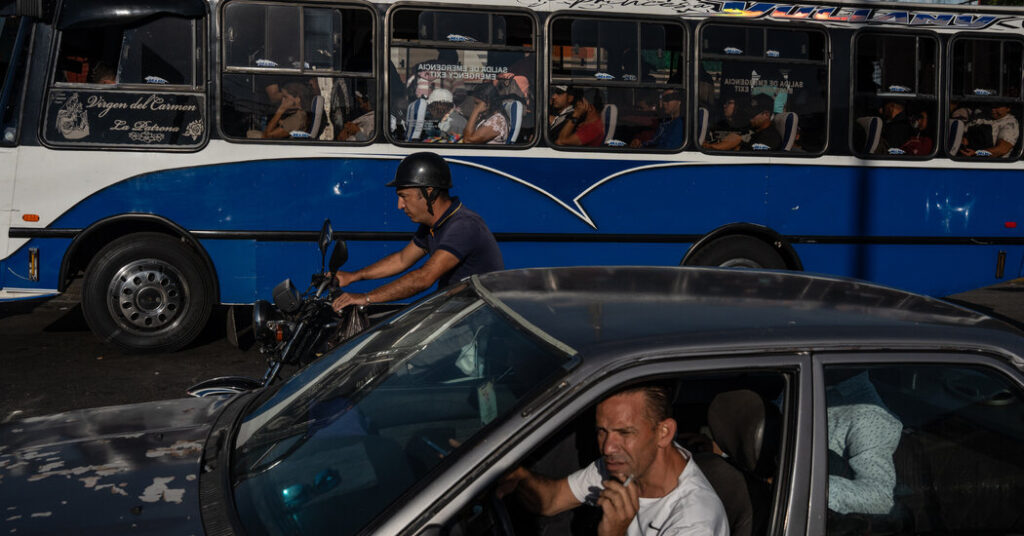
Heavily armed security agents have been stopping drivers and checking their phones on Caracas’s roads. Several checkpoints manned by military counterintelligence officers have sprung up near Ms. Rodríguez’s residence in her densely populated upmarket neighborhood in eastern Caracas, checking locals and passers-by alike.
Ms. Rodríguez’s government has released some political prisoners, more than 200 according to rights groups, but hundreds remain behind bars. And some new prisoners have already taken the released detainees’ places, a process that the opposition calls Venezuela’s “revolving door” of repression.
A former political prisoner, an American named James Luckey-Lange, said in an interview that as prison authorities were preparing to release him and a group of other detainees this month, they were simultaneously processing a group of new arrivals, including a 17-year-old. Practically all of them, including Mr. Luckey-Lange, had been accused of crimes related to terrorism, charges that rights groups say are nearly always fabricated.
On the economic front, Venezuelan financial regulators have been constantly calling the owners of Venezuela’s publicly traded companies, asking them to justify the surge in their stock prices.
The regular procedure took on a threatening undertone in a country where dozens have been detained for allegedly celebrating Mr. Maduro’s downfall.
Several businessmen contacted by the regulators recounted the ensuing absurd discussions, in which they tried to explain to the officials why their stock is surging, without mentioning the downfall of an autocrat largely responsible for one of the deepest economic collapses in modern history.
Mr. Maduro’s fall has so far brought no noticeable change to Venezuela’s severely restricted freedom of expression. At least two prominent Venezuelan journalists have been castigated or threatened by officials for mentioning taboo topics in their programs since the U.S. attack on Caracas on Jan. 3, according to the people involved, who spoke on condition of anonymity for fear of retribution.
The taboos have including mentioning the name of the exiled opposition leader María Corina Machado, who has been lobbying lawmakers in Washington to force new elections in Venezuela.
The atmosphere of fear that has gripped government opponents in Venezuela for years has now even spread to an unlikely new group: officials and businessmen who owe their positions and fortunes to personal ties with the Maduro family.
Since taking office, Ms. Rodríguez has demoted or fired several Maduro loyalists and overhauled the second tier of the country’s military command, even as she continued to publicly assert that she is a mere caretaker working for the president’s return.
The most prominent dismissal thus far targeted Alex Saab, a powerful Colombian businessman sanctioned by the United States for laundering money for Mr. Maduro. Ms. Rodríguez worked with the U.S. military this month to force a tanker carrying oil belonging to Mr. Saab to return to Venezuela, and in the past week she removed the businessman from his government posts.
Ms. Rodríguez’s supporters in the government said the interim leader is trying to thread a needle. She is trying to increase her popularity by working to create a sense of hope and optimism in the country after 13 years of Mr. Maduro’s rule. But this optimism cannot spill into open celebrations, according to people who know her, who spoke on condition of anonymity to be able to discuss sensitive matters. The fear, they said, is that open celebrations could provoke a violent counterreaction from paramilitaries loyal to the ousted president, who have been pining for revenge after the humiliation inflicted on them by the U.S. forces.
Ms. Rodríguez’s critics say the lack of any meaningful political concessions since Mr. Maduro’s downfall is a feature of her governing model, not a temporary glitch.
Ms. Rodríguez, they say, may be trying to recreate the path of economic development followed by China, which in the 1980s opened up to foreign investment and market forces, without sacrificing the ruling party’s monopoly on power. Some commentators have already taken to calling her Delcyping, a reference Deng Xiaoping, the architect of China’s market liberalization.
This outcome may be difficult to replicate. Some government insiders say Venezuela remains a more open society today than China was at the time, and the expected economic boom is likely to lead many Venezuelans to demand greater say in how any new oil wealth is spent.
And unlike China, Ms. Rodríguez’s government depends for its survival today on an outside power, the United States, which may have other ideas about how the country should be governed.
A combination of economic liberalization and outside pressure could also lead Venezuela to replicate the path of another superpower, the Soviet Union. In the late 1980s, a more open economy exposed the shortcomings of its political system, emboldened its citizens and brought down one-party rule.
Anatoly Kurmanaev covers Venezuela and its interim government.
The post In Venezuela, Freeing the Economy, but Nothing Else appeared first on New York Times.