Times Insider explains who we are and what we do and delivers behind-the-scenes insights into how our journalism comes together.
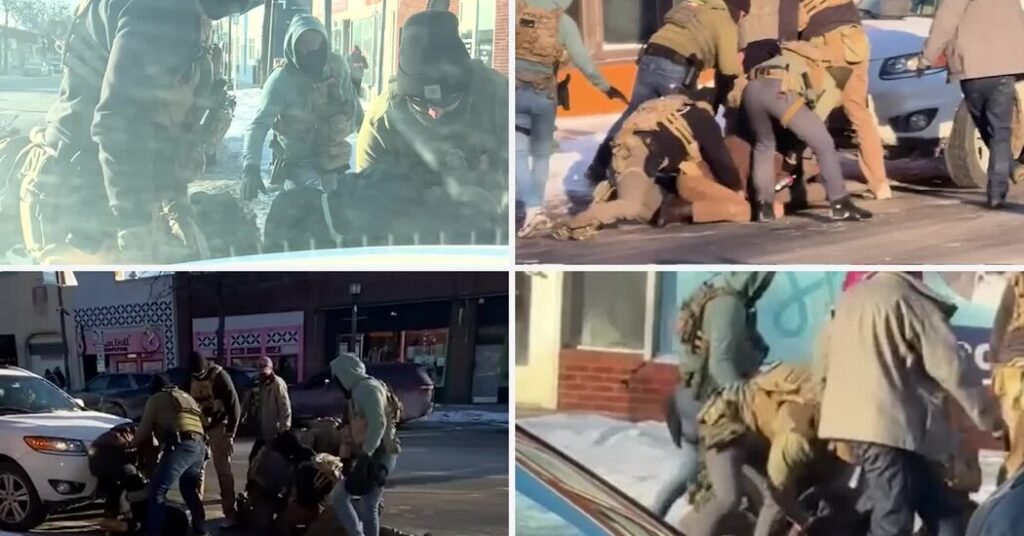
The first viral video from Minneapolis last Saturday morning told only a partial story: Federal agents skirmish in the street with several civilians. Officers bring a man to the ground. Gunshots go off.
What were the federal officers doing? What preceded the confrontation? What went on in the scuffle? Who fired? Who was the man? Was he alive or dead?
There are often more questions than answers in the work of the Visual Investigations team at The New York Times. Our job is to assemble and analyze visual material — including video footage taken by both witnesses and security cameras — to piece together chaotic events and present as full a picture of what happened as we can.
Our goal isn’t to establish guilt or innocence. We aren’t a court of law. Instead, we establish what we call ground truth: what happened, how it happened and who might be responsible. We follow the visuals wherever they take us, not to a predetermined conclusion. In doing so, this work can start to establish accountability.
In the case of Alex Pretti, a 37-year-old Minneapolis resident and intensive-care nurse, we started our work by establishing a few facts gleaned from the initial reporting and videos: Some demonstrators had gathered to protest immigration raids by federal officials. Mr. Pretti was filming with his cellphone before he was taken to the ground by several officers.
By midday Saturday, we had gathered video footage from a few angles that showed two officers firing at least 10 shots at Mr. Pretti, and we learned from the Department of Homeland Security that he had been pronounced dead at the scene.
For many viewers, the videos presented an unassailable conclusion: A man exercising his First Amendment rights was wrestled down and shot dead by federal agents.
Officials for the Trump administration had a different take: Mr. Pretti had attacked officers, said Kristi Noem, the Homeland Security secretary. Gregory Bovino, the official in charge of Border Patrol operations, said Mr. Pretti had wanted to “massacre law enforcement.” These claims echoed Ms. Noem’s characterization of Renee Good, who was shot dead by an ICE agent in Minneapolis in early January.
We wanted to understand whether what the footage revealed might contradict, complicate or confirm parts of the Trump administration’s narrative, not to mention the rumors and snap interpretations saturating the internet.
In the immediate aftermath of violent events, there are not yet depositions to consult. Police and medical reports may not be immediately obtainable. Those involved almost always refuse to comment. And we can’t command people to hand over evidence. So our team of open-source reporters — digital sleuths and video editors who are experts at finding and analyzing video footage — scour the web and approach eyewitnesses, trying to gather as many videos as we can.
Often we end up with pieces of footage, each capturing only a few seconds of the incident. Some of the videos have been shot at odd angles or from a distance; some reveal only a portion of the scene. The footage is often low resolution. Camera movements are jerky. Sightlines are obstructed.
These fragments can be frustrating. But they can also show us a single moment from multiple angles. And when we assemble, synchronize and meticulously analyze all the pieces, a more complete picture starts to emerge.
We study the visual and audio details at a granular level — hand movements, utterances, gestures, postures, body positions, sightlines — to account for highly nuanced variations in behaviors and actions: The precise instant that an officer reaches for his or her gun, or the exact words spoken by a protester.
Analyzing video at this level of detail — pixel by pixel, frame by frame — is a painstaking and time-consuming process, but a necessary one. It helps ensure we have as complete an understanding of the footage as we can get.
We often approach projects like these with a “hive mind” mentality in which several people assess the same things and cross-check one another’s work. This helps ensure that problems like confirmation bias aren’t creeping in. It’s rare to see solo, bylined work from our team.
We published an initial analysis on Saturday of Mr. Pretti’s killing, and several more since then. In this work, we relied on six pieces of video taken by bystanders. We compiled about a dozen additional videos showing what happened before and after the shooting.
Court papers filed on Monday by Trump administration officials said investigators would be assessing body-camera footage of the Border Patrol agents involved in the shooting. That could open up new perspectives on what happened.
Working with the visuals we had, we debunked the initial suggestion by D.H.S. that Mr. Pretti had approached officers brandishing a weapon.
He was clearly holding a phone. We also showed that he didn’t appear to be posing a threat when officers shot at him. We were able to provide clarity on some of those initial questions we had set out to answer, as well as a visual timeline with our colleagues in the Graphics department.
The question of why someone does something is often impossible for us to answer.
In my nine years of doing this work, I’ve learned there can be any number of reasons or explanations that emerge from testimonies or tell-alls: There can be groupthink, or reliance on intuition, both of which can often be wrong. There are people who give, or follow, orders that they shouldn’t. People who insert or assert themselves in ways that aren’t prudent. People who might see threats that aren’t there. Or that overreact to threats that are.
Those are more matters of human nature, not journalism.
What we as journalists can do is understand that when it comes to assessing any complex situation that results in a tragic outcome, it’s critical to exercise caution, check our assumptions and help viewers to see the facts for themselves.
Mark Scheffler leads the Visual Investigations team at The Times, which combines traditional reporting with advanced digital forensics.
The post How We Determined That Minneapolis Videos Contradicted Federal Officials appeared first on New York Times.