MINNEAPOLIS — Saturday morning started frigid and quiet on Minneapolis’ “Eat Street,” a stretch of road south of downtown famous for its small coffee shops and restaurants ranging from New American to Vietnamese.
Within five hours, seemingly everything had changed. A protester was dead. Videos were circulating showing multiple federal agents on top of the man and gunshots fired. Federal and local officials again were angrily divided over who was to blame.
And Eat Street was the scene of a series of clashes, before federal officers and local and state police pulled back and protesters took over the area.
It all started around 9 a.m. when federal immigration agents shot and killed Alex Pretti there, about a mile and a half from the scene where Renee Nicole Good was fatally shot Jan. 7 by an Immigration and Customs Enforcement officer, sparking outrage and daily protests.
And in just over an hour, anger exploded again in the city already on edge. Even before the current immigration enforcement surge, networks of thousands of residents had organized to monitor and denounce it while national, state and local leaders traded blame over the rising tensions.
Two Associated Press journalists reached the scene minutes after Saturday’s shooting. They saw dozens of protesters quickly converging and confronting the federal agents, many blowing the whistles activists use to alert to the presence of federal officers.
They had been covering protests for days, including a massive one Friday afternoon in downtown Minneapolis, but the anger and sorrow among Saturday’s crowd felt more urgent and intense.
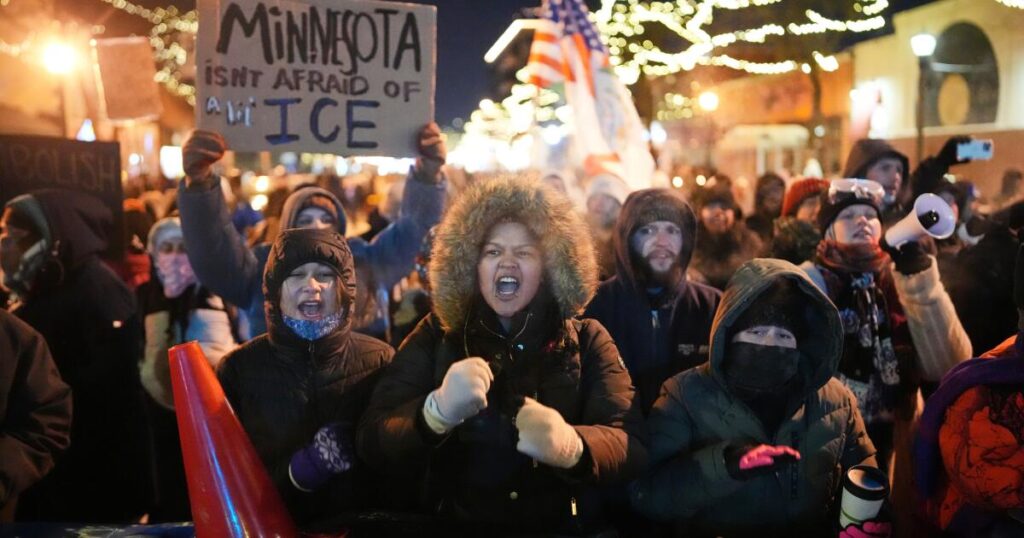
The crowd, rapidly swelling into the hundreds, screamed insults and obscenities at the agents, some of whom shouted back mockingly. Then for several hours, the two groups clashed as tear gas billowed in the subzero air.
Over and over, officers pushed back the protesters from improvised barricades with the aid of flash-bang grenades and pepper balls, only for the protesters to regroup and regain their ground. Some five hours after the shooting, after one more big push down the street, enforcement officers left in a convoy.
By midafternoon, protesters had taken over the intersection next to the shooting scene and cordoned it off with discarded yellow tape from the police. Some stood on large metal dumpsters that blocked all traffic, banging on them, while others gave speeches at the growing impromptu memorial for Pretti, who was a 37-year-old ICU nurse at a VA hospital.
People brought tree branches to form a circle around the area, while others put flowers and candles at the memorial by a snow bank.
Many carried handwritten signs demanding that Immigration and Customs Enforcement agents leave Minnesota immediately, using expletives against ICE that have been plastered all over the Twin Cities for weeks.
The mood in the crowd was widespread anger and sadness — recalling the same outpouring of wrath and grief that shook the city after the murder of George Floyd at the hands of police in 2020, although without the widespread violent protests then.
Law enforcement was not visibly present in the blocks immediately around the shooting scene, although multiple agencies had mobilized and the National Guard announced it would also help provide security there.
At an afternoon news conference, Minneapolis Police Chief Brian O’Hara said his officers and members of the Minnesota National Guard in yellow safety traffic vests were working to keep the area around the shooting safe and avoid traffic interfering with “lawful, peaceful demonstrations.” No traffic except for residents was allowed in a 6-by-7-block area around the scene.
Stores, sports and cultural institutions closed Saturday afternoon, citing safety. Some stayed open to give a break to the protesters from the dangerous cold, providing water, coffee, snacks and hand warmer packets.
After evening fell, a somber, sorrowful crowd in the hundreds kept a vigil by the memorial.
“It feels like every day something crazier happens,” said Caleb Spike. “What comes next? I don’t know what the solution is.”
Brook and Vancleave write for the Associated Press.
The post From frigid quiet to outraged sorrow, a few hours on Minneapolis street where agents killed man appeared first on Los Angeles Times.