SHANGHAI — A chatroom filled with thousands of posts about failed nose jobs and liposuction. A plastic surgeon with dozens of photos from patients — with swollen faces or mottled foreheads — seeking help after procedures gone terribly wrong. An actress who went viral after a cosmetic surgery left her with blackened, dead skin at the tip of her nose.
These are all signs of the dark side of the Chinese plastic surgery industry, which is booming among China’s millennial urban class as young women in particular seek laser treatments to smooth out skin discolorations or filler injections to smooth out wrinkles.
Safety standards have improved since the industry’s early days in China, when botched surgeries and unlicensed aesthetic products were commonplace. But the combination of social media, cosmetic clinics trawling for business in a competitive market and practitioners without proper qualifications is creating a dangerous underbelly in the industry, according to interviews with plastic surgeons, clinic owners, influencers, patients and industry experts in China.
“The most unhealthy aspect of medical aesthetics in China right now is some medical aesthetic clinics just want to make money, they don’t consider health issues,” said Lin Ruiyu, a plastic surgeon. This leads some clinics to push ever more procedures, he said.
Meanwhile, young Chinese women are inundated with social media posts about cosmetic surgery, which make them feel like “if I don’t do it, I’ll become ugly or lose my job, or lose relationships with friends — it’s not right,” Lin said in an interview.
Beijing is now aggressively cracking down on the industry, with stringent new regulations and a blitz of state media reporting about the risks of everything from tummy tucks to Botox.
The State Administration for Market Regulation (SAMR) cracked down on medical aesthetic advertising in 2021, prohibiting ads that produce “appearance anxiety,” and strengthened qualification reviews as well as training regulations two years later.
In May, SAMR issued guidelines requiring internet platforms to strictly regulate medical advertising — resulting in vast cleanups by social media sites like Xiaohongshu, which announced in December that it had banned more than 300,000 rule-violating accounts related to medical aesthetics, and worked with police in eight regions on counterfeit medical product cases.
State media also ran exposés in 2025 — including a report on the exploitative practices of intermediary agents who attract clients for clinics, as well as on medical aesthetics crash courses, which train people with no medical background to administer injections in mere days. China’s top health agency vowed to investigate following the latter report.
In July, state broadcaster CCTV warned high school students against getting surgery after completing their college entrance exam — a popular time in China when parents “reward” their teenagers with face-slimming procedures or Botox injections. It argued that even minimally invasive procedures “could cause many complications” leading to “psychological trauma” for minors.
China’s National Health Commission and SAMR did not respond to a request for comment.
But with the boom already very much underway, it may be too late.
Chinese demand for medical aesthetics — a term which encompasses everything from cosmetic injections to invasive surgeries such as liposuction — began to take off around a decade ago, analysts say, as the country’s growing middle class had more spare cash to throw around and a cultural stigma around these interventions began to recede.
Though the share of China’s population doing these procedures is still relatively low, the market was expected to reach $42 billion in 2025, according to international consultancy Deloitte. Analysts estimate it’s the world’s second largest market behind the United States.
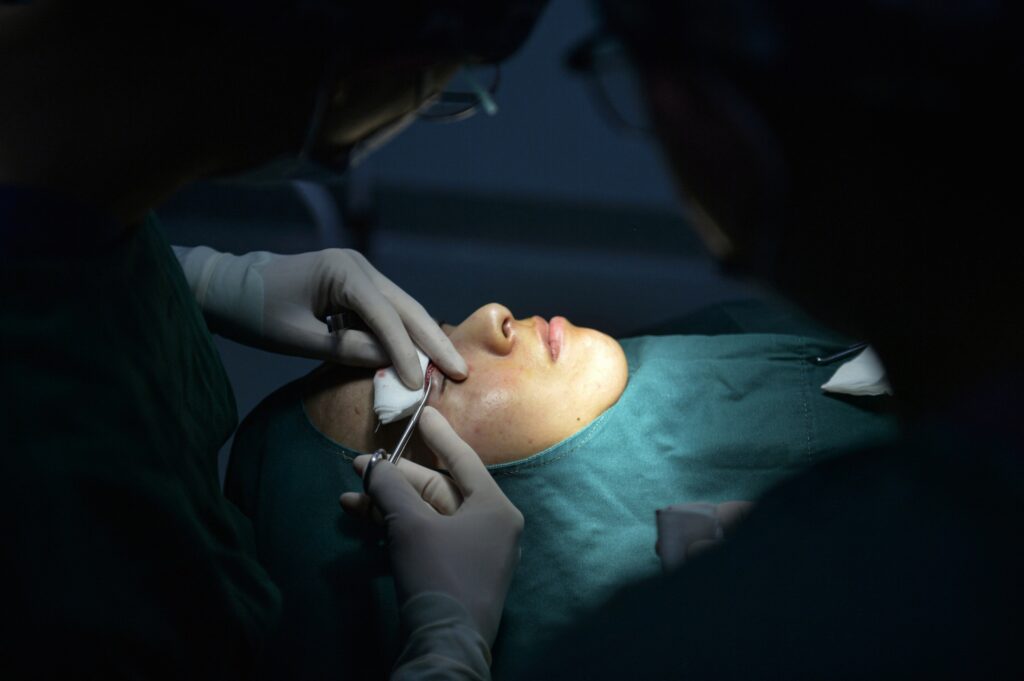
The surging interest is clear in downtown Shanghai. At a clinic called Maio overlooking the city’s historic Bund, nurses and patients filter in and out of VIP recovery rooms, operating theaters equipped with machines to suck out fat and a photography studio for before-and-after images.
Cao Wenhong, co-founder of the Royal Life Group that runs Maio and 11 other cosmetic clinics across China, attributed the rush to China’s “appearance economy.”
In other words, some people are nipping and tucking to “get more opportunities to have work or to have a date” in China’s uber-competitive society, Cao said.
The soaring demand is also clear on social media, both on mainstream Chinese platforms like WeChat and on specialized apps dedicated to cosmetic surgery content, such as So-Young and Gengmei (which means “more beautiful” in Chinese).
So-Young, which was founded in 2013 and now says it has revenue upward of $200 million, operates an app where users can search for doctors and chat with other injection enthusiasts. An artificial intelligence feature called the “Magic Mirror” scans users’ faces to find the proportions of their eyes, nose and lips. Then users can simulate how various cosmetic changes — grouped under categories such as “influencer face” or “high-class face” — would look on them.
A So-Young spokesperson said that the firm supports the government’s curbs on misleading advertising, adding that “So-Young does not believe there is a single ‘ideal’ face or ‘standard’ of beauty, and we do not encourage anyone to pursue unnecessary procedures.”
The industry has already come a long way in a little over a decade. In the early 2010s, it was a Wild West, said Lin, but the all-out government campaign to stop backroom surgeries and fake injections is already filtering down to clinics.
Amanda Yang, the co-founder of a new aesthetic center called Iduna just a few blocks down the Bund from Maio, said that “the government is now watching the aesthetic industry more” and is “very, very careful about” any industry related to medicine.
Before its planned opening in late January, Iduna had to complete many regulatory hurdles, including reams of paperwork, visits from various state agencies and a months-long process to receive a clinic license, said Yang.
But despite the government efforts, not everyone is convinced that all is hunky-dory now.
Meg Lu, 51, did her first cosmetic procedure in 2017 in her home city of Tianjin. Over the course of about a year, she underwent a series of treatments — including a minimally invasive facelift and injections — which left her face unnaturally tight and swollen and her chin hard and pointy.
The experience pushed her into years of deep distress, when she avoided going out in public. “I didn’t even look like myself back then. I couldn’t smile, and I didn’t dare look in the mirror,” she remembered. “I know a lot of people like this — I’m not even the worst one.”
She is skeptical that the industry’s persistent issues have been solved. “Things are getting better,” she said, but it’s “very, very difficult” to completely wipe out the dubious doctors and clinics.
A scan of a chatroom called “Plastic Surgery Failures,” hosted by Chinese search engine Baidu, vindicates Lu’s concerns. More than 50,000 posts, often including photos, describe makeover nightmares, such as an October post from a woman whose nose job left her with a dark indentation on her nose.
“It’s getting increasingly indented,” she wrote. “I’m starting to feel depressed.”
The proliferation of digital content about appearance modifications — like the apps that help people envisage their future faces — has led to concerns about unhealthy beauty standards, especially among younger generations.
About 60 percent of Chinese medical aesthetic consumers last year were between 26 and 35 years old, according to a joint report from Chinese tech firm Meituan and Roland Berger, a global consultancy.
Social media apps’ filters to blur out imperfections are not helping.
“When we are so used to these filtered images it’s hard for us to accept who we really are or what we really look like,” said Lu Yufan, an artist based in Tianjin who has been doing a photography project about China’s cosmetic surgery industry.
But not everyone agrees that cosmetic surgery leads to anxiety — in fact, some see it as a kind of female empowerment.
Susan, a 37-year-old cosmetic influencer in Hangzhou who spoke on the condition she be referred to by her first name only for privacy reasons, said that “more and more women are actually doing it for self-satisfaction.”
She first started seeking treatments after she was in a medical aesthetic advertisement around five years ago. Since then, she has done laser treatments, fillers and hyaluronic acid injections — which she sees as a kind of self-care ritual. She now creates content about the industry for her middle-aged female fan base on the Chinese version of TikTok and Xiaohongshu.
“Many people do cosmetic procedures just to be good to themselves, not for others,” she added.
There is also a beauty standard shift underfoot. While many clients used to try to change their appearance to match a specific celebrity or attain a Western ideal, clinic owners and experts say that Gen Z in particular is more accepting and confident in Chinese beauty, as well as individuality.
Cao, from Maio, cited the example of the double-eyelid surgery — which creates a crease in the upper eyelid more common in Caucasian people. Cao herself received the surgery as a young woman, but she is noticing decreasing demand for it. She is also seeing fewer customers coming into her clinics with a photo of an actress whom they want to resemble.
“Our sense of beauty has shifted — we used to lean toward Western ideals, but in the past two years, Chinese aesthetics have been increasingly embraced,” she said. “Chinese people are learning to respect and love their own culture.”
The post Amid botched procedures, China is cracking down on cosmetic surgery appeared first on Washington Post.