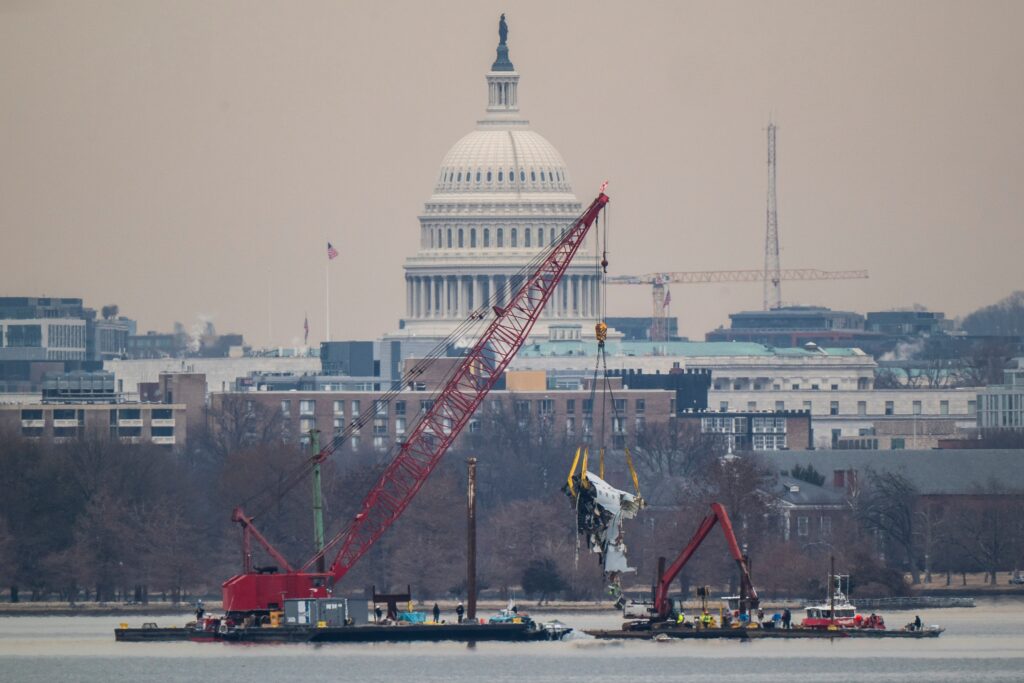
Nearly a year after 67 people were killed in a midair collision in the skies above the nation’s capital, all but the most critical helicopter flights near Reagan National Airport have been banned. The route the Army Black Hawk flew on the night of the collision has been permanently closed. And rules now bar helicopters and commercial jets from occupying the same airspace in certain areas near the airport.
In the control tower — where staffing on the night of the crash was “not normal,” according to a government report — updated procedures require that separate controllers manage passenger jets and helicopter traffic. There is technology in place to help controllers regulate the flow of aircraft to reduce last-minute conflicts. The Army is upgrading and installing advanced surveillance technology, known as ADS-B systems, throughout its Black Hawk fleet.
These and other changes have made the airspace safer, experts say. But the work to prevent a repeat of the deadly crash between the military helicopter and an American Airlines regional jet — the deadliest commercial aircraft accident in more than two decades — is far from complete.
“It is safer,” said Jeff Guzzetti, a former Federal Aviation Administration and National Transportation Safety Board investigator. “But the question should be: Is it safe enough?”
The accident on a clear evening on Jan. 29, 2025, exposed the risks created by the unique mix of military, civilian and law enforcement aircraft that have traversed the region’s skies for decades. A key question is why the FAA — despite repeated warnings from its own employees and data documenting at least 85 instances over three years of dangerously close brushes between helicopters and planes — failed to act on the information.
“Things worked because they worked, not because the processes were put in the place to ensure they worked,” said Michael McCormick, an associate professor at Embry-Riddle Aeronautical University who specializes in air traffic control. “And as things grew more complex, the risk grew.”
Clearing the air
This week the public will get a clearer picture of what further steps are needed when the National Transportation Safety Board releases the findings of its nearly year-long investigation into the crash. A separate review by the Army is expected about two months later.
Sen. Jerry Moran (R-Kansas) said he hopes the NTSB’s recommendations will provide a blueprint for changes that could make flying safer not just at National, but also at other airports around the country where helicopters and commercial aircraft operate in the same airspace. The crash affected Moran deeply. The regional jet had begun its journey in Wichita before it collided with the Army helicopter, which was on a training mission.
“This should not be a one-time effort at improving air safety,” he said, adding that bureaucracy that stymied change must be reduced and that investments must be made in technology and personnel to address shortcomings in the system. “We must be consistent and insistent so that this never happens again.”
The findings and recommendations also could lend new momentum to the Rotorcraft Operations Transparency and Oversight Reform Act (ROTOR), a bipartisan measure that would require that aircraft be equipped with and use technology that transmits their position to others operating in the same airspace. The Black Hawk helicopter involved in the collision was equipped with the technology but had a waiver that allowed it to operate without the technology switched on. ROTOR would close that loophole, undoing a provision inserted in a Pentagon funding bill passed in December that sought to restore some of those exemptions.
Since the crash, the FAA has taken a number of steps to reduce potential conflict between commercial aircraft landing at National Airport and helicopters run by more than 50 operators. It bolstered controller staffing and reduced hourly arrival rates for flights into National from 36 to 30. Last week, the agency also published an interim final rule that will permanently ban all nonessential helicopter traffic near National. Many of these changes were ones frontline employees had long pushed for.
“Since Secretary [Sean] Duffy took office, he and the FAA have taken decisive steps to correct past failures, strengthen accountability, and modernize the [national airspace system],” the agency said in a statement, adding that it will “diligently consider” any additional NTSB recommendations.
Citing the pending NTSB investigation, the Army has said it can’t discuss what steps it has taken since the crash to change how it operates in D.C. airspace, or how it’s maintaining its ability to perform a continuity-of-government mission under the new flight restrictions. But it has addressed some issues that have already been identified, such as securing funding to upgrade its ADS-B systems, which let aircraft determine their position via satellite navigation and broadcast their coordinates to air traffic control and other aircraft.
The Army is also prohibiting missions from the Pentagon’s helipad after an incident in May in which radar at the Pentagon lost visibility of an approaching Black Hawk. At the time, two approaching commercial airliners at National were forced to abort landings to avoid the military traffic.
The radar that lost contact had been moved due to renovations of the control tower at the Pentagon and has since been relocated to the Pentagon’s roof. The 12th Aviation Battalion has continued training for portions of the continuity-of-government mission but has suspended other parts due to the now-closed route and helipad access.
Remembrance and action
Some family members said they are approaching this week with a mixture of dread and hope.
On Wednesday, families will gather at a special event at DAR Constitution Hall in D.C. to remember those who perished and honor the first responders who took part in the recovery. The Army, which lost three of its own, will hold a separate private remembrance ceremony this week at Fort Belvoir for the 12th Aviation Battalion and the Army Aviation Brigade to mark the anniversary.
Doug Lane, who lost his wife, Christine, and his son Spencer, feared this week would be the worst. On the day of the accident, the pair were flying back from Wichita, where Spencer, 16, was taking part in a development camp for promising young skaters. But Lane said he is finding comfort in being around other families and participating in the week’s events, including Tuesday’s NTSB hearing and a memorial event for families and first responders.
Lane was also in the audience this past summer, when the independent safety board held three days of hearings about the tragedy. There, witnesses detailed how night vision goggles worn by the Black Hawk crew could have limited their view, making it more difficult for them to spot the regional jet, and data released by the NTSB investigators revealed that instruments on the helicopter gave inaccurate readings of the aircraft’s altitude. FAA controllers also detailed how efforts to raise an alarm about the volume of traffic at National were rebuffed.
“I feel like the more answers I get, the better I feel,” he said.
Ben Shtuhl, who lost his partner, Melissa Nicandri, is also finding solace in the bonds he has developed with other families.
“Just being able to have the family group that we can kind of spend this week together is really nice for me and is more reassuring now that we’re getting closer.”
Flight 5342 families have been a constant presence in the halls of Congress, where they have pressed for reforms that eventually made their way into the ROTOR Act. In December, when language inserted into the Pentagon funding measure sought to undo some of the postcrash changes, they quickly mobilized and warned that the provision could restore flying procedures that were in place before the crash.
But the measure has stalled in the House because of opposition from Rep. Sam Graves (R-Missouri), chair of the Transportation and Infrastructure Committee.
“Congress needs to get this right,” Graves said. “That means first getting all the information from the NTSB’s investigation and final report, reviewing those findings, and then considering the best way forward.”
In a letter sent last week to key Senate leaders, the bill’s sponsors — Sens. Ted Cruz (R-Texas), Maria Cantwell (D-Washington), Moran and Tammy Duckworth (D-Illinois) — asked to have it included in the fiscal 2026 Transportation, Housing and Urban Development appropriations package currently being negotiated.
Shtuhl and Lane hope that the NTSB hearing will provide more answers and accountability, particularly around the systemic issues and decisions made by the FAA, the Army and airlines that contributed to the accident.
The changes that have been made so far are “necessary, but not sufficient,” Shtuhl said. “I also worry about the temptation to just do the easy things and call it a win.”
For Guzzetti, the safety expert, one of the key issues to address is the volume of traffic at the airport. It has grown over the decades in part because Congress has the ability to add flights even though local officials and frontline controllers have long opposed such increases. Last September, Virginia’s senators, Democrats Mark R. Warner and Tim Kaine, called on Congress to reduce the number of flights at National following a report by The Washington Post that detailed serious safety risks tied to the volume of traffic at the airport.
“There’s too much airline traffic coming in and out of [National], and it was never designed for that,” Guzzetti said. “It’s a very small footprint, nestled in a very congested area. Enough is enough.”
In a statement, Kaine said he remains “extremely concerned” about the number of flights at National.
“This is some of the most complex and crowded airspace in the country, and every additional flight that is crammed into it stretches an already overburdened runway and air traffic control workforce,” he said adding that he will fight to ensure that legislative efforts that follow the NTSB and Army’s reports on the crash involve reducing the number of flights at DCA.
But that effort will probably be among the hardest to implement. The Post report detailed how frontline controllers repeatedly pressed their managers to reduce the number of arrivals at National, citing concerns about the volume of traffic at the airport. One such attempt — in 2023 — came as Congress was considering a plan to add additional flights, which controllers strongly opposed. FAA managers turned down their request. Though a specific reason was not given, one controller testified that his manager told him that “it was not a good time to address this.”
For local residents, for whom tragedy is a stark reminder of what happens when the system fails, the changes haven’t been enough to convince some that it’s safe to use National.
Caitlin Jacobs says she is surprised at how deeply affected she was even though she didn’t know anyone connected. She thinks of it during her commute on the Metro’s Yellow Line, where she can look down the Potomac River toward the crash site.
She admits she was never comfortable with the steep approach into the airport, and after the crash, she stopped flying out of National altogether. More changes are needed to make the airport safer, she said, and she worries that politics could get in the way.
“There are too many flights going in and out of there,” she said. “The system is overloaded. They need more air traffic controllers.”
The night of the crash, Kimberly Moore was on her way to National to pick up her sister when her cellphone rang. It was her sister calling to tell her she was being diverted to Dulles because there had been a midair collision.
“My heart ached,” Moore recalled. “I immediately thought of all the families.”
She now has a ritual when she flies into National: “I remember [the families] and pray for the 67 people who died.”
The post After the deadly DCA crash, some airspace rules have changed. Is it enough? appeared first on Washington Post.