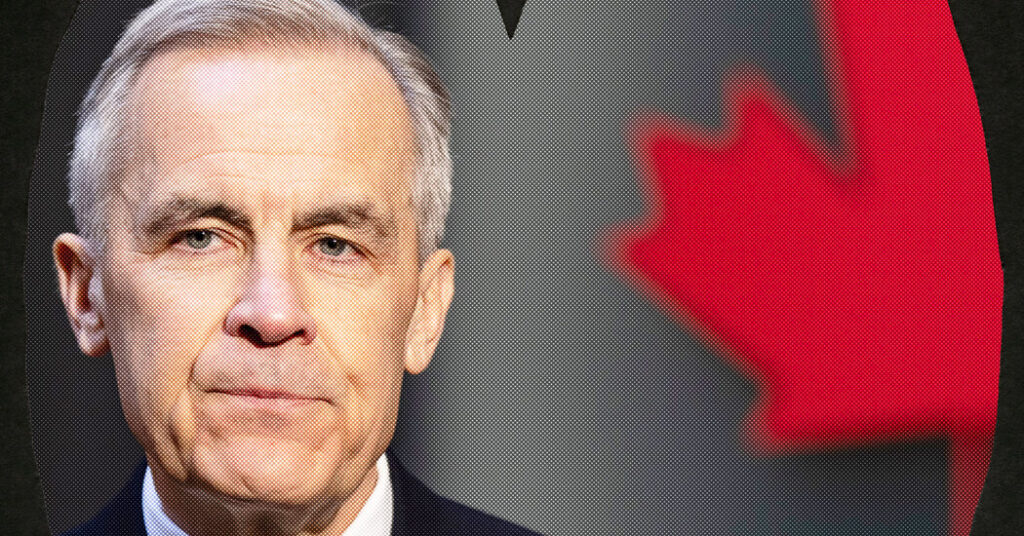
“Dear Prime Minister Carney,” President Trump wrote on Truth Social on Thursday. “Please let this Letter serve to represent that the Board of Peace is withdrawing its invitation to you regarding Canada’s joining, what will be, the most prestigious Board of Leaders ever assembled, at any time. Thank you for your attention to this matter!”
Everything Trump has done over the last week has made him look tawdry, addled and small. He began his latest play for Greenland by complaining about being passed over for the Nobel Peace Prize and ended it by disinviting Carney from his “Board of Peace.” For Trump, nothing — not even peace — transcends his brutish transactionalism.
Coolly assessing that transactionalism is what landed Carney in Trump’s sights. Two things stood out to me about the speech that Carney gave at Davos last week. First, Carney’s speech used the word “hegemon” four times. He said the word “America” only once, and then only to specify “American hegemony.” This is who we are now to our northern neighbors: Not the America they once knew, or thought they knew, but “the hegemon.”
Second, Carney invoked Vaclav Havel’s story of how communism perpetuated itself. In his essay “The Power of the Powerless,” Havel imagined a grocer who hangs a “Workers of the World, Unite!” sign in his window. Why does he do this, Havel asked? He does it because to do otherwise would invite ruin.
“Havel called this ‘living within a lie,’” said Carney. “The system’s power comes not from its truth but from everyone’s willingness to perform as if it were true. And its fragility comes from the same source: When even one person stops performing — when the greengrocer removes his sign — the illusion begins to crack.”
Carney sought, at Davos, to be that greengrocer; he sought, before the eyes of the world, to remove the sign. Carney spoke as Trump was threatening tariffs against Europe if Greenland was not delivered into American hands. That threat is now forestalled, but for how long?
Great powers, Carney said, are “using economic integration as weapons. Tariffs as leverage. Financial infrastructure as coercion. Supply chains as vulnerabilities to be exploited. You cannot ‘live within the lie’ of mutual benefit through integration when integration becomes the source of your subordination.”
As if to prove Carney’s point, Trump responded, during his own speech, with a Mafioso-style warning: “I watched your prime minister yesterday. He wasn’t so grateful. They should be grateful to us, Canada. Canada lives because of the United States. Remember that, Mark, the next time you make your statements.”
Sometimes, world leaders fall into conflict because they misunderstand each other. But Carney and Trump understand each other all too well.
It is hard to dispute Carney’s rendering of America under Trump. Early in Trump’s second term, I asked a number of his advisers to explain Trump’s theory of international relations to me. Every one said some version of the same thing: America has leverage it does not use. Under Trump, it is going to start using it.
This is perhaps Trump’s most fundamental belief about how the world works. “The best thing you can do is deal from strength, and leverage is the biggest strength you can have,” Trump wrote in “The Art of the Deal.” “Leverage is having something the other guy wants. Or better yet, needs. Or best of all, simply can’t do without.”
What is striking about Trumpism is how devoid it is of idealism of any kind. In this way, it betrays Havel’s framework. What Carney left out of his rendering of Havel’s argument is that, to Havel, some lies are stronger than others. Here is Havel, writing about what the imagined grocer is really saying when he hangs his “Workers of the World, Unite!” sign:
Verbally, it might be expressed this way: “I, the greengrocer XY, live here and I know what I must do. I behave in the manner expected of me. I can be depended upon and am beyond reproach. I am obedient and therefore I have the right to be left in peace.”
This message, of course, has an addressee: It is directed above, to the greengrocer’s superior, and at the same time it is a shield that protects the greengrocer from potential informers. The slogan’s real meaning, therefore, is rooted firmly in the greengrocer’s existence. It reflects his vital interests. But what are those vital interests?
Let us take note: If the greengrocer had been instructed to display the slogan “I am afraid and therefore unquestioningly obedient,” he would not be nearly as indifferent to its semantics, even though the statement would reflect the truth. The greengrocer would be embarrassed and ashamed to put such an unequivocal statement of his own degradation in the shop window, and quite naturally so, for he is a human being and thus has a sense of his own dignity. To overcome this complication, his expression of loyalty must take the form of a sign which, at least on its textual surface, indicates a level of disinterested conviction. It must allow the greengrocer to say, “What’s wrong with the workers of the world uniting?” Thus the sign helps the greengrocer to conceal from himself the low foundations of his obedience, at the same time concealing the low foundations of power. It hides them behind the facade of something high.
Trumpism does not hide behind the facade of something high. Part of Trump’s appeal is that he offers his venality as a thuggish honesty: This is what everyone is doing. I’m the only guy willing to admit it. Voters believe that politicians are corrupt. Trump proves them right by flaunting his own corruption; his success confirms their disgust with the system and the need for a champion who has mastered its rules.
This is both a lie and a weakness. It is a lie because Trump’s worldview is not universally shared. Relatively few people are as nakedly transactional or thoroughly corrupt as Trump. And it is a weakness because it creates a hunger for its opposite.
There is a reason Carney’s speech lit such a fire: Carney was, himself, taking a risk. He was, himself, acting against self-interest. He was, himself, showing that he intended to do something more with his power than profit off it. It was a bracing speech, but more than that, it was a brave act. It was the kind of act that Trumpism suggests does not exist, the kind of act that rebuts Trumpism by simply existing.
I am not saying this will go well or easily for Carney — or for other world leaders who choose to take down their signs. Trump is vengeful, and he is right that America can inflict terrible harm on any country it chooses.
But Carney is right that America’s power is, in part, dependent on the willingness of other countries to be entwined with our might. “Hegemons cannot continually monetize their relationships,” Carney warned, “Allies will diversify to hedge against uncertainty. They’ll buy insurance, increase options in order to rebuild sovereignty — sovereignty that was once grounded in rules, but will be increasingly anchored in the ability to withstand pressure.” This is the path Canada is already following, in part through seeking closer ties with China and Qatar.
The world is built on relationships, not leverage, and relationships are built on reciprocity and respect. It is not Trump’s genius to recognize America’s unused strength; it is his blindness to see that our strength was a function of our restraint.
The Times is committed to publishing a diversity of letters to the editor. We’d like to hear what you think about this or any of our articles. Here are some tips. And here’s our email: [email protected].
Follow the New York Times Opinion section on Facebook, Instagram, TikTok, Bluesky, WhatsApp and Threads.
The post Why the Carney Fire Is Still Burning appeared first on New York Times.


