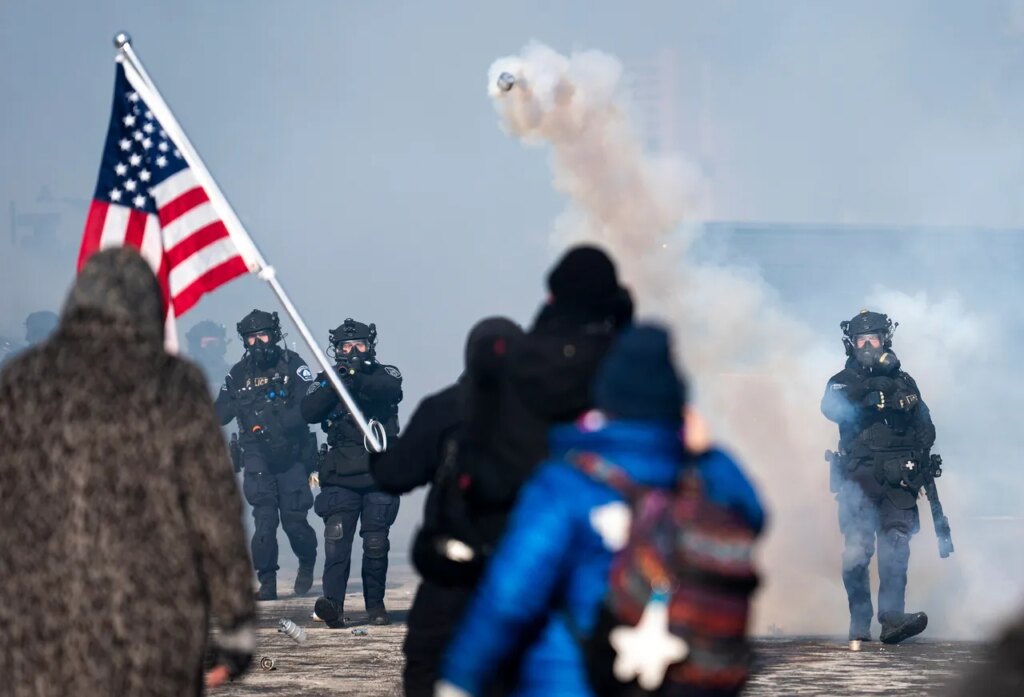
America has never seen a moment in modern history like the federal occupation of Minneapolis. Thousands of masked federal officers with uncertain authority are rampaging through the region, assaulting protesters and innocent people, abusing constitutional safeguards, staking out daycares and schools, snatching people off the streets in unmarked vans based on the color of their skin or their accent, and recklessly, relentlessly provoking violent confrontations with civilians—all against the loud, repeated expressed wishes of local and state officials.
Saturday morning, federal agents—apparently from the Border Patrol—shot and killed a 37-year-old nurse, Alex Pretti, amid a chaotic scuffle in front of a well-known Minneapolis donut store after agents began hassling and shoving him in the street. It was the second time this month that federal agents had resorted to deadly force within mere seconds after initiating an encounter with a Minneapolis civilian who never posed a threat to agents.
All of this unnecessary violence raises the question: Why can’t elected officials do more to stop ICE? Apart from the courts, doesn’t Minnesota’s government have cards it can play in the battle against the Trump-led occupation, like calling out the National Guard for a showdown with federal agents?
The answer, in its shortest form, is mostly no, due to the basic foundations of American federalism. Over and over, Minneapolis mayor Jacob Frey and Minnesota governor Tim Walz have asked President Donald Trump to call back his operation. On Saturday, they again told the public that they had pleaded with the federal government to reconsider and withdraw the upwards of 3,000 immigration officers, who together nearly outnumber the region’s 10 largest state and local police departments combined.
But Walz and Frey haven’t taken overt actions to use state and local governments to actively resist because a key part of federalism in the United States is that a state can’t really resist federal authority or kick out federal law enforcement officials. That principle primarily exists because the federal government is meant to be the “protector” of last resort if local and state officials fail to uphold the rights of ordinary citizens. What’s remarkable, and worrisome, is that Trump today is using that arrangement to punish political opponents based on his own whims, as un-American an action as any president has ever undertaken and one that threatens the very union of the United States.
Tension in Minnesota between the national and state and local elected officials is already sky high—and there’s rising animus between the federal forces and local law enforcement as well.
Minneapolis police were quick to condemn the shootings of both Pretti and Renee Nicole Good, who was shot and killed by an ICE agent on January 7. They have also been vocal in recent days about how their own officers have been harassed and even assaulted by immigration agents while off-duty. (“Every one of [the off-duty officers stopped by immigration agents] is a person of color,” one police chief complained.) DHS agents tried to bar local police from the shooting scene on Saturday, forcing them to return with a court order, and this time FBI agents again apparently resisted allowing access. “We’re in uncharted territory here,” the head of the state’s investigation bureau said.
A governor also has the state’s National Guard at their disposal, which could hypothetically be deployed to counter ICE’s actions. Yesterday, Minnesota governor Tim Walz announced that he activated them following the shooting, amid a tense series of hours that saw the NBA postpone its evening game in Minneapolis for safety reasons. In a statement whose banality and simplicity underplayed just how stunning it was, the governor’s office said the guard was needed because “local law enforcement resources are stretched thin because of the disruption to public safety caused by thousands of federal immigration agents in our neighborhoods.” So far it seems like Walz’s intent is to use the National Guard and local and state policy as more of a buffer between federal forces and Minnesota residents, rather than as a supplement to the street resistance efforts.
For now, state and local officials—like those who also suffered from heavy-handed immigration deployments last year, like Los Angeles, Chicago, and elsewhere—are primarily focused on using federal courts for relief. Overnight, a federal judge issued a temporary restraining order to ensure that federal officials didn’t destroy or alter evidence related to Saturday’s shooting. More broadly, Minnesota has a pending lawsuit aimed at blocking the immigration deployments altogether.
This restraint is almost certainly intended to prevent even further escalation, driven by President Trump’s apparent eagerness to declare Minnesota in a state of “insurrection” that would allow him to activate and deploy federal troops against its residents. Trump has already launched unprecedented criminal investigations against Walz and Frey, and others, in an apparent bid to create pretexts that could aid the use of the Insurrection Act.
The situation is so unprecedented—and the Trump administration’s political incentives so skewed by social media and the president’s own manias—that it’s impossible to understand or predict how the coming days and weeks might unfold. It’s especially unclear how state or local elected leaders might make the situation better for their constituents and neighbors—and, because of the Trump administration’s lawlessness, there are many paths where the situation worsens.
President Trump and his Department of Homeland Security in many ways appear to be attempting to provoke an actual showdown between federal forces and local or state authorities. DHS and White House officials have repeatedly labeled protesters exercising their First Amendment rights in Minnesota “domestic terrorists” and were quick to smear the victim of Saturday’s shooting; they shut down an investigation of the ICE officer who killed Renee Nicole Good earlier this month and ordered a federal investigation of Good and her spouse instead, leading to the resignation of the FBI agent assigned to the case; at least six federal prosecutors also resigned, refusing to participate in the attempt to scapegoat a victim.
In a deeply troubling development, ICE agents have started declaring that people who so much as record them are being entered into a national database as “domestic terrorists.” “Have fun with that,” an ICE officer in Maine was captured joking to a civilian filming him. (That the assault on Minneapolis has little to do with violent crime or immigration issues was underscored Saturday when attorney general Pam Bondi sent state officials a letter saying they’d withdraw the federal forces if Minnesota complied with a Trump request to turn over its voter rolls.)
While Walz and Frey’s seeming passivity in the face of an all-out federal attack on their constituents is provoking anger among activists, it may be a case where caution and restraint is the better part of valor. Citizens are already generating massive resistance to the federal presence in Minnesota, and any additional “official” resistance by local or state officials may tip the scales for Trump and bring federal troops into the picture, an escalation that would be surely worse for residents, the state, and the nation at large. Trump has already put some 1,500 federal troops in Alaska on standby to deploy to Minnesota and all indications are that he’s eager for an excuse to do so.
Any such declaration of “insurrection” or deployment of federal troops to further subdue local and state authorities would bring the country the closest it’s been to civil war since, well, the actual Civil War.
A Brief History of the Sending in the Troops
Under normal circumstances, the use of federal military forces in domestic situations is highly proscribed and limited by two sets of law, the Posse Comitatus Act of 1878—which prohibits the use of the military in civilian law enforcement—and the Insurrection Act, a series of statutes that date to 1792 and outline when a president can call out troops to suppress rebellions and domestic violence.
Considering how critical a principle it guards, the Insurrection Act is badly antiquated, as recent reform efforts have shown. As national security legal scholar Scott Anderson wrote in 2024, “Few principles of American government are more foundational than the idea that the US military should not be used against Americans, except in the most dire of circumstances. But even fewer foundational principles are so loosely grounded in the law … The fact that past presidents have done so relatively rarely is more a product of longstanding political norms than hard legal limits.”
While state National Guard units and federal troops are routinely used to help respond to natural disasters at the request of and in coordination with local and state officials, since Reconstruction presidents have only reluctantly ever sent in federal agents or troops against the wishes of state governments. Even then, it’s in highly limited circumstances, such as defending civil rights and freedoms in moments when state officials refused to do so. (National Guard units usually report to state governors, although they can be federalized by presidential order to report to the commander-in-chief instead—meaning that Trump could always circumvent Walz activating them by putting them under direct Pentagon control anyway.)
In fact, while National Guard troops were used repeatedly in the 20th century by governors and presidents to break labor strikes—often brutally—it wasn’t until the Civil Rights movement and the 1960s that federal troops began to play a more routine role in responding to civil disturbances.
In 1957, when Arkansas governor Orval Faubus used the state’s National Guard to block the integration of Little Rock Central High School, President Dwight Eisenhower responded by federalizing all 10,000 Arkansas National Guardsmen and deploying troops from the 101st Airborne Division to force the school’s integration and protect the nine Black students attempting to enroll there. The mission was a key learning opportunity for the military, and when the Army manual on “Civil Disturbances” was republished in 1958, it had doubled in size and now contained a new section on riot control.
In every year of his short presidency, President John F. Kennedy deployed federal marshals or troops against the wishes of state officials as the civil rights movement gained momentum. In 1961, some 400 federal marshals were sent to Alabama to protect the Freedom Riders, and when James Meredith attempted to enroll as the first Black student at the University of Mississippi in 1962, Kennedy sent federal marshals who then faced incredibly violent white protesters.
With the marshals under attack, Kennedy deployed first the Mississippi National Guard and then thousands of federal troops as well. (That military operation, codenamed RAPID ROAD, was actually the first and only time during the Cold War that the military activated and used plans it had developed to quell civil disturbances in the wake of a nuclear attack.)
Then, in 1963, Kennedy again relied on the National Guard to help with the integration of the University of Alabama, and his successor, Lyndon Johnson, used marshals and the National Guard to protect civil rights marchers in Selma after Alabama state troopers infamously attacked them at the Edmund Pettus Bridge in an incident that came to be known as “Bloody Sunday.”
Presidents began using military troops, including the National Guard, more routinely in America’s cities in the 1960s. During summer riots following police brutality in Detroit in 1967, President Johnson ordered elements of the 82nd and 101st Airborne Divisions into the city and Michigan governor George Romney called up the Michigan National Guard; more than 40 people were killed, more than half by Detroit police. National Guard troops killed 11, including a four-year-old girl, Tanya Blanding, who died when a Michigan guardsman opened fire with a tank-mounted .50-caliber machine gun on her apartment after wrongly believing a sniper was inside.
While troops were used again amid the 1968 riots that followed the assassination of Martin Luther King, Jr., the downside and risk of such deployments was vividly captured two years later at Kent State University when National Guard troops opened fire on students protesting the Vietnam War, killing four and wounding nine.
Over the years since there has been incredibly limited domestic use of federal troops—the Los Angeles riots of 1992 being one exception—and presidents and attorneys general until the Trump administration usually go out of their way to coordinate surges of federal law enforcement to cities or states.
Even during the peak of the marshals and troop deployments to the South amid the civil rights movement, presidents only acted after state officials either refused to quell violence targeting Americans practicing their constitutional rights or, in the case of the Alabama state troopers, were the cause of the violence against peaceful citizens themselves. Often, a president acted only after there was defiance on the ground of a lawful court order—ensuring that there was a second branch of government acting as a check-and-balance and trigger for such federal action.
While Trump has said that the immigration enforcement effort in Minneapolis—as with previous efforts in Los Angeles, Washington, DC, Chicago, Charlotte, Portland and, most recently, Maine—is meant to enforce “law and order,” there’s no apparent rhyme, reason, or necessity to deployments beyond political terror.
Trump today is attempting something unprecedented that stands in contravention of all historical tradition in the United States: the brutal application of federal forces against a state and region with no apparent reason beyond it being led by members of the political opposition.
“Few principles of American government are more foundational than the idea that the US military should not be used against Americans, except in the most dire of circumstances.”
In deploying immigration officers and border security agents from DHS, rather than deputy US marshals from the Department of Justice—as presidents in the past have done—Trump is also changing the nature and tenor of his federal force. Marshals, whose work and training involves constitutional rights and protections, have always been used to protect civil rights and valid court orders and come with strong federal policing powers and authorities. The agents from Customs and Border Protection (CBP) and Immigration and Customs Enforcement (ICE) are different. They are not trained to normal federal law enforcement standards of dealing with the public and are meant to operate with severely limited authority to enforce immigration matters, not general federal laws. CBP agents in particular are less a regular law enforcement agency, grounded in due process, and more a paramilitary force meant to operate on the border regions. They were never intended to have regular contact with US citizens and civilians.
Trump has also attempted to use troops in similar crackdowns over the last year and been stymied by federal courts, who, among other instances, preliminarily blocked his federalization of the California National Guard.
Invoking the Insurrection Act might give Trump cover to circumvent such restrictions.
Today, the Insurrection Act has three potential triggers: one in cooperation with state officials and two against the wishes of state officials. Trump, DHS, and the Justice Department appear to be attempting to artificially manufacture some combination of actions that would allow them to declare Minnesota as representing “unlawful obstructions, combinations, or assemblages, or rebellion” or beset by “insurrection, domestic violence, unlawful combination, or conspiracy” that “so hinders the execution of the laws” that federal military reinforcements are necessary.
If Walz, Frey, and other state officials seem reluctant to do anything other than use words to oppose Trump, it’s surely because they’re wary of what unrest and conflict would come from giving Trump any excuse to declare an “insurrection”—and the precedent any court battle over the vague words of the Insurrection Act might end up creating.
As one reform effort recently concluded, “Under the Insurrection Act, a president’s authority to deploy US troops turns on terms—including unlawful ‘combinations,’ ‘obstructions,’ and ‘assemblages’—that lack settled contemporary meaning.”
In the meantime, even as ICE and CBP’s trail of violence continues, the residents of Minneapolis might find that they’re on their own to face the full weight of Trump’s masked secret police. But the spreading and growing resistance to the Trump administration shows that the protesters of Minnesota are hardly alone nationally. Their courage in the face of the federal assault is contagious. Hours after the shooting Saturday in Minneapolis, at a vigil and protest rally in Boston, a crowd assembled in chilly temperatures ahead of a historic weekend storm and chanted, “We’re not cold, we’re not afraid, Minny taught us to be brave!”
Let us know what you think about this article. Submit a letter to the editor at [email protected].
The post Why Minnesota Can’t Do More to Stop ICE appeared first on Wired.