Donald Trump’s most profound break with American democracy, evident in his words and actions alike, is his view that the state’s relationship with its citizens is defined not by ideals or rules but rather by expressions of power, at the personal direction of the president. That has been clear enough for years, but I had not truly seen what it looked like in person until I arrived in Minneapolis, my hometown, to witness what Trump’s Department of Homeland Security called Operation Metro Surge.
On Jan. 14, at 7:44 p.m., eight hours after I got to town, the City of Minneapolis’s official X account announced that there were “reports of a shooting involving federal law enforcement in North Minneapolis.” “Federal law enforcement,” as everyone by then knew, meant one of the 3,000 immigration agents fanned out across the metropolitan area, which Minneapolitans invariably called “ICE”: Immigration and Customs Enforcement, the agency at the vanguard of the surge.
They had been there since December, ostensibly in relation to a fraud investigation that fell well out of their departmental purview and settled instead for what appeared outwardly as a more indiscriminate pursuit of potential immigration violations. The Minneapolis metro area is not big: Hennepin and Ramsey Counties — home to the Twin Cities of Minneapolis and St. Paul, respectively, and many of their suburbs — are together less than one-fifth the size of Los Angeles County, the target of the administration’s first such immigration crackdown last year.
It is also home to a population of urban progressives who had thrown themselves into the task of tracking federal agents. The city had become a giant eyeball, every exercised citizen’s smartphone a sort of retinal photoreceptor for the optic nerve of neighborhood channels on the encrypted messaging app Signal, scanning public spaces for signs of ICE.
In the heightened atmosphere of the moment, the lines between documentation and confrontation had grown blurry. ICE officers, when they stuck around anywhere for more than a few minutes, were likely to be met by not just one or two camera-wielding observers but many, and observation inevitably turned into protest. The latent combustibility of these encounters was visible in the footage that bystanders had captured of an ICE agent, Jonathan Ross, fatally shooting a resident, Renee Good, in her car on a snowy street in South Minneapolis on Jan. 7. That combustibility would be visible again in the fatal shooting on Jan. 24 of Alex Jeffrey Pretti, a 37-year-old V.A. hospital registered nurse, by Border Patrol agents.
Shock over the violence of the deployment quickly gave way to redoubled anger. Within minutes of the city’s X post on Jan. 14, a crowd of perhaps a hundred people from all over the metro area had assembled at the location, in the Hawthorne neighborhood on Minneapolis’s north side, where, according to an F.B.I. agent’s affidavit, an ICE agent had shot an undocumented immigrant in the leg after being attacked with a broom during an arrest. When I arrived, several blocks were cordoned off with crime-scene tape, and milling around in the darkness beyond it were federal agents in balaclavas and tactical gear, most of them identified by their patches as members of ICE’s Enforcement and Removal Operations unit.
The agents, in their masks and military-style kit, suggested a fierce omnipotence, but ICE and the other agencies have just as often been visibly unprepared to handle the policing situations their presence created in the city — or even the weather. Across the intersection, an agent slipped on the icy pavement and then fled, leaving an unsecured magazine full of live ammunition on the street, to the jeers of the crowd. Nearer to where I stood, an unmarked black Jeep Grand Cherokee was struggling to get clear of the crowd, escorted by a few officers on foot. “Get out of my [expletive] street!” someone yelled.
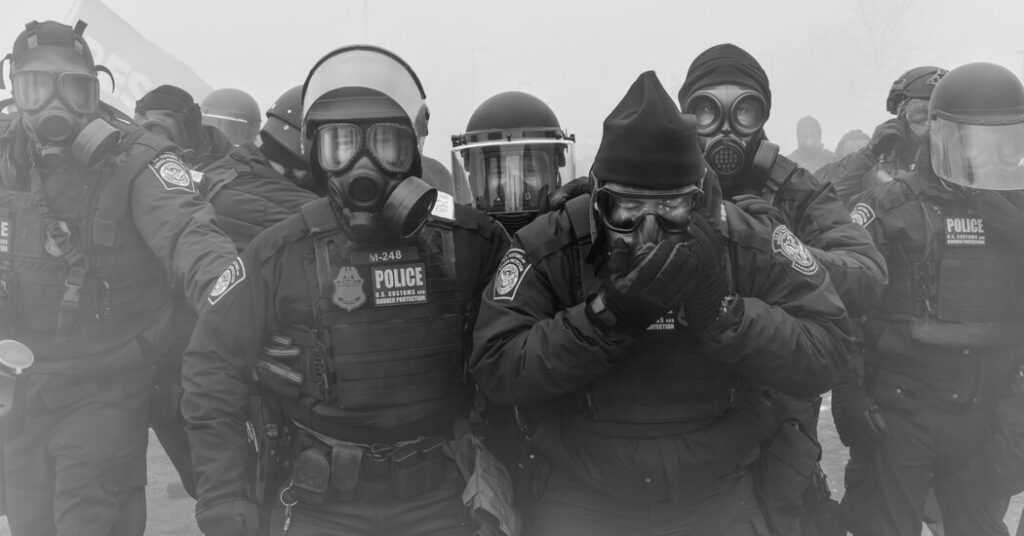
A woman in a fur-ruffed parka swung a plastic post at the rear windshield of the vehicle, which shattered with a dull crunch. It was not long before the air was alive with smoke grenades and sting balls and thick with tear gas. Faces peered out of second-floor windows along what had been, less than an hour earlier, a quiet residential street. “You killed Renee Good!” a man bellowed.
The atmosphere was strange and unstable for a street protest, missing some important steps of the usual choreography, and it took me a moment to realize why: I saw no police officers. I had passed a Minneapolis Police Department cruiser parked some distance down the street, but here, where the agents were clashing with the crowd, they were nowhere to be seen. The federal agents themselves looked more like a platoon of soldiers navigating a hostile foreign capital than conventional law enforcement in an American city.
For weeks, these agents had been actors in a kind of theater of power, meting out various forms of state force and violence, framed by the smartphone cameras they carried, providing a steady stream of content for the Trump administration’s various social media platforms. What was clear in person, seeing the scene outside of the frame, were the limits of this performance of power. The agents had no capacity to maintain order or much apparent interest in doing so. Their presence was a vector of chaos, and controlling it was not in their job description. All that was holding the crowd back, as far as I could tell, was the knowledge that an officer like these shot a woman a week earlier and that another shot a man up the street an hour ago. I left the scene that night certain it would happen again.
‘Take Out That Phone and Hit Record’
Tim Walz, Minnesota’s embattled governor, appeared live on camera from his official residence on the night of the second shooting and clash. He described the federal deployment to his state as an “occupation” and “a campaign of organized brutality against the people of Minnesota by our own federal government.”
In his remarks, Walz implicitly affirmed what has been widely understood in America since at least the civil-rights-era confrontations over integration in the South, which is that the tools state governors have to formally resist the imposition of federal power in real time are extraordinarily limited. What Minnesota and every other state did have, though, was plenty of personal electronics. “Carry your phone with you at all times,” Walz advised the state’s residents. “And if you see ICE in your neighborhood, take out that phone and hit record.” The aim, he said, was to “create a database of the atrocities against Minnesotans — not just to establish a record for posterity, but to bank evidence for future prosecution.”
This sort of citizen surveillance of federal agents is a tactic that had spread widely — often with the support of Democratic officials like Walz — along with the immigration raids themselves, refined over the course of previous operations in Los Angeles and especially Chicago. As Walz suggested, it served a kind of double purpose: capturing evidence and also capturing the narrative, showing the world what Trump’s immigration crackdown looked like in practice.
Because of Minneapolis’s small size, the sledgehammer scale of the deployment and the extreme contempt that Minneapolitans had for it, ICE-watching had attained a manic intensity in some neighborhoods of the city, which became an exacerbating factor in the fog-of-war confusion and paranoia the raids brought to town.
One afternoon, I was idling in my rental car in the parking lot of a gas station where my friends used to buy cigarettes in high school when I heard a shrill chorus of whistles behind me — Minneapolitans, like Chicagoans last year, had distributed them widely and blew them en masse to alert people to ICE’s whereabouts. I got out to look around, only to see that the whistlers were pointing at me. It was the third time I had been mistaken for an ICE agent in the space of a week.
On the ICE-watchers’ heels was a pack of journalists, many of whom I knew from the expanding media circuit of the great American unraveling: militia rallies, Trump court appearances, protests against immigration raids in other cities. I reached out to shake the hand of a celebrated war photographer, but he retracted it, holding up his palms apologetically: “Mace,” he said.
They had just come from a clash in a nearby park between locals and Gregory Bovino, the camera-mugging senior Border Patrol official, who had been on the scene in Minneapolis personally for weeks, ducking in and out of the action, often dressed in a military-style greatcoat that invited, and received, Gestapo comparisons. Someone pulled out a phone to show me a video of Bovino minutes earlier, personally lobbing a green-smoke grenade at some protesters, with the jocular informality of a backyard barbecue host tossing a tallboy to a newly arrived neighbor. As they left, once again a federal agent dropped a magazine of live ammunition in the street. Officers from Bovino’s agency would shoot and kill Pretti less than a mile away three days later.
What was striking, and not a little chilling, when you watched videos like this as well as their public digestion on various social media platforms, was that they did not differ dramatically from the videos that the Trump administration disseminated itself. Nor did people on either side of the country’s chasmic ideological divide seem to disagree all that much about what they were seeing in the images of immigrants being marched away from their cars in subzero temperatures and demonstrators pepper-sprayed at point-blank range. These were pictures of the state deploying violence confidently and with open disinterest for the niceties of process or protocol — the expression of power as an end to itself. To some, it was horrifying; to others, it was exhilarating. To many city residents I talked to, the message of it all was clear enough: Nobody could help them. They were on their own.
“I’ve been telling people, if you want to really be prepared for stuff like this that’s going on in Minneapolis right now, you need to know your neighbors,” Steve Gagner, a resident, told me the day after Walz’s address. We were sitting at a coffee shop not far from Gagner’s house in South Minneapolis, an area that had become the heart of the local resistance to the federal deployment. The shop’s owner was running around directing pickups and drop-offs of boxed groceries and household necessities stacked by the door: donations for the thousands of immigrant families, undocumented and otherwise, that were known to be hiding out in their homes across the metro area for fear of arrest.
South Minneapolis might be thought of, in coastal terms, as roughly comparable to Brooklyn’s Prospect Heights or Los Angeles’s Echo Park: a historically diverse (by Minneapolis standards) and working-class area that was now the gravitational center of the city’s college-educated, progressive professional cohort, a neighborhood of social workers and graphic designers. Gagner, a longhaired 41-year-old who grew up in the suburbs, now lives in the city with two children and twice as many jobs: carpentry and handyman work, animation and jewelry design. He had made the earrings he was wearing, in the image of the Minnesota state flag, which had taken on an unexpected valence in recent weeks as a banner of defiance.
South Minneapolis was also where George Floyd was murdered by a police officer in 2020. At the time, Gagner lived five blocks from the Third Precinct police station, where the officer, Derek Chauvin, was assigned; the first group of demonstrators had marched past Gagner’s house on the way to the station. “We were actually out there, clapping,” he said. Half an hour later, tear gas began wafting into the open windows. “And then,” he said, “everything erupted.”
The protests and rioting that followed Floyd’s death in Minneapolis, in which the Third Precinct building and a number of local businesses were burned down, were often depicted in the national media as occurring along racial lines, which was not quite right. They raged most furiously in largely white South Minneapolis, not the historically Black north-side neighborhoods like Hawthorne. Gagner had supported the protests and was highly critical of the Police Department, but he also did not particularly want his house to burn down.
He and others in nearby neighborhoods had formed ad hoc community-watch groups during the first days of the upheaval, and much of this informal infrastructure had been revived amid the current crisis. “I’ve seen a lot of the same people that stepped up before stepping right back into those roles,” Gagner said, though now people were using encrypted communications or staying offline entirely. “It’s also very different because this is” — his voice dropped to an incredulous whisper — “this is the government.”
Although the work they were doing was, in the current climate, clearly political, it felt strange to describe Gagner or anyone else I met who was involved in the rudimentary activities of the resistance as activists; most of their activities would, in any other circumstances, have seemed like the most uncontroversial kind of civic participation. Since the early days of the standoff, many people across the Twin Cities and their suburbs had joined neighborhood-level efforts, organized through Signal chats, to track the federal agents and had stood watch around locations — schools, apartment buildings, local businesses — they believed were particularly vulnerable.
But by mid-January, many of the people I talked to in South Minneapolis had decided it was more useful to focus on the targets of the raids, giving immigrant families’ children rides to school — federal agents in Minnesota and other states had been arresting parents during drop-offs and pickups — and delivering supplies to those who were afraid to leave their homes.
This work had become a point of contact between the area’s white progressives and Latino community institutions — in particular Dios Habla Hoy, a nondenominational evangelical church with a mostly Latino congregation, which had become a local hub of food deliveries. Since the federal raids began, the church’s Mexican American pastor, Sergio Amezcua, had emerged as a voice of defiance in the media. He was also a self-described conservative who voted for Trump in 2024.
Amezcua, who also owns insurance agencies, said that many Latino businesspeople he knew in Minneapolis had been supportive of Trump until the immigration crackdown. “A lot of our businesses were like, ‘I think Trump is the answer,’” he told me. “Believe me, 100 percent of them regret it.” (He said he did.)
Other response efforts were coordinated through parent-teacher organizations, particularly those of schools with large populations of Latino students. The school-based organizing, like the ICE-watching tactics, was a strategy imported from community networks in Chicago, where parents last year mobilized around so-called sanctuary schools. Particularly for parents of elementary-school-age children, who found themselves suddenly having to explain why parents were standing guard against federal agents around the school property and why their Latino classmates were staying home, their latent politics had been supercharged by a very parental mix of fear and fury.
A mother at another school in South Minneapolis, who asked to remain anonymous to avoid drawing further attention to the school, described coming upon ICE agents detaining the driver of a car, then taking him away along with the keys. Looking in the abandoned vehicle, she saw a woman in the front seat and a small child huddled in the back seat. “They just — take off,” she said, and she started sobbing. “They just walk away. They don’t care. It’s like — we’re all people.”
I asked her how she discussed what was happening with her own children. “We’re lying to them all the time,” she said. “‘You are not in danger.’ I don’t think they are, but we can’t guarantee that. Because they” — ICE — “are not following the rules. We’re white, but who knows? You look at them wrong, and they’re going to smash your window.”
‘Don’t Turn On the Lights’
One afternoon later that week, I drove out to a nondescript lower-income apartment complex in a Minneapolis suburb. A man in his 30s let me into the building and led the way up to an apartment on the third floor, then closed the door behind us.
The apartment was small, and it felt smaller with the windows covered. The man and his wife, both of whom asked not to be identified out of fear of arrest, had tacked up a blanket over one window and a floral-print sheet over the other, illuminated by the wan winter light outside. Their young daughters would try to peek out, but the parents would shoo them away from the windows. If anyone pulled back the sheet, they warned the girls, drones could see inside.
The man left the apartment only for the most furtive missions: to take out the trash, to move the car when snowplows came to clear the parking lot. It took him a moment to recall when he had last ventured farther than that. It was November, he thought. That was around the time that “the school,” he said, “let us know that the raids were happening.”
The building was home to a number of immigrants like the man, who said he came with his wife and their daughters several years ago from Ecuador. He said they had petitioned for asylum at the border. This was a legal process under which an increasing number of people had been admitted during the Biden administration. Some asylum applicants cited highly specific threats to their lives. Others made much broader claims, like this man, who said he and his family had come to the United States because of prejudice against the country’s Indigenous people and the escalating violence in the capital, Quito, where they lived. Peaceful as recently as six years ago, it had since become a battleground in a proxy war between Mexican drug cartels vying for control of Pacific-coast smuggling routes.
The family’s claim was still in process, the man said. In the meantime, he said he had been given a work permit and a Social Security number. In the summer, he cut lawns; in the winter, he cleared snow. But an administrator at his daughters’ school had warned him that he should be careful about working outside. He began watching the street from inside the apartment.
He noticed large S.U.V.s, Chevy Suburbans with tinted windows, idling outside the apartment complex for a few hours at a stretch. He took a picture of one of them and sent it to someone at the school. “They told us: ‘They’re ICE. Be careful,’” he said. “‘Cover the windows. Don’t turn on the lights. Don’t go out shopping. If you need anything, ask.’” That was nearly two months ago.
It had taken a week or two, after the man stopped going to work and everyone stopped leaving the apartment, for the food to run out. After days of eating only potatoes, the family appealed for help to their church. Soon volunteers began dropping off essentials in cardboard boxes.
At first the family kept the girls home from school. But after the school warned that such absences could result in legal action, the girls resumed going every other day, escorted by a teacher or an administrator.
The girls asked why they couldn’t otherwise leave the apartment, why they couldn’t buy food themselves, why they couldn’t look out the windows, and the man tried to figure out what to tell them. “I have told them that there are people out there looking for criminals,” he said. Like most of the immigrants I met in Minnesota and elsewhere who had been affected by the immigration raids or were living in fear of them, he had supported the idea of rounding up violent criminals in the United States illegally when Trump first spoke of it. And he assured his daughters that he was not a criminal himself. “But we’re not from this country,” he would tell them, he said, “and we have to be careful. Because they’re taking everybody.”
Although his wife couldn’t bring herself to mention it to the girls, lately the man had started trying to talk to them about what would happen if their parents were arrested. This was difficult in part because he himself did not know what would happen. When it became clear that the federal agents sweeping the city had no plan for the children the raids left behind, school staff members started quietly urging immigrant parents to sign a delegation of parental authority form, which would give someone else the power to make decisions over their children — a limited form of custody. But who could the man even ask to take on such a responsibility? His family’s relatives in Minnesota were all in the same position as he was.
His own closest encounter with ICE agents, he said, happened when he was moving the car and found himself at an intersection opposite a pair of large S.U.V.s with tinted windows. He sent his wife a voice message and then shrank into the seat, praying to God to make him invisible.
I asked the man how he knew the drivers at the intersection were ICE agents. “They were in two of those big trucks — the really big new ones that are driving around,” he said. Were they wearing masks? He didn’t know.
At some point, the paranoia in Minneapolis had created its own reality. The furtiveness and randomness of the documented raids was very real, but now half of Minneapolis and an ever-expanding press corps were driving around looking for federal agents, too, prowling streets and parking lots in ways that resembled the agents themselves, creating their own layers of rumor and confusion.
When I had first pulled into the apartment building’s parking lot, I saw an S.U.V. idling by the entrance, an iPhone visible against the windshield, filming me. When I got out and held up my press credential, the window rolled down to reveal two smiling white women who were out delivering food to people like the family in the apartment. “Sorry!” one of them said brightly.
Leaving the building an hour later, I saw two more large S.U.V.s slowly circling the lot. Were they ICE agents? Were they people watching for ICE agents? Who knew? Earlier that day, outside a church that was distributing aid, I overheard a young man on his phone reporting a “confirmed ICE” vehicle. I looked around for it, until I realized he was reading off the license plate from my rental car.
‘The Somalis Have Taken Over Your Neighborhoods!’
When Trump, hours after returning to the presidency last year, pardoned the participants in the Jan. 6 riot at the U.S. Capitol, one beneficiary was Edward Jacob Lang, a 30-year-old from upstate New York who had spent several years in jail awaiting trial on 11 charges for, among other things, attacking a Capitol Police officer with a metal baseball bat. Lang, who goes by Jake, had parlayed his incarceration into a brand as a sort of political prisoner-influencer, though he did not seem to actually have much of a profile on the right; two years ago, I stopped by a protest on his behalf outside the Metropolitan Detention Center in Brooklyn, where he was being held, and found it attended by fewer than 10 supporters. The people who most fervently followed him and his stunts — claiming to form a militia from inside jail, throwing Nazi salutes outside the AIPAC headquarters — seemed to be gullible and easily outraged liberals, along with the more shamelessly click-baiting reporters whose content they consumed.
As tensions in Minneapolis escalated, Lang announced he would be coming to town to lead a “CRUSADER MARCH on ‘Little Somalia,’” with the aim of burning a Quran outside Minneapolis City Hall on Jan. 17. The main, if unintended, effect of Lang’s announcement, besides stirring up the people who could be counted on to react to it, was to call attention to just how far Trump’s crackdown had drifted from its stated intentions. Trump initially said federal agents were coming to town in relation to the federal investigation of a several-billion-dollar fraud scandal involving the state’s social services, which had produced indictments of nearly 80 people, most of them members of the state’s Somali community — the largest Somali diaspora population in the country, much of it refugees who settled in Minnesota in the 1990s.
Trump, who had vowed to stop refugee flows to Minnesota during his 2016 campaign, had ranted against Somalis in December, calling them “garbage” in a cabinet meeting. But a majority of Minnesotan Somalis have U.S. citizenship, and by the time Lang came to town, the agents’ attention seemed to have largely shifted; the few arrests that D.H.S. publicly announced appeared to be mostly Latinos and Hmong immigrants.
“The Somalis have taken over your neighborhoods!” Lang shouted into a microphone as he marched through downtown. He was clad in a tactical vest that made him resemble the city’s new diaspora population of ICE agents; as right-wing influencers and law enforcement have embraced similar paramilitary gear and content-creation strategies, the lines that might have once distinguished them visually have grown sketchier. “These people are animals. Look at them! Look at them! Immigrant scum!”
When he got to City Hall, a crowd of perhaps several hundred counterprotesters was waiting for him. They leaned toward the most reliably bait-taking segments of the left-liberal spectrum, from the itinerant leftists leading chants for unrelated causes — “Free Palestine!” — with their own megaphones to older suburbanites holding up signs that read “LOVE ALWAYS WINS.” The South Minneapolis types I had been talking to throughout the week had been urging nonattendance.
I had wondered what a clash between whichever constituency Lang managed to mobilize — it was about 10 people — and an increasingly infuriated population would look like in a city where local law enforcement had been barely visible for days. Making my way through the crowd, I found Lang holed up in the well of a ground-floor window of City Hall along with a few others, gamely enduring the attacks of the crowd: an endless barrage of insults, a squirt gun that lashed him with gouts of freezing cold water and water balloons.
This was a move pioneered during Trump’s first term by more-enterprising right-wing influencers who, with video rolling, would place themselves in the path of particularly knuckle-headed anarchists in cities like Portland, Ore., and lean into their beatings with the verve of Italian soccer players. But there was, once again, something off about the way it was playing out in Minneapolis. I climbed onto a bench to get a better look, just in time to see Lang, who had jumped down from the window well, disappear into a sea of windmilling fists for several minutes, then emerge out the other side.
As the scrum surged in my direction, I joined the crush of people running after Lang, turning the corner past City Hall and bounding over a light-rail track. A man to my left turned and decked another man in the face. Both were wearing balaclavas and heavy coats; everyone was bundled up in so many layers of outerwear — the temperature was in the single digits — that the usual signifiers of political identities were impossible to make out. All anyone seemed to really know was that everyone was either chasing Lang or chasing the people chasing him, and that nobody seemed to be stopping anything; we had passed a single police cruiser idling alongside City Hall.
Lang made it several blocks, as far as the doorstep of the Hotel Indigo, before his pursuers caught up with him, knocked him down and began vigorously kicking him in the head. He managed to get to his feet and sprinted through the hotel bar with a few photographers in tow, crashing out a side entrance and into the back seat of a passing car, which a mob briefly waylaid in traffic before the vehicle managed to get free. (One of his rescuers, a transgender woman named Daye Gottsche, later told a local reporter that she had made it clear to Lang, as they drove him to safety, that she did “not support the type of man he is.”)
From the back of the crowd, it had been hard to follow exactly what was happening, and a number of demonstrators, believing Lang to be inside the hotel, lingered outside. Jody Carr, a retiree from the exurb Chaska, looked on from across the street with her daughter, a nurse. “I am disappointed in the people who’ve gotten violent, because that is not what this is about,” Carr told me. She had attended recent No Kings protests in Chaska; this was her first demonstration related to the ICE deployment. “I’m proud to be an American, but I’m not proud of what our administration is doing,” she said. One of her daughter’s co-workers, an American-born woman of Kenyan descent, had been stopped a few weeks before by ICE and thrown out of her car, she said — “in her scrubs on the way to work!”
Chaska sits on the far periphery of the Minneapolis metropolitan area, a politically mixed territory between the solidly Democratic metro area and Republican rural areas beyond. I asked Carr if there was disagreement about the deployment among the people she knew there, and she nodded.
“My niece told me I was a threat to humanity,” she said.
Just then, a van pulled up carrying a dozen Minneapolis Police Department officers in riot gear, arriving belatedly to disperse the crowd. Following a couple of bullhorn announcements about the impending use of chemical agents — after ICE, which fired them off with no warning, this seemed quaint — the demonstrators took an impromptu victory lap through the streets of downtown. A man with a drum led a call and response:
“Who protects us?”
“We protect us!”
I left the protest feeling numb: It seemed as if we had all come fairly close to seeing a man beaten to death in the street. I called Lang the next night to ask how he was doing.
“As good as a man who’s been ripped limb from limb by a pack of wild hyenas can be!” he replied cheerfully.
Lang was back on the East Coast already. He told me he was up for an interview, but only if we did it in the form of a video clip that I would guarantee The Times would publish, and that he would as well. “That’s usually the way that I’m leaning toward things now, because the video content is so important for dissemination on both our social media platforms,” he said. We would not copublish a video. I went to sleep feeling a little sheepish. Lang was going to be fine.
The content, as he surely knew, was exceptional.
‘Get Out of the City’
I went to meet Mayor Jacob Frey of Minneapolis at Karmel Mall, a large and labyrinthine complex of Somali businesses on Lake Street in South Minneapolis, on the afternoon of Jan. 22. The location was his staff’s choice, and a pointed one. As we walked through the mall, it was largely empty, with most of the market stalls closed and locked down behind metal shutters, another picture of a city battened down in a storm. The Islamic afternoon call to prayer drifted from a speaker over a deserted hallway. In one of the few open stalls, he spotted a merchant he knew. “Osman!” he called out. The man greeted him with a hug. “You are winning,” he said.
Although Walz’s career had run aground amid the fraud scandal — he announced, amid Operation Metro Surge, that he would not be running for governor again — Frey, like Gov. Gavin Newsom of California, had arguably benefited from the enemy-of-my-enemy politics the federal invasion foisted upon Minneapolis. Although he easily won re-election in November, many south-side progressives still grumbled about his support for the city’s Police Department during the George Floyd crisis, which had led to his heckling out of George Floyd Square during a visit to the memorial that June.
“I got spat on and shamed and booed,” he told me, tucking into a plate of goat and rice in the otherwise deserted food court. “But it was the right decision” not to defund the Police Department, he said. “And it’s the right decision now to tell ICE to get out of the city.”
Like other mayors and governors who had found themselves on the receiving end of Trump’s immigration raids, Frey — who, like Walz, is currently under investigation by Trump’s Justice Department for impeding the federal action — had responded with lawsuits and media appearances, projecting unequivocal defiance while carefully keeping city law-enforcement agencies out of the fray. When I brought up the Lang episode, he told me that the police, uniformed and not, were nearby, ready to intervene if necessary. “It had the potential to be a complete disaster, and it wasn’t,” he said.
This was true, but in the moment, that outcome had seemed to be luck as much as anything else; I hadn’t seen any officers around until well after the beating, I said. “They were there,” Frey insisted, “and they did run to help” Lang before he got away in the car. Lang, he pointed out, had not actually filed a police report about the assault.
Trump’s federal deployment in Minneapolis, like the others before it, was not only about immigration; it was also a kind of ritual disciplining of unruly liberals, a ripping away of the protections they had so long enjoyed and a demonstration of how little the politicians they elected could really do to stop it. This would be underscored two days later, hours after I left Minneapolis, when Border Patrol agents confronting neighborhood observers several blocks from Karmel Mall shot Pretti, repeatedly and apparently after first disarming him of a gun he was licensed to carry and was not holding, based on video footage.
At the mall, I asked Frey whether this display of power, and imposition of powerlessness, might undercut the credibility of the city government, the faith its citizens had — needed to have — in its ability to stand up for its citizens in material terms.
“What we’re seeing is exactly the opposite,” Frey replied. “We’re seeing people unite. We’re seeing people proud to work with police officers — people who have been extraordinarily critical of law enforcement,” he added. “The loudest critics are now the most vocally supportive.” It was only later that I realized he had turned the question to the citizens’ support for the city, not the other way around.
Only a couple of food vendors adjoining the food court were open, and when we arrived, Frey had stopped to commiserate with one of them, a young Somali man. “It’ll be like a light switch when ICE leaves,” he said. “It’ll be a celebration.”
“We’re going to have a big party,” the man said, hopefully.
Frey nodded. “People will be dancing in the hallways here.”
His promise echoed down the empty hall.
Philip Montgomery is a photographer whose work examines the fractured state of America. A retrospective of his work is currently on view at the Deichtorhallen museum in Hamburg, Germany, through May.
The post Watching America Unravel in Minneapolis appeared first on New York Times.