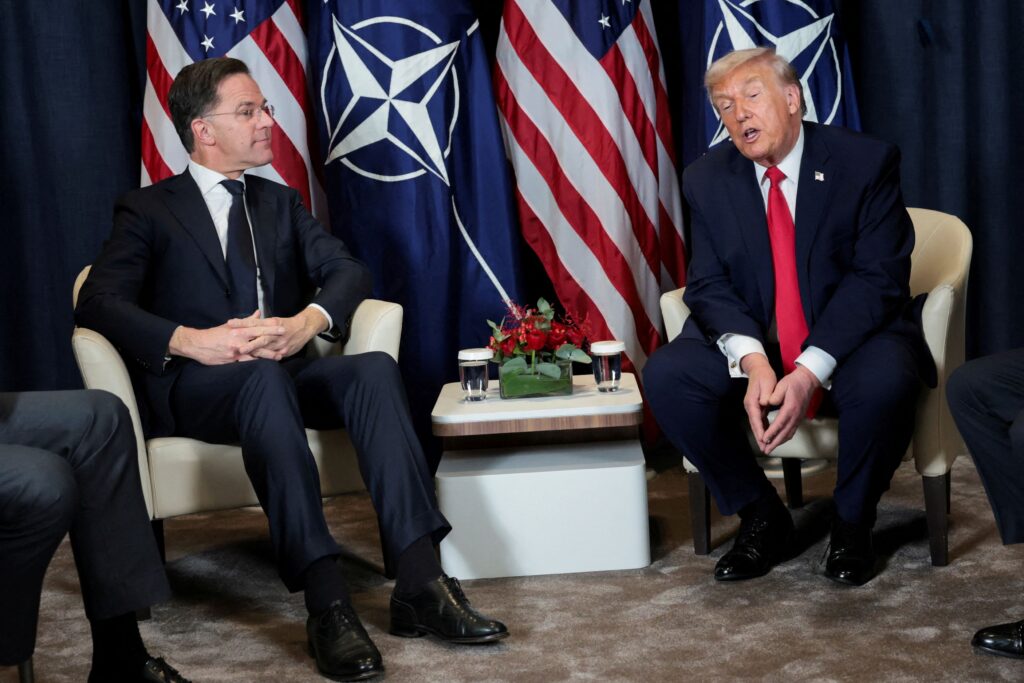
President Donald Trump’s spectacular back-down from his demand that the United States be given ownership of Greenland, in which he had threatened punishing tariffs and military force, has shown that guardrails still exist that are capable of constraining his wildest impulses.
In this case, it took a combination of pressures: a unified front of opposition from America’s transatlantic allies, a thumbs-down from the financial markets at the prospect of a tariff war and a lack of enthusiasm from normally acquiescent Republicans in Congress. House Speaker Mike Johnson (R-Louisiana), for instance, had downplayed the talk of military action as a negotiating strategy on the president’s part, aimed at drawing more attention to Greenland’s strategic importance.
Just hours after Trump delivered a blistering hour-long speech Wednesday at the World Economic Forum in Davos, Switzerland — in which he reiterated his goal to “get Greenland, including right, title and ownership” — the president swerved from the brink and announced the “framework of a future deal” after meeting with NATO Secretary General Mark Rutte.
But that framework, still under negotiation, does not include the U.S. taking possession of the icy island, a self-governing territory of Denmark. Nor is it clear that it will give the U.S. anything that was not already available, or nearly so, through renegotiation of previous agreements stretching back three-quarters of a century.
Still, while the immediate crisis appears to have passed, it remains to be seen what lasting damage the episode has done, particularly to how other members of NATO regard and trust the U.S. As Trump was doubling down on his threats, Canadian Prime Minister Mark Carney gave a speech in Davos in which he declared: “We are in the midst of a rupture, not a transition.”
“It seems that every day we’re reminded that we live in an era of great power rivalry, that the rules-based order is fading, that the strong can do what they can, and the weak must suffer what they must,” Carney said. “Faced with this logic, there is a strong tendency for countries to go along to get along, to accommodate, to avoid trouble, to hope that compliance will buy safety. Well, it won’t.”
Though Carney did not mention Trump, no one missed who or what he was talking about. And it marked a departure from the tack that NATO allies have taken, with some success, through much of the first year of Trump’s second term, which is to bend him with flattery and gifts.
Last June, NATO’s Rutte went so far as to refer to Trump as “daddy,” which he may have meant ironically but which was pleasing to the president.
But there are limits to the long-term benefits of smothering Trump with praise. What the Europeans have learned, and relearned, is that the president is protean — predictably unpredictable, as his pivot on Greenland demonstrated yet again.
This quality has also made it more frustrating for European allies to pin him down as he has swerved on how much he is willing to support Ukraine against Russia and the territorial designs of its president, Vladimir Putin.
The makeup of Trump’s new “Board of Peace” is hardly reassuring to those who worry about his penchant to make common cause with authoritarians against the postwar order of international law and norms.
Originally envisioned with a narrower purpose of helping along the peace process in the Gaza Strip, it is now being portrayed by the administration as having a far more ambitious mission, akin to that of the United Nations Security Council. Trump has also asked a voluntary contribution of $1 billionfor a permanent seat on the board.
The establishment of the Board of Peace, which Trump will chair until he chooses to resign or is incapacitated, comes as his administration has withdrawn the U.S. from 66 international organizations, many of them U.N.-related. Also notable is that Gaza is not mentioned in the charter.
It is unclear how many world leaders will be takers for Trump’s invitation to join what he has described as “the most prestigious board ever formed.” One of them, tentatively, is Putin.
Meanwhile, leaders of most European Union countries have not, with the exception of Bulgaria and Hungary, which is led by autocrat Viktor Orban. However, pressure could build to bring Trump along on other issues important to the Europeans, chief of which is support for Ukraine.
“The Board of Peace as a concept for the future of Gaza, I think, is a welcome one,” Trump’s first-term vice president Mike Pence said in an interview Thursday with Bloomberg television. “I was disappointed to see the addition of Russia and the presence of other representatives of authoritarian regimes and the absence of European allies.”
Pence added: “I think the Board of Peace itself ought to first be comprised of nations that have a demonstrated commitment to freedom and to peace, and Russia doesn’t make that list.”
If there is a silver lining to the thunderclouds of the past week, some argue, it is that Europe has been forced to take a larger role in assuring its own security, rather than relying on an assumption that the U.S. will always be there as its stable guarantor. That in fact had been a goal in Trump’s often combative relationship with NATO, where he has successfully prodded individual countries in the organization to step up spending on their own defense.
“For 80 years, it has been the United States directing traffic in Europe. We call the shots,” said Max Bergmann, director of the Europe, Russia, and Eurasia Program at the Center for Strategic and International Studies. No longer, he said, will that be a given.
But Bergmann added that for the U.S., there is another question: “How do you revive American leadership and trust after this?”
The post Trump’s sudden retreat on Greenland shows that limits still exist appeared first on Washington Post.