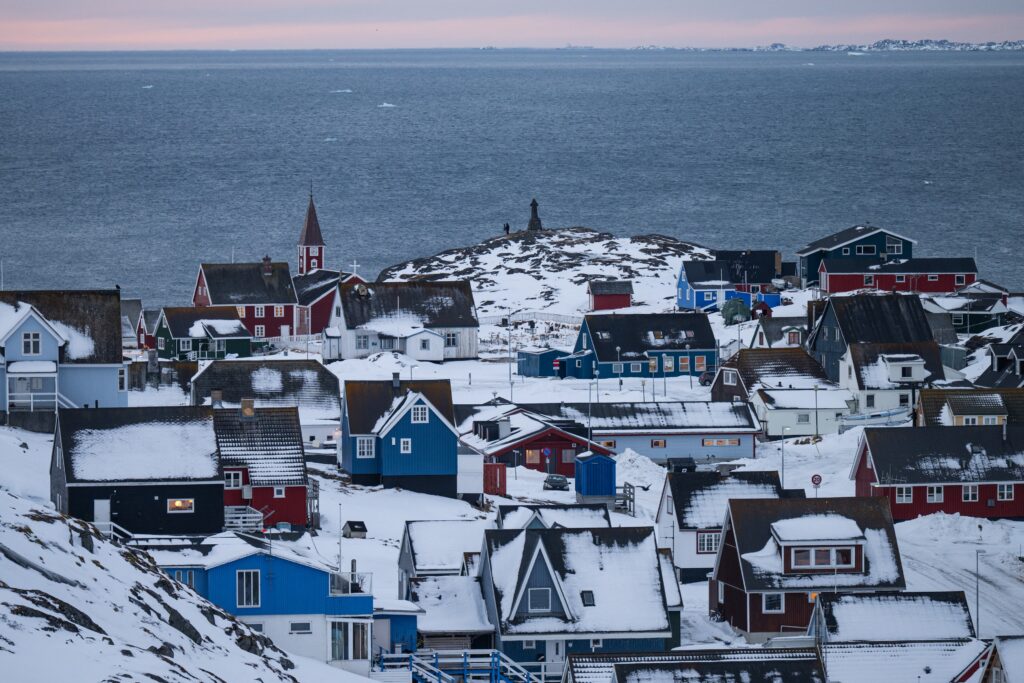
In speaking of his ambitions for the United States to acquire Greenland from Denmark, President Donald Trump has laid out a story of the countries’ relationship — one where the United States “saved” Greenland and made the “stupid” mistake of giving it back — which historians and analysts say skews the actual history.
“American presidents have sought to purchase Greenland for nearly two centuries,” Trump said in his address at the World Economic Forum. “They should have kept it after World War II, but they had a different president.”
In the months since Trump began to call again for the United States to acquire Greenland — including, at times, alluding to the possibility that the autonomous territory could be taken by force — Greenland’s history and relationships with Denmark and the U.S. have become the subject of heated discussion. And though Trump said Wednesday that he had negotiated the “framework” of a deal on Greenland, some in Europe fear that the distance between the White House and the territory on these historical question may yet lead to renewed threats.
The United States has initiated several attempts to acquire Greenland since the 19th century. In the 1860s, after the United States purchased Alaska from Russia, the country began looking at other nearby territories.
In a State Department report published in 1868, Robert J. Walker, former treasury secretary and expansionist, argued that the United States “should purchase Iceland and Greenland, but especially the latter.” He praised Greenland’s great shoreline, its valuable coal and mineral wealth, and its immense fisheries and enormous quantities of whale, walrus, seal and shark.
In 1910, U.S. ambassador to Denmark Maurice Francis Egan wrotea letter to Washington describing what he called a “very audacious suggestion”: that the United States acquire Greenland and the Danish West Indies in exchange for the Philippine islands of Mindanao.
And in December 1946, the Truman administration pitched to Copenhagen an outright U.S. purchase of Greenland.
Danish historian Rasmus Mariager said the resistance to selling Greenland was “exactly the same” then as now. “Denmark will not want to sell Greenland,” he said. “There is nothing to discuss.”
Greenland is home to 57,000 residents. “This is 2026, you trade with people but you don’t trade people,” Danish Foreign Minister Lars Loekke Rasmussen told Fox News last week. He cited a national pollthat found that only 6 percent of the Greenlandic population wants to be part of the United States.
Trump has claimed that neither Greenland nor Denmark could single-handedly defend the territory, saying only the United States would be able to guarantee the island’s security.
“On one hand, that’s true,” said Ulrik Pram Gad of the Danish Institute for International Studies. “The point is that we are part of a NATO alliance where we make an agreement that we defend ourselves collectively.” Greenland is part of the Danish kingdom, and Denmark was one of the founding partners of NATO in 1949.
Rasmussen told Foxlast week that Denmark shares the United States’ concerns about the threat of China and Russia. But Greenland has not seen a Chinese warship in a decade or so, he added, and the territory has avoided Chinese investments. There is a “third way” forward, he said, to “accommodate the president’s concern” while still respecting the territorial integrity of the kingdom of Denmark and the right to self-determination for the people of Greenland.
In 1941, one year after Denmark fell to Nazi Germany during World War II, the Danish envoy to the United States, Henrik Kauffmann, acted on his own to forge a defense agreement with the American government to give the United States the right to use Greenlandic territory to defend Greenland.
Mariager, the Danish historian, said the agreement gave the United States profound leeway while operating in the territory, including the right to construct and operate defense infrastructure and maintain military forces in the territory. But the agreementalso acknowledged Denmark’s sovereignty over Greenland.
It was “not in any way” an agreement that the United States could “have” Greenland, Mariager said. “It was an agreement that the United States troops, the American military, could make use of Greenland during the war. That’s all.”
In 2004, Greenlanders signed onto an agreement that reaffirmed but updated the older security arrangement, recognizing Greenland’s home rule government.
Trump’s interpretation of Greenland’s history appears to hinge on his worldview, Gad said. “In military terms, during WWII, the U.S. controlled the territory of Greenland,” he said. “In that sense, his remarks make perfect sense if you have the worldview in which might is right.”
Trump has also repeatedly cast doubt on Danish legal claims to Greenland. “Why [does Denmark] have a ‘right of ownership’ anyway?” Trump mused in a recent message to Norway’s prime minister. “There are no written documents, it’s only that a boat landed there hundreds of years ago, but we had boats landing there.”
“The boat thing is weird,” said Gad, who noted that Danish and Norwegian Vikings had landed in Greenland thousands of years ago. At the same time, he added, numerous documents and treaties confirm Danish authority over Greenland, including some signed by the United States.
There was a treatyin 1814 that gave Denmark ownership of Greenland after the monarchy of Denmark and Norway broke apart.
And when the United States acquired the Danish West Indies in 1917, Secretary of State Robert Lansing declared that “the Government of the United States of America will not object to the Danish Government extending their political and economic interests to the whole of Greenland.”
There have also been international rulings that confirm Denmark’s sovereignty over Greenland. The Permanent Court of International Justice ruledin 1933 that Greenland was Danish. And in 1954, the United Nations General Assembly adopteda resolution confirming that status.
“My point is that the United States has quite a free hand in Greenland,” Mariager said. “You can do almost whatever you want to but you cannot buy it.”
The post Trump tells one history of Greenland. Historians tell another. appeared first on Washington Post.