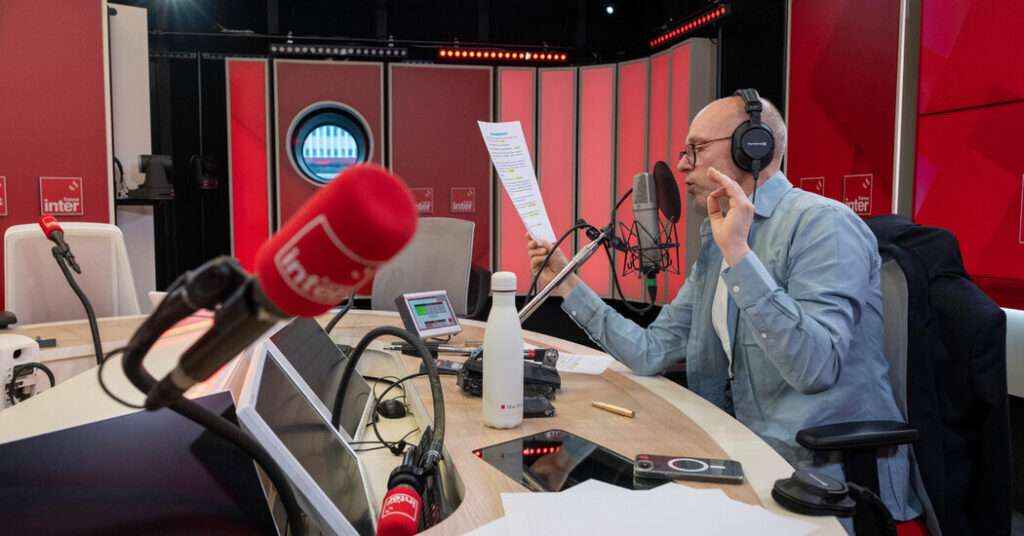
This past fall, the French podcaster Philippe Collin traveled with his millions of listeners to an enormous, almost 900-year-old castle in southwestern Germany, where members of the Nazi-backed French collaborationist government retreated after the D-Day landings.
To the sound of laughter and clinking champagne glasses, Mr. Collin’s listeners heard how the French collaborators celebrated Christmas in the castle’s grand mirrored gallery during the last year of World War II and planned their return to Paris on the backs of German tanks.
It’s a part of French history that is little known, decidedly inglorious and — to many in France — best forgotten. Yet by making podcasts about it, as part of a broader series about France’s checkered World War II history, Mr. Collin has become among the most popular podcasters in France.
His podcast, “Facing History,” has proved an unlikely but smashing success, passing 40 million downloads. Among historians and politicians, it has spurred reappraisals of key historical figures. And, amid fears of an expansion of Russia’s war farther into Europe and the growing popularity of the French far right, Mr. Collin hopes it will burrow into the minds of his listeners and inspire them to defend the soul of the French Republic.
“I am trying to reactivate the memory of the resistance,” Mr. Collin explained over coffee recently, referring to the French underground movements that resisted the Nazis during the German occupation of much of France in 1940-45.
Mr. Collin, 50, has spent his career as a producer and host of France’s most popular radio station, France Inter, where he built a reputation as an innovator and someone keen to try new things. Over the years, he has hosted shows as varied as the afternoon daily talk show and a weekly program on American culture.
For more than four years, his focus has been historical podcast series, many at least partly dedicated to France’s delicate, complicated experience of World War II, as both a victim of Nazi Germany and a collaborator.
Each series of “Facing History” lasts eight to 10 hours and is packed with archival radio clips, snatches of letters and memoirs read by actors, and interviews with as many as 12 historians. Despite — or perhaps because of — their uncomfortable subjects and rigorous treatment, the shows have proved popular. The series on the German castle has been downloaded more than two million times. Mr. Collin’s 2024 novel, “The Barman of the Ritz,” was so popular, its cover went back onto Paris subway walls in January to announce the paperback version.
The podcast has given him material for three spinoff books, three television documentaries and a nine-hour play about Léon Blum, France’s first Jewish prime minister, who was sent to the Buchenwald concentration camp. Two more plays based on the series are in the works, and historians credit Mr. Collin with finding new information for them.
Henry Rousso, a celebrated French historian of World War II, said that even he learned things while listening to Mr. Collin’s podcasts. “For me, he is an historian,” said Mr. Rousso, who has appeared on three of the podcasts. “He has the ability to create a historical narrative that is uniquely his own.”
Not all historians agree. Mr. Collin caused an uproar among experts on France’s war in Algeria after the podcast downplayed reports that Jean-Marie Le Pen, a far-right leader, tortured Algerians during the conflict. After the podcast, a confession by Mr. Le Pen, published posthumously, acknowledged the reports were true.
Mr. Collin “dabbles in everything, and like all people who dabble in everything, he very often doesn’t really know what he’s talking about,” said Fabrice Riceputi, a historian who was motivated by the podcast to write a book documenting Mr. Le Pen’s torture of Algerians.
The French passion for its national history can explain some of the series’ success. But Mr. Collin thinks the country’s current mood has made it particularly receptive to these stories.
The podcast began less than a year before Russia’s invasion of Ukraine, and fears of a larger war, engulfing France, have since grown. At the same time, France’s far-right party has surged. Polls show that one of its leaders would win the next presidential election in 2027, which would create the first far-right government in France since the collaborationist Vichy regime in World War II.
“People have a sense the Republic is threatened again and are looking for tools to combat that,” Mr. Collin said. Adding to that sense of social anxiety, he said, are the deaths of the last remaining heroes from the war — “the guardians of the memory of the resistance,” as he calls them.
“We are in the process of breaking away from that past,” he said.
By his own admission, Mr. Collin is “obsessed” with that past. He was trained as a historian, doing his master’s degree on the purge of suspected collaborators near the end of World War II. He would have continued had his parents had the money to keep funding his studies, he said.
Born in 1975, he grew up in the tiny village of Le Fret in Brittany, the eldest of two sons of a mother who was a child care assistant and a father who worked in the navy. Like many in France, the family was haunted by the history of the war. Both of his grandfathers had been captured soldiers. Meals with the extended family were peppered with their stories, he said.
Then, there was the discovery of a terrible family secret.
His favorite great-uncle, Marcel Grob, whom he visited every summer in the Alsace region, had fought with the Waffen S.S. — the fanatical Nazi unit known for civilian massacres.
When he learned the truth, Mr. Collin cut his great-uncle off. He didn’t attend Mr. Grob’s funeral, he said, because he thought to himself, “I’m not going to the funeral of a Nazi.”
Later, he received Mr. Grob’s military service record and realized he had made a painful mistake. Mr. Grob, then just 17, had been a forced conscript. Through research, Mr. Collin learned that the families of conscripts who evaded their orders were sent to German labor camps.
“All of a sudden, I said to myself, ‘What would you have done in his place?’” Mr. Collin said.
In 2018, he published a graphic novel, “The Journey of Marcel Grob,” as a form of apology. He spent eight years writing “Barman of the Ritz,” about a Jewish bartender during the war who served Nazis at night and found fake papers for Jewish employees by day.
Mr. Collin has two stepsons with his partner, Sonia Devillers, another well-known radio journalist at France Inter. He said one of them recently asked him if he thought about the war every single day. “I said yes,” he said.
But his podcasts are often about much more. With his team of 10, he has examined Napoleon, the writer Molière and Louis XV’s official mistress, Jeanne de Barry. His latest series is about the Statue of Liberty, a gift to the United States from the French public.
His podcast on the life of Alfred Dreyfus, a Jewish Army captain wrongly convicted of treason in the late 19th century, helped inspire a French lawmaker to sponsor a law that gave Mr. Dreyfus a posthumous promotion. “I listened to the entirety of Philippe Collin’s podcast,” the lawmaker, Charles Sitzenstuhl, said in an email. “It made a deep impression on me and helped me in my work.”
If there were a drum beat to the series, it would be what Mr. Collin calls the “values of the French Republic.” By that, he means liberty, equality and fraternity — the country’s motto, born during the French Revolution in 1789 — as well as the societal systems that ensure the promise is kept.
He worries those values are being attacked and sees France’s current divisions as an echo of those of the 1930s, he said.
“Today, we are facing a form of radicalization and polarization within society, and we can clearly see the seeds of a civil war — an ideological civil war — being replanted,” he said. “We are losing our way, much like the United States, for that matter. People in the United States can no longer speak to each other.” There, he said, “the ‘other’ is no longer a human being.”
He hopes his podcast offers listeners a kind of antidote. But, he said, he remains humble.
“We aren’t in politics,” he said. “We are just a podcast.”
Ana Castelain contributed reporting from Paris.
Catherine Porter is an international reporter for The Times, covering France. She is based in Paris.
The post The Podcaster Poking at France’s Biggest Secrets appeared first on New York Times.


