For more than two decades, Carol Sauer lived on the streets of Northern Virginia.
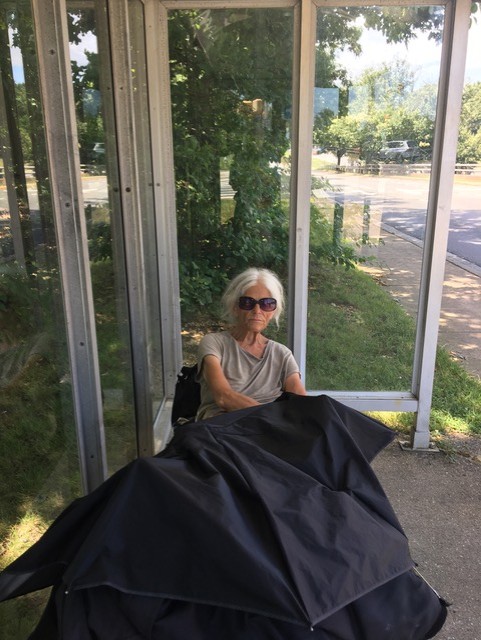
At 5-foot-2, she became a well-recognized fixture at a bus stop in Arlington. She usually dressed in all black and wore her chic, oversize black sunglasses as she sat on a bench next to her duffel bag, a backpack and a tattered umbrella.
But weeks ago, she wasn’t at her bench. She died New Year’s Eve at a local hospital. The community could have been left wondering what happened to her, but her family wrote a wrenchingly honest death notice that explained who she was and how she ended up living on the streets for decades, despite their frustrating and futile efforts to get her housing and help.
“Living and dying in her own mind,” reads the first line. It explains that she died at the age of 66 at 11:28 p.m. at Virginia Hospital Center.
“Had Carol not been hospitalized for pneumonia-turned-sepsis, it’s unlikely she would have marked or noticed the new year that was just around the corner,” it reads. “This was not just because she was chronically homeless, but because she existed in a parallel world of paranoia, delusion, and schizophrenia.”
Her family believes she had an undiagnosed mental illness that started in her 40s.
After a stranger posted the death notice to a Facebook group, it went viral. Thousands of people reposted it and clicked likes for it. Many commented about how they, too, had struggled to help their loved ones get help for mental illnesses and homelessness and found it increasingly hard at a time when government services for those in need are being cut. Others shared how they had seen Carol at the bus stop and wondered about her story.
One reader recalled in a post how she had once met Carol 15 years earlier and “vividly remembered Carol’s kindness” and how she showed her some of her artwork. Another wrote that she didn’t know the Sauers but commended their “bravery and honesty in sharing this true account of a loved one’s life of struggle and survival.”
When a family friend told Carol’s brother Bob Sauer how popular the death notice was online, he was slightly surprised but mostly grateful.
“We wrote this because we didn’t want to be silent,” said Bob, who along with his family spent decades trying to persuade his sister to get assistance. “We wanted to get rid of the stigma about homelessness and mental illness and raise awareness because there’s a lot of people suffering in this same way.”
He said his family had also become increasingly frustrated with laws in Virginia, which like other states says loved ones can’t force a person with mental illness to seek help unless they’re a danger to themselves or others. His sister never fit that bill.
Carol was the third of four children raised in Springfield, Virginia. Her mother took care of the family, and her father worked as a commercial airline pilot.
As a child, Carol liked reading, swimming at the neighborhood pool and playing the piano. Like her grandmother, she was feisty, and the two were close, often vacationing together.
After graduating from West Springfield High School, Carol attended George Mason University. But after their mother died of lung cancer in 1979, she withdrew from college. She never gave a reason, her brother said.
She moved to Orlando and got an administrative job at Lockheed Martin before transferring to Maryland. She later worked at the Howard Hughes Medical Institute in Bethesda.
In 2000, her family said they started to notice her mental state fraying, as she squirreled away possessions and became fearful people were looking for them. She went from an ordered world to “darker places shaded by paranoia, the existence of which was very real to her,” the death notice reads.
She moved to Virginia and worked as a salesperson at what was then the Hecht Company at Fair Oaks Mall. But she took a major pay cut for the job, couldn’t pay her bills and was eventually evicted from her apartment. She lived briefly with her brother and his wife, Tricia, at their Leesburg home, and he tried in vain to encourage her to see a doctor.
For years, he would go around Arlington a few times a month to take her blankets, money, food and hand warmers, often finding her at her usual haunts — the bus stop, the Rosslyn Metro stop and the public library on Quincy Street. She had recently allowed him to put an AirTag in her heavy duffel bag to help track her more easily.
He would invite her to come stay at his house and sometimes she would, spending nearly two hours playing Scrabble with him and accurately keeping score. She would get cleaned up and eat with him and his wife, but inevitably, Bob said, “she’d pick a fight” and leave. She wouldn’t let him drive her back to her Arlington bus stop, preferring to walk — with her bags in tow — the roughly 40 miles along the shoulder of busy Route 7. After a while, Bob said he stopped inviting her to stay at his house because he worried for her safety walking on the road.
Carol would often tell her family and others who stopped to check on her at the bus stop that she was homeless because she had been evicted from her apartment by the governor, the county and even the U.S. president. She believed that she would get back her home if she won pending litigation. Until then, she believed the streets were safer.
This past spring, Carol had been approved to get an apartment through PathForward, a group in Arlington that helps homeless people. But days before she was supposed to move in, she pulled out, her brother said.
“She never gave me a reason,” he said. “That was her. There would be something happening, and then something would sabotage it.”
A few weeks before Carol died, her brother persuaded her to go to one of PathForward’s shelters, but when she got there and they offered to arrange for her to talk to a doctor, she declined.
“That’s the sadness of it,” her brother said. “She’d never admit she had a mental illness. The people who could help her the most — doctors, psychiatrist — those were the ones she was most afraid of.”
Her brother said she developed what his wife called “Angels of Arlington” who looked out for her. Parishioners from a nearby church occasionally gave her food. One man, who did outreach work for his church, once tried to get her signed up for Social Security benefits.
La Mont Mitchell, a 71-year-old retired administrator from the local school system who lives a few blocks from her bus stop, gradually became her friend over the past six years. He took her extra hand warmers to ward off frostbite that her brother had left with him.
The first thing Mitchell said he noticed when he saw Carol at the bus stop was her signature sunglasses. “She was such a classy-looking homeless lady,” he said.
Their conversations ranged from him trying to share spiritual wisdom with her to her telling him how she had been wronged by an insurance company. At times, he said, she would be completely lucid. When she saw him driving his red convertible Corvette, she would comment on how the line’s body style had changed over the years.
Still, she never took his offers of money or food, and when he bought her a black ski outfit to keep warm, she wouldn’t take it. Occasionally, she accepted small packets of trail mix he would buy her at Trader Joe’s. Once he offered her an umbrella to replace hers, which was held together by tape. She would not take it. Later, he walked by her bus stop and left it near the bench. A few days later, he saw her using it.
This past summer, Carol started to reflect on her life to him.
“She said she would have been better if she had a place to live,” he recalled. She told him, given her homelessness, she would probably live another eight to 10 years.
In mid-December, Carol went to one of PathForward’s shelters. A few days after Christmas, a nurse at the shelter persuaded her to go to a hospital because she had a bad cough, her brother said. Two days later, Mitchell went to see her. He told her she was safe.
“I thought she was going to survive, get better,” Mitchell said. When her brother called him the night she died, he was sad and surprised. “She was a tough old bird. She was a pistol.”
After she died, Carol’s brother started going through her bags. Among the mementos he found: a plaque for her years of service at Howard Hughes, the license plate from her beloved blue Toyota pickup truck that had been towed long ago, old Christmas cards she had received from her family, and a photo of one of her brothers and her niece.
Margot Jones, 63, who lives in Vienna and posted the death notice to a foodie group on Facebook after it ran in The Washington Post on Jan. 11, never met Carol, but she wanted people to know her story.
“When I first saw the obit, I was so moved,” said Jones, who plans to attend her funeral on April 29, Carol’s birthday. “I cried thinking about her. This beautiful woman sitting for 20 years at a bus stop and nobody could make a difference. … It’s a reminder of the power and responsibility we have to help those who are homeless and mentally ill.”
The death notice ends with the family noting the difference between Carol and many people who are living on the streets.
“Carol hovered somewhere in Northern Virginia, and this enabled family members to keep tabs. PathForward had her on their search radar. … A luggage tracker sent signals into the night. But not every person snared in the throes of mental illness and homelessness exists within a similar quilt patch of circumstances that keep people like Carol alive, whether they recognize the efforts or not. Tens of thousands of others around the country have no such hodgepodge collection of assistance.”
“Carol did not like being homeless,” it reads. “Her delusions masked the real reasons why she was living on the street.”
The post She lived on the streets. In a powerful death notice, her family explained why. appeared first on Washington Post.