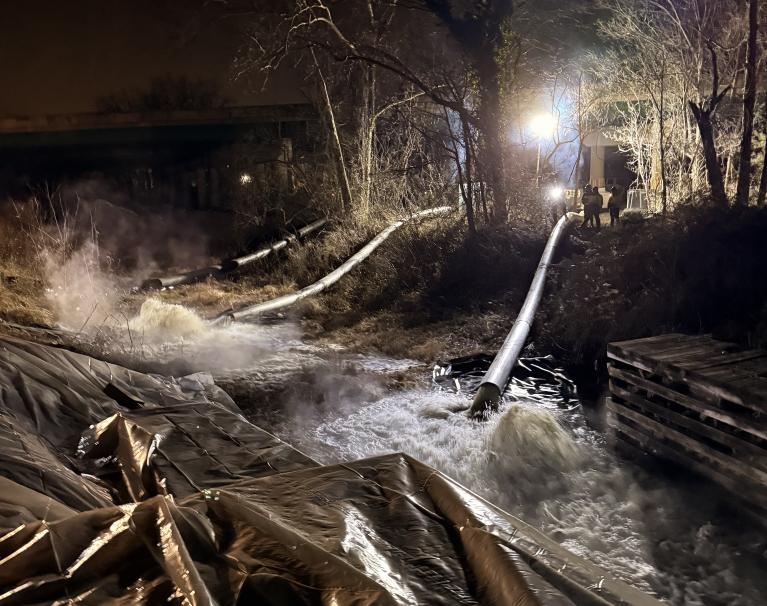
D.C. Water crews have installed high-powered pumps in an effort to divert sewage after part of a major pipeline collapsed this week, spilling millions of gallons of untreated wastewater into the Potomac River. Work is still underway to completely stop the overflow.
For the past several days, crews have been setting up the pumps and equipment along the Clara Barton Parkway in Maryland after the break was discovered late Monday night through security cameras at a nearby D.C. Water facility.
A section of the 54-mile sewer line, known as the Potomac Interceptor, collapsed, resulting in a “significant overflow,” according to officials with D.C. Water. The interceptor line is roughly 60 years old and carries up to 60 million gallons of wastewater per day — from Loudoun, Fairfax and Montgomery counties, Vienna, Herndon, and areas near Washington Dulles International Airport to the Blue Plains wastewater plant in D.C. for treatment.
The broken pipe measured roughly six feet in diameter, which officials said was a “very, very large” break. Officials said they estimate 40 million gallons of untreated sewage a day came from the broken pipe and that they don’t yet know what caused the rupture.
Six industrial pumps are rerouting the wastewater around the damaged pipe about 125 feet to a section of the Chesapeake & Ohio Canal, where it is being redirected into the sewer line.
The pumps are directing sewage into an isolated part of the C&O Canal, which is designed to be gravity-fed so the sewage will “flow down and then be diverted back” into the Potomac Interceptor, according to D.C. Water. The canal’s locks 11, 12 and 13 were removed to accommodate the bypass, officials said. The sewage did not overflow onto the towpath, which remains open.
Officials had anticipated the pumps would be turned on Monday, but crews were able to finish the installation of the bypass and turn them on Saturday evening before the snowstorm started.
On Sunday morning, D.C. Water spokesman John Lisle said the bypass and pumps are working.
Tonight’s bypass operation in action. #DCWater pic.twitter.com/5DyY34dDzU
— DC Water (@dcwater) January 25, 2026
“We’re seeing a significant increase in flow reaching the downstream pump station, which confirms that diversion efforts are working,” he said. “However, overflow to the Potomac River is still occurring.”
When the pipe broke, sewage overflowed at three spots, including at two manholes and a sinkhole created when wastewater backed up in the pipe. With the pumps on, Lisle said, there’s no longer sewage coming from the manholes, but there is still overflow from the sinkhole.
He said D.C. Water’s engineers believe it is “going to take more time for the system to fully respond and draw down levels in the pipe and eliminate any remaining overflow.”
Crews are working through the snowstorm, and there is no estimated time frame on when the system will be fully repaired, Lisle said.
D.C. Water officials said the break does not affect the public’s drinking water because the systems for human consumption and wastewater are separate. Parts of the Clara Barton Parkway have been closed for the repairs. Drivers should expect delays.
The public — and their pets — are advised to avoid touching wastewater in the area and to seek medical attention if needed. Untreated sewage can cause a variety of illnesses.
The interceptor pipeline is part of an aging system. A 10-year, $625 million “high priority” project is underway to rehabilitate its “most vulnerable sections,” D.C. Water officials said.
Lisle said the section where the collapse occurred is planned to undergo rehabilitation, but crews had not been working in that area. There was rehab work underway about a quarter-mile from the site of the collapse, he said.
On Friday, Allison Colden, Maryland executive director at the Chesapeake Bay Foundation, said there are environmental concerns: “Any time untreated wastewater is reaching our rivers and the Chesapeake Bay, it is not good.”
Dean Naujoks, of the Potomac Riverkeeper Network, said Friday that his group has documented signs of fish kill and has taken environmental samples to try to determine whether — or how — the watershed and river have been affected. The initial test results were expected back early this week, Naujoks said.
D.C. Water said it is working with partners from D.C.; Montgomery, Fairfax and Loudoun counties; state agencies; and federal offices, including the Environmental Protection Agency, the National Park Service and the U.S. Coast Guard, to contain the overflow and monitor environmental impacts.
The public can report exposure to wastewater to D.C. Water at 202-612-3400.
Clarence Williams contributed to this report.
The post Pumps installed to divert sewage spill from Potomac River appeared first on Washington Post.