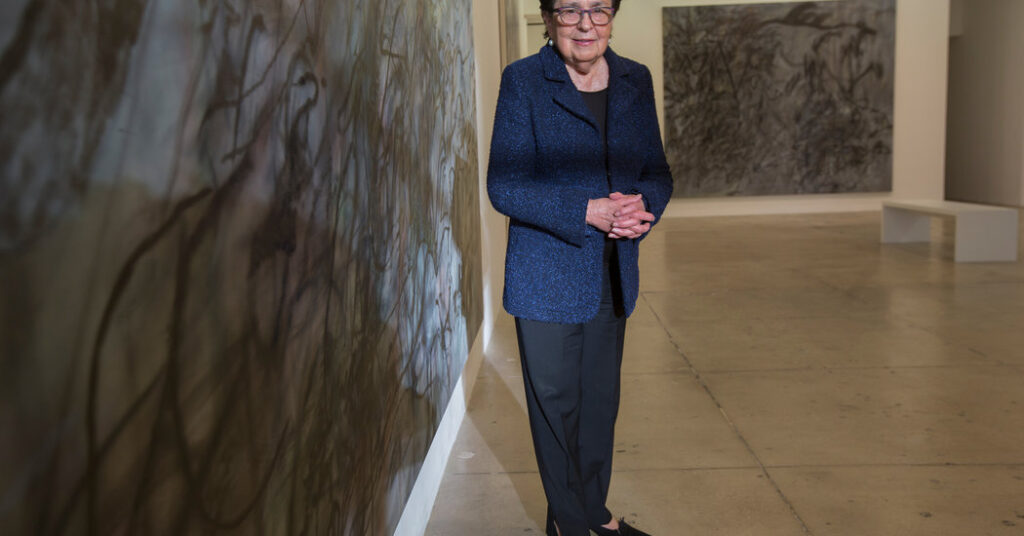
Marian Goodman, a renowned New York art dealer who favored artwork that was difficult, abstruse and sometimes unsalable, and who played a key role in bringing avant-garde European art to prominence in the 1980s, died on Thursday in Los Angeles. She was 97.
Linda Pellegrini, a spokesman for Ms. Goodman’s gallery, confirmed the death, in a hospital. Ms. Goodman had moved to Los Angeles to be near her son.
In 1977, when Ms. Goodman opened the gallery on 57th Street that bears her name, American art dominated the market, and the capitals of Europe had yet to recapture the cultural pre-eminence they had lost during World War II. Ms. Goodman resolved to provide a bridge between New York and the leading lights of European art.
“I realized that everyone was looking in the wrong direction,” she told ARTnews in 2000, in one of her many digs at what she saw as the provincialism of the New York scene.
It was at her gallery that many New Yorkers had their first glimpse of the intense, war-haunted paintings of Anselm Kiefer and Gerhard Richter, the acclaimed German artists whose success in New York once seemed doubtful.
Mr. Kiefer’s monumental, straw-laden paintings of scorched landscapes evoked the Holocaust and aroused a moral queasiness. But by the end of the 1980s, Ms. Goodman’s exhibitions had established him and his fellow Neo-Expressionists as major figures, so much so that there began to be talk that New York was losing its centrality as the global art capital.
Although known for promoting German painters, Ms. Goodman also evinced a taste for artists who shunned painting altogether, in favor of newer and more cerebral mediums. They included the Canadian photographer Jeff Wall, the Belgian film director Chantal Akerman, and the Italian satirist Maurizio Cattelan, whose sculpture “America” consists of a gaudy toilet in solid 18-karat-gold.
She also represented the Italian artist Giuseppe Penone, a poet of the ephemeral who treats human breath as sculptural form; and Julie Mehretu, the celebrated Ethiopian-born American painter whose sweeping linear networks spoke to Ms. Goodman’s interest in art that challenges power structures.
Famously loyal to her artists, Ms. Goodman aimed to place their work in museum collections rather than in private mansions. Her priorities could amount to a thorn in the side of collectors.
“I had to convince Marian that we were worthy,” Mitchell P. Rales, the billionaire businessman who co-founded Glenstone, the art museum in Potomac, Md., once observed, when Ms. Goodman refused to sell him a work by John Baldessari unless he agreed to a condition: He had to purchase six more Baldessaris for the Hirshhorn Museum, where he was then a board member.
Her gallery, which long occupied the fourth floor of 24 West 57th Street before moving to its current location in TriBeCa, harked back to an era when art dealers harbored simpler ambitions, aspiring to pay their monthly rent and help artists build careers rather than plotting to open branches in Gstaad and Hong Kong and conquer the global market. Yet Ms. Goodman was not averse to expansion. In 1999, she opened a gallery in Paris, in a townhouse near the Pompidou Center.
A soft-spoken woman with close-cropped hair, Ms. Goodman stood five feet tall. Her taste in fashion ran toward red-framed eyeglasses and Chanel blazers. Her friends described her as a tireless worker who never took a day off. She once purchased a house in the Hamptons but then quickly sold it because she could not find time to visit. A native New Yorker, she spent almost all her life living within a 20-block stretch of Central Park West.
Born on June 15, 1928, Marian Ruth Geller grew up during the Depression in an educated and cultured household at 1 West 85th Street, on the corner of Central Park West. Her parents, Maurice P. Geller and Stella (Freulicht) Geller, came from immigrant Hungarian families. Her father, an accountant, was a devotee of the American modernist Milton Avery, eventually owning 40 of his paintings and apparently none by anyone else.
Marian attended Emerson College in Boston, majoring in history. “My dream in life was to join the United Nations and save the world,” she once said. Instead she married William Goodman, a civil engineer, and settled briefly into domesticity. But a tragedy of national dimensions befell the couple in 1964, when their nephew Andrew Goodman, a civil rights activist who had traveled to Mississippi to register Black voters, was murdered by members of the Ku Klux Klan.
Ms. Goodman and her husband divorced in 1968. They had two children, Michael Goodman and Amy Goodman Kiefer, both of whom survive her.
Ms. Goodman organized her first art show in 1962, as part of a fund-raising drive for the Walden School, which her children attended. Hung in the school’s auditorium and meandering hallways, the show brought together reasonably-priced posters that Ms. Goodman had obtained by knocking on the doors of artists, including Franz Kline and Stuart Davis, and asking them outright. The show was a hit, at least by school standards. Ms. Goodman, deciding she needed a deeper knowledge of art, enrolled at Columbia University to earn a master’s degree in art history.
She made her entry into art dealing in 1965, when she was in her late 30s. With $5,000 raised from the sale of an Avery painting her father gave her for seed money, she and four friends inaugurated Multiples Inc., a print publisher and gallery at 929 Madison Avenue, across from what was then the Whitney Museum.
Despite the elite address, the business had a populist slant, enlisting Andy Warhol, Roy Lichtenstein and other young artists to turn out prints, felt banners, and Pop Art jewelry, objects that existed in limited editions and did not claim to be unique. A print renaissance was already underway in New York, and the notion of affordable art spoke to the social idealism of the era.
In 1968, Ms. Goodman had an epiphany when she traveled to West Germany to see the Documenta fair in Kassel. It was not an easy trip for an American Jew who had been a teenager during the Holocaust.
“Like a lot of people in New York, I swore that I would never step foot in Germany,” she told The New Yorker in 2004. “I was offended by people who bought Volkswagens.”
Yet the trip to Kassel acquainted her with a generation of younger German artists who grew up after World War II, and whom, she felt, could not be held responsible for the sins of their fathers. Returning to New York, she expanded the Multiples roster to include the German artists Joseph Beuys and Blinky Palermo, and their Belgian colleague Marcel Broodthaers.
Hamstrung by money problems, Multiples gave up its rented space in 1975. Two years later, Ms. Goodman opened her own gallery on East 57th Street. In explaining its origins, she always related the same anecdote: She thought it was “crazy” that an artist of Mr. Broodthaers’s significance had been unable to find a gallery willing to represent him in America, so she started her own to fill the void. Her first show of his turned out to be posthumous; Mr. Broodthaers died in 1976, on his 52nd birthday.
In 1981, Ms. Goodman moved the gallery to a larger space at 24 West 57th Street, on a main axis of the Manhattan gallery scene. By the mid-90s, her neighbors were evacuating Midtown for West Chelsea, the new art enclave, and Ms. Goodman seemed like the last woman standing. A prodigious reader of nonfiction, she was especially sad to see local bookshops depart — first Coliseum Books, then Rizzoli. But she decided to stay, choosing to define herself through the strength of her artists rather than a chic street address.
“I was consistently struck by the depth of her relationships with artists whose work is often regarded as among the most challenging to interpret,” said Christophe Cherix, the director of the Museum of Modern Art. “She possessed an extraordinary sense of wonder.”
Not many art galleries last for more than a generation, but Ms. Goodman hoped hers would. In July 2021, she promoted five of her employees to partners, and cut back on her daily involvement.
In October 2024, the partners moved the gallery from 57th Street to a five-story building at 385 Broadway in the resurgent neighborhood of TriBeCa. “We had to make a move for the sake of the audience our artists deserve,” said Emily-Jane Kirwan, a partner.
Since Ms. Goodman’s retirement, several of her artists have moved on to other galleries in New York. Gerhard Richter switched to the David Zwirner Gallery. William Kentridge went to Hauser & Wirth. The photographers Nan Goldin and Hiroshi Sugimoto also departed, as has the estate of Francesca Woodman.
The departures are a reminder of the ever-accelerating pace of the gallery scene and of Ms. Goodman’s loyalty to an older Manhattan: She once said she never moved her gallery because she considered it essential to be within walking distance of the Museum of Modern Art, which was founded a year after she was born, and which she visited with great pleasure as a child.
The post Marian Goodman, Eminent New York Art Dealer, Dies at 97 appeared first on New York Times.