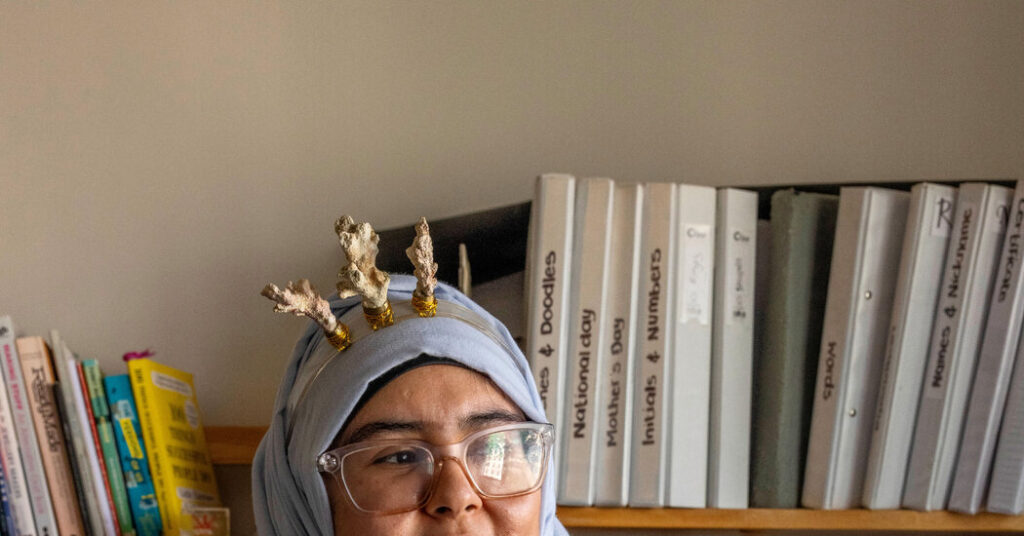
Hannah Al-Lawati remembers the moment that, as a young Muslim girl, she realized making jewelry could be more than just a hobby.
At the age of 10, Ms. Al-Lawati visited her sister, who was studying architecture at the Glasgow School of Art in Scotland. They had grown up in Oman, with childhoods that included arts and crafts, but in Glasgow she saw young women who were studying creative fields in preparation for careers.
“That’s not what they teach you in school or anywhere in this culture,” Ms. Allawati, now 33, said in a recent interview in her apartment and studio here in Muscat. “It’s always a hobby. But I saw for the first time that a woman could do anything.”
Fast-forward a few years to the time when her Peruvian mother (her parents met as college students in the United States) retired from a banking job in Muscat and began doing beadwork for fun.
“She bought all these amazing stones, but then she gave up the hobby,” Ms. Al-Lawati recalled. “So, I saw an opportunity to play around with them and began making jewelry.”
She studied jewelry design at the London College of Fashion but in 2013 returned to Oman, at 20 years old, and started dabbling with the idea of making jewelry full time.
In 2018, she registered her business, Alhannah Jewellery, and has been operating it herself ever since. The line includes mostly necklaces of silver, acrylic and gemstones, plus bracelets, pebble rings, shell rings and mother-of-pearl and shell pendants, among other items, priced at 8 to 30 Omani rials ($21 to $78). She sells on Instagram and at local fairs.
Ms. Al-Lawati said she realized early in her career that designing jewelry had particular challenges, regardless of the market.
“When I was in college, we were always told to imagine that you’re working for a major design house,” she said. “So it’s like you’re working for Vivienne Westwood and she designs the clothes, so you have to design the jewelry for that outfit. This was always the mentality I had.”
But designs for the Middle Eastern market have to work with the hijab, the head scarf that covers the hair, neck and upper shoulders traditionally worn by many Muslim women. And sometimes women prefer multiple layers of head scarves, which can bunch at the neckline.
“They tend toward modesty here, so they cover their chest, their necks and their arms, so when they wear jewelry, it tends to be hidden under the scarf,” Ms. Al-Lawati explained, especially because many necklaces for sale are only 40 centimeters (just less than 16 inches) long.
“The complaint I discovered,” she continued, “was ‘I spend so much money for a necklace that I can’t even show off when I wear it on top of my abaya because it won’t show’.” (An abaya is the long gown-like garment worn by many Muslim women.)
That complaint inspired her to start designing longer necklaces and, at the local Mutrah Souk in Muscat, she asked a silversmith to solder two necklaces together to get a sense of the length.
She now creates designs about 70 centimeters long, or a bit less if the piece includes a pendant, which adds length. She works with a few silversmiths at the souk to custom-make the longer chains. They also make other silver items, such as pendants and rings, to which she adds beads or other flourishes.
Ms. Al-Lawati’s busy season is about to begin with Ramadan, which starts in mid-February, and the Eid holiday afterward, with fairs around Oman.
“During Ramadan and a month or two before, there are a lot of exhibitions where women are going to look for a new abaya or a new jalabiya to wear for Eid,” she said. “There are ones specifically for Eid, which are different from ones for, say, weddings. And the jalabiya is a one-piece dress that started off as a comfort garment. Now it’s become very decorative.”
In the Gulf, women traditionally have preferred black outer garments and head scarves, but Ms. Al-Lawati said she had been seeing a shift to more colorful and decorative materials, like those often worn by Muslim women in Southeast Asia, particularly Malaysia and Indonesia.
“Over the last 10 years, the women’s jewelry market in the Gulf region has dramatically evolved into a dynamic creative hub, and young independent designers have taken root as influential voices alongside the major maisons,” Charlie Boyd, the jewelry and watches editor at Harper’s Bazaar Arabia, wrote in an email. “Their design codes speak to personal expression, fashion-led styling, storytelling and identity.”
To accent the evolving combination of fashion and jewelry, one of Ms. Al-Lawati’s favorite jewelry materials is bright red Peruvian huayruro seeds, a nod to her Peruvian ancestry. She also works with acrylics, shells, coral and silver, and she recently began incorporating gemstones — a change produced by a pendant that she made last year for her nephew. It featured agate that she had bought in Iraq during a pilgrimage to Karbala, a significant destination for Shiite Muslims.
“Before then I wasn’t really into gemstones, and I had heard people talk about how they have good energy, but I never really believed in that,” she recalled. “But on this trip, I was told that agate stone is very good because the prophet and his grandsons would wear an agate ring when praying. That inspired me.”
She sold four similar agate necklaces and recently has begun to use turquoise, mined in Oman, and amber, which is imported. And she almost always uses 925 silver, the kind of sterling silver traditional in Oman.
Ms. Al-Lawati recalled that her introduction to traditional Omani jewelry was that first piece she made as a young teenager with her mother’s beads. To her surprise, it was not difficult.
“I made a key chain for the first time and realized that I was now a jewelry maker,” she recalled. “I was watching the movie ‘Love Actually’ at the time.”
“It only took ‘Love Actually’ plus an hour to make it,” she added with a laugh.
The post Jewelry Adapted to Modest Garb appeared first on New York Times.