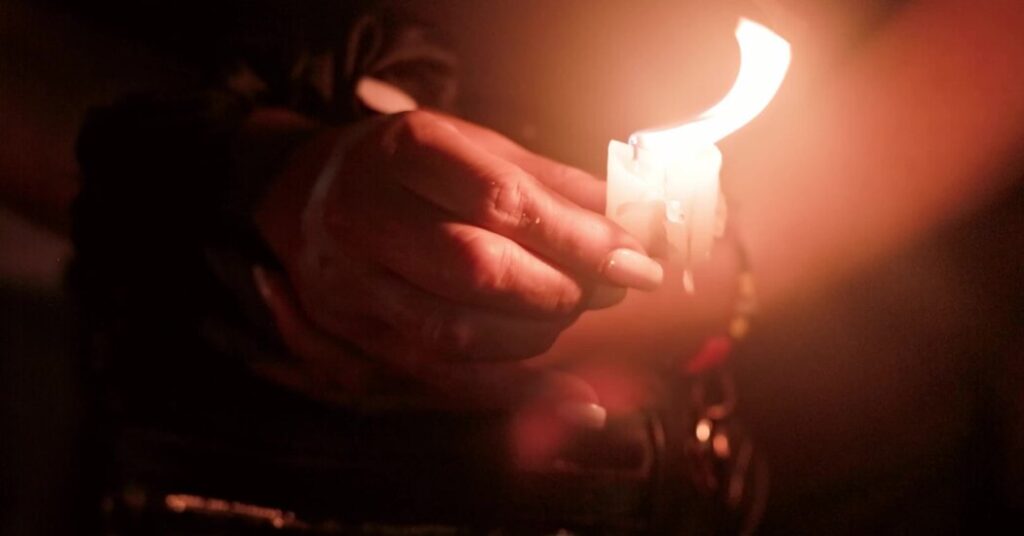
After taking a 10-hour bus ride across Venezuela in a quest to find her missing husband, Carolina Carrizo fashioned a makeshift bed out of discarded sofa cushions to sleep outside Zona 7, a detention center in Caracas.
Two months ago, she said, about 30 uniformed police officers looking for weapons forced their way inside her home in western Venezuela and took her husband, Omar Torres, 53, a political activist. The authorities never acknowledged the arrest, she said, and she has not heard from him since.
She has slept outside Zona 7 since arriving in Caracas two weeks ago. She is not even sure that he is there.
After the Trump administration’s capture of Venezuela’s president, Nicolás Maduro, its interim government has drawn international headlines for releasing dozens of political prisoners who rights groups say were wrongfully detained. The trickle of releases has shone a renewed spotlight on a related phenomenon in Venezuela: people who were arrested, largely for political reasons, and then disappeared.
President Trump’s words of praise for what he says is the accommodating attitude of the interim leader, Delcy Rodríguez, has made families in Venezuela hopeful that the newfound cooperation between the two countries could bring freedom for dozens of people who were taken without a trace.
“We’re all here, outside the prisons, because of Trump, because of what he did,” Ms. Carrizo said. “Now I just want my husband back.”
For two weeks, other mothers, wives and girlfriends from across Venezuela have slept on the street outside Zona 7, where their tents sit next to dozens of police officers wielding riot shields. The police claim the jail is empty, but the families say that they have heard screams coming from inside.
“I feel that Trump is the one who is going to get them out,” said Betsy Orellana, who said her son, Rodolfo José Rodríguez Orellana, a former police officer, is serving a 24-year sentence for participating in a plot to overthrow the government. He has been missing since August, she said.
The locations of at least 66 prisoners are unknown in Venezuela, according to Foro Penal, a leading rights group, which tracks politically motivated detentions.
Of those, about 30 of them, like Ms. Orellana’s son, were arrested during an attempted invasion of Venezuela in 2020 known as Operation Gideon. The effort to topple Mr. Maduro, hatched by an American former Green Beret, failed spectacularly: Eight would-be rebels were killed and the rest are still in prison, and have not been heard from since being transferred in August.
The Venezuelan government did not respond to requests for comment for this article.
Forced disappearances is a decades-old practice that became a notorious tool used by Latin American dictatorships against critics — from foreigners to students and political activists. The practice is categorized as a violation of international law and a crime against humanity because the authorities are obligated to acknowledge when a person is in police custody.
In Venezuela, some people have been missing for over a year.
Under Venezuelan law, detainees are supposed to be brought before a court within 48 hours, a provision that human rights activists say is often ignored. But in the cases of the disappeared, the families do not even know where they are being held.
The Venezuelan government unleashed a harsh crackdown, called “Operation Knock-Knock,” to stamp out dissent after a July 2024 presidential election that Mr. Maduro claimed to have won despite vote tallies showing he lost decisively.
Nearly 800 people considered political prisoners are still detained after 154 were released in recent days, according to Foro Penal.
Even in a countries where human rights are frequently violated, the disappearance of inmates is considered particularly serious because the detainees are outside the protection of the law, human rights experts said. It is difficult for families to hire defense lawyers for a case that officially does not exist, making the defendant particularly vulnerable, experts said.
Amnesty International, in a report last year, said Venezuela saw a significant increase in forced disappearances after the 2024 elections.
People would disappear for hours, days, weeks or months, the organization said.
Clara del Campo, the South America campaigner for Amnesty International, said families “literally” knock on prison doors asking for their loved ones, but the guards claim no one by that name is in custody.
“It speaks to the ingenuity of repressive governments whereby they find new ways of applying cruelty and punishing those that they consider real or perceived dissidents,” she said.
The word “desaparecido” became common in the 1970s in Argentina, when a military dictatorship abducted as many as 30,000 people, tortured them and, in hundreds of cases, threw them from airplanes into the sea.
For years, the term was largely considered synonymous with “missing and most likely dead.” In more recent years, the practice became commonplace in countries like Nicaragua, where missing people are believed to be alive but imprisoned, with no records to document it.
In Nicaragua, several dozen people who were detained and missing were recently released, but nine remain unaccounted for, according to a prisoner monitoring group.
In Caracas, Venezuela’s capital, Victor Borges, 39, a political activist, has been missing since Nov. 25, relatives said.
“It is as if the earth swallowed him,” said his former partner, Yesley Bello, 26.
Witnesses told Ms. Bello that vehicles bearing the insignia of Venezuela’s Bolivarian National Police arrived at Mr. Borges’s workplace, an elite private school, where he cared for animals at the school’s petting zoo, and took him away.
His family can rattle off the names of government agencies, prisons, hospitals, police stations and morgues where they have gone to ask about him. Each time, the family said, they were told the same thing: No one by that name was there.
Ms. Bello has begun to consider the possibility that he may never return to her or his five children.
“I will tell them about the great father they had,” she said, her eyes filling with tears.
Martina Rapido, a researcher with Human Rights Watch, said that forced disappearance is “always a strategy to break not only the person who is detained, but also their families, sometimes in retaliation for political opposition.”
Ms. Rapido said the disappearances generally fit one of two patterns. They are often short-term detentions that last a few days. But others involve high-profile activists who are held incommunicado for an extended period.
Marilis Rodríguez, 58, traveled 200 miles to Caracas recently from the city of Acarigua searching of her son, Carlos José Rodríguez Rodríguez. She said the police took Mr. Rodríguez, 29, from his home on Sept. 23, 2025, after accusing him of illegally selling dollars on the black market, she said.
“My son was taken from his house for an investigation,” Ms. Rodríguez said. “They were going to question him about something, and it’s going to be four months since we last heard from him.”
She said her son, a vendor of imported goods, was not politically active.
She said she was told at one prison in Caracas that he had been released, only to be told a day later that it was not true.
Mr. Rodríguez’s first child, a boy, was born after he was taken, so they have yet to meet.
The family said it had tried to find him in at least five prisons in Caracas and also asked about him at every police station in Acarigua.
“We’ve turned the town of Acarigua upside down,” said Adriana Graterol, a cousin.
Leomaris Prado traveled eight hours by bus from Guárico State to El Helicoide, a prison with a reputation as a center for torture in Caracas, looking for her father. Leonardo Prado, a mechanic, has been missing since Dec. 28, when she said he was stopped at a checkpoint and taken.
Her father was not politically active, Ms. Prado said, but had recently gotten into a dispute with noisy neighbors who happened to be police officers, and his family now wonders whether that triggered his detention.
“I’m here because I want proof that my father is alive,” Ms. Prado said. “I want them to tell me where he is. I want them to tell me why they took him. I want them to show me the evidence.”
Frances Robles is a Times reporter covering Latin America and the Caribbean. She has reported on the region for more than 25 years.
The post In Venezuela, Families Search for Relatives Who Are Detained and Missing appeared first on New York Times.