On a clear December evening at a beach resort in Abu Dhabi, the capital of the United Arab Emirates, Sotheby’s staged a series of luxury auctions that provided a glimpse of the house’s future in the region.
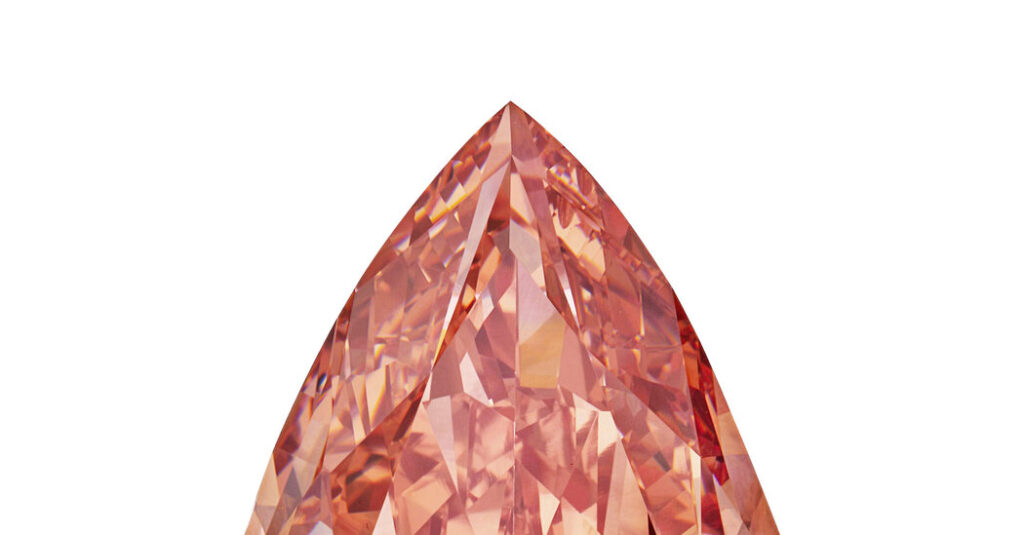
Among the items on the block that night was the Desert Rose, a 31.68-carat pear-shaped diamond with a distinctive orangy-pink hue, not unlike the evening’s sunset. Emma Paleschi, Sotheby’s managing director for global jewels and fashion, was in the crowd during the 20-minute bidding battle over the gem. It ended when a telephone bidder acquired the stone for $8.8 million.
In a recent telephone interview from her office in London, Ms. Paleschi recalled the atmosphere that night at the beachside auction.
“At one point, you could look left and see the sun going down, and then look right and the moon was appearing — it was really quite magical,” she said.
“There’s something about the light in the Middle East that really brings these stones alive in a way I don’t see in other parts of the world.”
That is one way to explain the region’s fabled affinity for extravagant jewels. (Maria Sidiropoulou, the exhibition director of the Jewellery Arabia show in Bahrain, recently described her first visit, in 2024, to the consumer-facing event: “I could see people walking out of the halls with bags” the way most people carry groceries out of the supermarket.)
Lately, however, jewelers from around the world have begun to look at the region — in particular, the six countries that make up the Gulf Cooperation Council (G.C.C.): Bahrain, Kuwait, Oman, Qatar, Saudi Arabia and the U.A.E. — with fresh eyes.
Home to young buyers, many of whom are seeking styles modeled by their favorite social media influencers rather than traditional designs, the Middle East is shaping up to be the global jewelry trade’s brightest prospect this year, especially amid persistent tariff-related challenges in the United States and the continuing luxury slowdown in China.
“There’s definitely a big opportunity there,” Ms. Paleschi said.
She emphasized Sotheby’s commitment to the region — which is home to ADQ, an investment and holding company in Abu Dhabi that in late 2024 announced a minority equity investment in Sotheby’s — as well as her own personal commitment: This month, Ms. Paleschi moved to Abu Dhabi.
“With my role being global, I can essentially do it from anywhere in the world,” she said. “And where better to be doing it than in a location that is at the center of the growth that we see for the coming years?”
Growing Competition
Sotheby’s will have to contend with a fair bit of competition, as more jewelry brands and designers, dazzled by the possibilities for growth in the Middle East, expand their activities across the region.
Mo Shadman, the intelligence director of the Chalhoub Group, a luxury retailer and distributor in Dubai, predicted that the G.C.C. region’s luxury market would grow about 6 percent annually and exceed $15 billion by 2027, outperforming global benchmarks.
“The market’s resilience in the G.C.C. is driven by a combination of favorable economic conditions, strong consumer confidence and sustained investment in physical retail and tourism infrastructure, particularly in Saudi Arabia and the U.A.E.,” Mr. Shadman wrote in an email. “The region also benefits from currency stability, a growing affluent population and continued inflows of high-spending tourists and expatriates, creating a solid foundation for luxury consumption even amid global uncertainty.”
Count the Swiss jeweler Chopard, which has long sold its pieces through the region’s key retailers, among the brands expanding its regional footprint. Late last year, Chopard opened two additions to its regional network of boutiques: one in the Marassi Galleria Mall in Bahrain and the other, in the Solitaire Mall in Riyadh, Saudi Arabia.
Equally of note are Chopard’s Middle Eastern marketing initiatives, which lean heavily on appearances by celebrities such as Uma Thurman, Dakota Johnson, Queen Latifah and Juliette Binoche. The brand has sponsored the Red Sea International Film Festival in Jeddah, Saudi Arabia, for four consecutive years, and has for several years been a major partner of Fashion Trust Arabia, an organization in Qatar that supports emerging designers in the Middle East and North Africa.
In late November, the Los Angeles jeweler Daniela Villegas made her first appearance at the Fashion Trust Arabia Awards, held at the National Museum of Qatar in Doha. Known for her oversize, insect-inspired designs, Ms. Villegas said she was nevertheless impressed by the boldness of the region’s jewelry style.
“The cliché is that all the money is there — they want all the big stones — but yes and no,” she said. “They’re very into originality, and jewelry is definitely a way of expression. People don’t feel afraid of showing off. But it’s not about, ‘Look what I have.’ It’s about family rituals. And I love that they dress up, not for a special occasion, but for life.”
Independent Designers
At Aubade, a fine jewelry retailer in Kuwait that was among the first in the region to introduce local consumers to independent, design-led brands such as Spinelli Kilcollin, Fernando Jorge and Anita Ko, the perpetual desire for adornment is on full display as the store prepares for Ramadan next month.
“It’s our high season,” Harriet Lindsay, Aubade’s brand and buying director, said on a video call in December from her home in Dubai.
“Obviously, we observe a religious aspect of fasting, but it’s almost like 30 days of Christmas,” said Duha AlRamadhan, Aubade’s founder and chief executive, who joined the call from Kuwait. “It’s 30 days of family dinners and family gatherings. We dress in these beautiful, elaborate caftans and with caftans, you need to accessorize.”
While a passion for jewelry has been a cultural throughline in the Middle East for centuries, the styles that appeal to local buyers have evolved since Aubade’s opening in 2014. “There’s a historical love for jewelry in the region,” Ms. Lindsay said. But, she noted, “when we first opened, you were either in the souk or you were Cartier.”
“The No. 1 comment we used to get was, ‘Why wouldn’t I just go to Cartier or Van Cleef?’” she said. “I don’t think we’ve heard that in five or six years.”
Ms. Lindsay said Aubade’s female customers have been instrumental in helping the retailer establish its trendsetting reputation. “We’re so lucky because it’s mainly women who are founders, creators, businesswomen, C.E.O.s buying jewelry for themselves,” she said.
Tania and Dima Nawbar, the sisters behind the fine jewelry brand L’Atelier Nawbar in Beirut, Lebanon, attribute their brand’s enduring success across the G.C.C. market to the reception they received from Kuwaiti clients, primarily women, when they started selling in the region in the early 2010s. At the time, the Nawbars were offering colorful, design-forward jewels to buyers more accustomed to diamonds in traditional matched sets.
“The Kuwaiti market is the most avant-garde in the Middle East,” Tania Nawbar said on a video call this month from her home in Beirut. “They’re the most stylish and daring. So when they saw our product, they called on us in two seconds. I always say that the Kuwaiti market is what made us. Because at the time, our jewelry was very different.”
Likewise, the Parisian designer Yvonne Léon, who sells her pieces at Clé: The Gallery, a luxury retailer in Riyadh, and at the luxury e-tailer Ounass in Dubai, said women buying for themselves have fueled her brand’s recent growth in the region.
“For us, it’s a market growing very strong because the women are not afraid to buy very original pieces,” Ms. Léon said by phone in December. “They don’t want to have the same stack as the other women.”
A New Generation
A desire for newness and distinctive design is how Mr. Jorge, a Brazilian designer based in London, explains his brand’s ascent in the region. “For independent designer brands like ours,” he wrote in an email, “I believe these opportunities are driven by an increasing openness from a newer generation, who have been exposed to luxury and design all their lives, and are looking for their own path as collectors.”
Over the past year, he said, exposure at design-focused events such as Nomad, a traveling art and collectible design fair that held its first edition in Abu Dhabi in November, has resulted in larger sales and more bespoke commissions.
The Greek designer Nikos Koulis echoed Mr. Jorge in calling attention to his Middle Eastern clients’ persistent desire for high-end, one-of-a-kind designs. “I really enjoy that most of the clients are jewelry connoisseurs,” he said on a call last month. “I don’t have to explain when a stone is D flawless or Type IIa — they know and appreciate these details.”
That kind of commitment to jewelry, evident not only in Middle Eastern consumers’ maximalist style but also in their openness to new ideas, is what struck the London designer Anabela Chan in 2021 when she entered the market through a partnership with the Dubai retailer Damas. Known for her use of lab-grown diamonds and gemstones, Ms. Chan said her designs particularly resonated with younger buyers.
“When I first started in 2013, lab-grown gemstones were nonexistent in the world of fine jewelry,” Ms. Chan said. “Nowadays, to see so many people embracing lab-grown across the world and especially in more conservative regions such as the Middle East, where jewelry has such a long heritage — to see people embrace the future, it’s really exciting.”
The post In the Middle East, Jewelers See Their Brightest Prospect appeared first on New York Times.