In Tehran, the capital of Iran, security forces opened fire at protesters from the roof of a police station. In Karaj, they fired live rounds into a march, shooting one person in the head. In Isfahan, young men barricaded themselves in an alley as gunfire and explosions rang out.
Scattered protests had percolated since late December, starting with a strike in Tehran’s bazaar and fueled by a plunging economy. But by early January, Iranians had revolted en masse, and the security forces began to crack down with deadly force.
It was not just the protests unnerving the regime. President Trump encouraged the demonstrators and threatened military intervention. In many places, riots flared in parallel with peaceful protests; government buildings, commercial properties, mosques and police stations were set on fire.
On Friday, Jan. 9, Iran’s supreme leader, Ayatollah Ali Khamenei, ordered the Supreme National Security Council, the body tasked with safeguarding the country, to crush the protests by any means necessary, according to two Iranian officials briefed on the ayatollah’s directive. Security forces were deployed with orders to shoot to kill and to show no mercy, the officials said. The death toll surged.
Despite Iran shutting down the internet and disrupting phone service, some Iranians managed to evade restrictions to share witness accounts and hundreds of videos, many of which The New York Times was able to collect and authenticate.
The Times has verified videos of security forces opening fire on protesters in at least 19 different cities and in at least six different neighborhoods in Tehran in early January.
These videos show the breadth and ferocity of the regime’s crackdown. So do the testimonies of doctors and a nurse working in hospitals in Iran, and photographs shared by a witness and authenticated by The Times of hundreds of victims brought to a Tehran morgue.
The Times also interviewed two dozen Iranians in Tehran, Isfahan, Shiraz, Rasht and Ahvaz who had attended protests, as well as relatives of people killed. Protesters, residents and medical staff interviewed for this article all asked that their names or full names not be published for fear of retribution.
By Monday, Jan. 12, the protests had largely been crushed.
As more information emerges from Iran, the death toll has hit at least 5,200 people, including 56 children, according to the Washington-based Human Rights Activists News Agency. Iran Human Rights, a Norway-based group that also monitors the situation in Iran, has confirmed at least 3,400 killed. Both organizations say that the numbers could prove two or three times larger as verification continues.
Iran’s National Security Council said in a statement that 3,117 people had been killed, among them 427 of its security forces. Officials, including Mr. Khamenei, have blamed terrorist cells tied to Israel and the United States for the uprising and killings.
“This is not merely a violent protest crackdown. It is a state-orchestrated massacre,” said Raha Bahreini, a lawyer and an Iran researcher at Amnesty International.
Crackdown
On Jan. 8, Nasim Pouraghayee, 45, a mother of two, and her husband, Ali, marched with large crowds in the Sadeghiyeh neighborhood in Tehran. She called her mother to say the atmosphere was boisterous and the turnout huge.
Abruptly, things turned deadly.
Her husband was walking behind her, hands wrapped around her shoulders to protect her, according to a cousin of Ms. Pouraghayee’s who, in an interview, recounted the events of the night as described by Ali. A bullet hit Ms. Pouraghayee in the neck; she fell to the ground and began vomiting blood, the cousin said.
“Nasim, Nasim, Nasim,” her husband screamed, holding her face. But she was unresponsive. “Help, help,” he pleaded to other protesters fleeing the chaos, but nobody came forward. He felt his wife’s body getting cold as he picked her up, the cousin said, and walked for an hour and a half to reach their car. When they reached the hospital, she was pronounced dead.
A video verified by The Times captured the sound of live fire being directed at protesters in Sadeghiyeh. The protesters turn, flee and scream as gunshots are heard.
About 40 verified videos show gunmen and security forces cracking down on demonstrations. Across the footage, they are seen riding in pairs on motorbikes and using a variety of weapons, including firearms, batons and tear gas. In a video filmed in Haft Howz Square in Tehran, men and women flee amid the sound of gunfire. Some protesters clearly have leg wounds, and leave trails of blood along a sidewalk as they limp away, a video verified by The Times showed. On the street, some can also be seen carrying people unable to walk.
Mohammad, 40, a shop owner, said he and his younger brother were among the demonstrators in Tehran Pars, a middle-class neighborhood in eastern Tehran, on Friday, Jan. 9, when they heard the rat-tat-tat of gunfire. “I saw two young men who were running away collapse; they were shot from the back,” Mohammad said.
Security forces fired on protesters from the rooftop of a police station in Tehran Pars for more than six minutes, one video shows. The video shows the muzzle blasts of several rifles and picks up the sound of hundreds of gunshots and what appears to be automatic fire. A group of protesters run away along an adjacent street. Minutes later, a person is dragged inside the courtyard of the police station.
Another video filmed farther along the same street — and in the direction the security forces were firing — shows protesters sheltering from incoming gunfire. “Put your phone down, they’ll shoot your hand off,” one person says. “There’s a sniper among them.”
The sound of bullets striking nearby can be heard amid chants of “Death to Khamenei.”
A video that The Times confirmed was filmed at the nearby Tehran Pars Hospital showed several body bags lined up on the ground outside an emergency room entrance as people could be heard wailing.
A husband and wife had a violent encounter with members of the Basij militia, a plainclothes security force, on motorcycles in Karim Khan in central Tehran. The wife, 50, who is a designer, said in an interview that the men shot indiscriminately into the air and at people, and screamed, “Get back inside.”
The husband was shot in his lower back with a pellet bullet. The wife said a member of the Basij found her hiding behind an electric pole, stood near her and pointed a gun to her forehead, several millimeters away from her eye. He threatened to kill her, but had run out bullets, she said.
A series of videos verified by The Times from Jan. 8 in Fardis, a suburb of Karaj, showed hundreds of people marching, then fleeing when a tear-gas canister is fired in their direction. Gunshots ring out. Another video, filmed near a police station in Fardis, shows a protester who appears to have been shot in the head. More than two dozen gunshots are heard as screaming protesters take cover. In the last video, the lifeless bodies of seven people sprawl on the ground.
In Mashhad, a conservative city in the northeast, huge crowds gathered on Jan. 8 chanting slogans against the government, a video verified by The Times showed. Later that night, a group of protesters were walking down a road about a mile away from where the crowds had been when security forces on motorcycles rode up to them. Some of the officers dismounted and beat demonstrators with batons, while others fanned out, pointing firearms down the street as gunshots rang out nearby.
In another video filmed at a protest in Mashhad and verified by The Times, a person is seen lying on the ground as others run to help.
“Look, they shot a girl,” the person recording the video said. “They are using weapons of war.”
Hospitals
Across the country, hospitals swamped by thousands of injured protesters were unprepared for the scale of the gunshot wounds they were seeing, according to interviews and text messages with eight doctors and one nurse in Iran.
Gun violence is rare in Iran, and private citizens are not allowed to own weapons. The doctors and the nurse sharing their experiences in Tehran, Mashhad, Isfahan and Zanjan described scenes of chaos: medical staff frantically trying to save lives, white uniforms drenched in blood. They said patients lay on benches and chairs, and even on bare floors, in the overcrowded emergency rooms.
They said hospitals were short of blood and searching for trauma and vascular surgeons. The internet shutdown prevented medical staff from checking patients’ names and medical history, they said.
A nurse at Nikan Hospital in Tehran said in an interview that the hospital resembled a war zone. A doctor at Shohada Tajrish Hospital in north Tehran, a sprawling government medical facility, said that, on average, medical staff saw about 70 protesters with gunshot wounds per hour on the two days of peak violence, Jan. 9 and 10. Many patients were dead on arrival or shortly afterward, he said.
In an audio message shared with The Times, a physician in Mashhad called the situation at his hospital “terrifying.” In addition to a staggering number of injured protesters, he said, security forces showed up demanding access to patients to arrest them. He said a team of physicians had set up an ad hoc triage unit at a villa outside of the city, where they treated patients too afraid to go to hospitals.
An anesthesiologist at a hospital in the Sattar Khan neighborhood of Tehran said in a text message shared with The Times that in just one night, his hospital had seen 300 injured protesters. A text message from a doctor at a university hospital in Zanjan shared with The Times said most victims were shot in the upper torso, head and neck, and that the hospital had recorded about 200 killed.
The Times received photos and videos from inside hospitals that are too gruesome to show. Other very graphic images were posted online by an account with a record of publishing images later found to be authentic. They showed bloody, lifeless bodies inside hospitals said to be in Tehran. Some victims appeared to have been shot in the head. The Times was unable to independently authenticate the images from inside hospitals.
Farabi Eye Hospital in Tehran, a national hub for ophthalmology, registered about 500 cases of eye injury from pellet bullets on Jan. 8 and several hundred eye injuries with live bullets on the following two nights, a surgeon said in a text message. He was in the operating room for three nights straight and said he wished for death when he had to empty both eye sockets of a 13-year-old.
A doctor in Isfahan said in a text message that they had seen “young people whose brains were smashed with live bullets, and a mom who was shot in the neck, her two small children were crying in the car, a child whose bladder, hip and rectum was crushed with a bullet.”
“What I witnessed will forever haunt me,” the doctor added. “I feel guilty that I’m alive.”
Photos, videos and text conversations shared with The Times by Dr. Kayvan Mirhadi, an Iranian American doctor in Rochester, N.Y., who has been in regular contact with medical teams and hospitals in Iran, showed dozens of apparent gunshot and pellet wounds to the torso, limbs, head and eyes.
“They are essentially executing people on the streets,” Dr. Mirhadi said. “Starting Thursday, the reports of injuries I was receiving changed significantly. It went from brute force, fractures and tear gas to skull fractures and gunshot wounds.”
Some images shared by Dr. Mirhadi were sent by people asking how to treat their own wounds or those of relatives. One person asked about a bullet wound in his brother’s leg. Another sent a photo of an eye, with blood pouring out of a gash just above it.
The Times sent a representative sample of 17 images to experts from the Independent Forensic Expert Group coordinated by the International Rehabilitation Council for Torture Victims, who determined that the injuries appeared to be caused by buckshot or birdshot fired at close range.
HRANA, the rights agency in Washington, documented a significant number of injuries from pellet gunfire during recent protests, including shots into the eyeball. It said 7,402 people had serious injuries.
A video obtained by the London-based Persian-language news channel Iran International and verified by The Times shows bodies in the courtyard of Alghadir Hospital, less than a mile from where protesters were fired upon and injured in Haft Howz Square. Some of the bodies are covered and tied in plastic bags; others are wrapped in blankets.
A woman crouches over the body of a man wrapped in a blanket whose eyes remain closed. She weeps and speaks to him.
The Morgue
Bodies shrouded in black plastic bags covered every space and surface. Stacked in refrigerators. Placed on the floor inside. Scattered, row after row, on the ground in the parking lot and courtyard.
Tehran’s main morgue, Kahrizak Forensic Center, was overflowing in the immediate aftermath of the killing spree.
The number of bodies overwhelmed the capacity of the morgue, a government official admitted on state television, blaming the killings on terrorist cells.
But the handling and processing of bodies was also disorderly, according to videos and a person who visited the morgue. Families searching for loved ones were taken to a hall where a television screen flashed the faces of the dead, each with a number assigned to it. There were several photos of some victims because the severity of their injuries required multiple angles to identify them, according to the visitor to the morgue.
Sometimes families would ask the morgue staff to pause, rewind and zoom in, the visitor said. Others would immediately recognize a loved one and collapse. People screamed, wailed and hit their faces and bodies in shock and grief.
Multiple images and videos verified by The Times showed hundreds of bodies laid out at the Kahrizak morgue within days of the protests erupting on Jan. 8. Outside the center, men unzipped black body bags as they searched for missing relatives. Others tearfully embraced as they discovered bodies. Inside a large hall where dozens more were laid out, women wailed.
One 16-minute video filmed outside the center showed close to 300 victims laid out on sidewalks and asphalt.
“It’s a line. A line of people, so they can pick up their deceased,” the person filming said. “The young people. Their apple of their eyes.”
Staff in white lab coats unzipped body bags and examined victims’ wounds. One staff member identified a wound at the back of one victim’s head, blood trailing from it, and jotted details in a notebook. Another documented apparent bullet wounds on the torso of a bloodied victim.
As the camera moved through the crowd, people could be seen going from body to body searching for a loved one. Men embraced tearfully over the dead body of someone they identified.
In one heartbreaking video, a father sobbed as he searched inside the center for his son, Sepehr Shokri, 19, a boxer. “Sepehr, my son, where are you?” he cried. “Damn Khamenei, this is his crime. Sepehr, Baba, where are you?”
The Times obtained photographs of over 300 bodies brought to Kahrizak. The photographs showed the faces of the dead, the top of their black body bags unzipped, with white identity cards on their chests.
Dozens were marked as “unknown man,” “unknown woman,” “unknown child.” Over 190 were marked only by numbers. The Times identified 29 legible names, among them Mohammad Erfan Faraji, 18, who an Iranian rights organization reported was shot during protests in Shahr Rey, a suburb of Tehran about 10 miles from the morgue where his body was photographed.
The Times could not make a conclusive assessment of injuries based on the images. But a majority of the bodies showed severe head trauma, large gashes and collapsed eye sockets. Some were severely disfigured. Several still had tubes in their mouths and EKG pads on their chests, indicating the bodies had been transported from a hospital.
Dr. Nizam Peerwani, a forensic adviser for Physicians for Human Rights who analyzed the images for The Times, said the evidence suggested multiple victims had been “brutally bludgeoned or beaten up at the scene or in detention.”
When one woman recognized her husband on the screen and dropped to the floor, another woman approached her, said the person who was at the morgue. She told her, “Get up, get up my dear, you have work to do.”
Funerals
Across Iran, funerals are taking place. Parents are burying children. Children are burying parents. Siblings, friends, neighbors, colleagues, classmates and teammates are attending burial processions.
As the faces and stories of the victims surface, recounted by relatives or friends and posted on social media, so does the story of the uprising. The protesters killed represent a broad swath of Iran, ethnically, economically and socially.
Many were very young. Teenagers and people in their early twenties took to the streets with dreams of a better life, of a prosperous future and of freedom, their families say.
A 21-year-old basketball star who played for a national team; a 17-year-old Kurdish soccer player with a national youth club; a 15-year-old swimming champion; a 19-year-old college student majoring in Italian; a 26-year-old English teacher.
The death on Jan. 8 of Sina Ashkbousi, 17, was described by his aunt in an audio message posted on the Instagram page of lawyers in Iran who represent human rights cases. “Sina was killed with a direct bullet in his heart in Tehran Pars,” she said. “He was very smart, a dreamer. He was after freedom and was very kind.”
Funerals have turned into protests, with thousands of attendees holding pictures of victims and chanting “Death to Khamenei,” videos verified by The Times show.
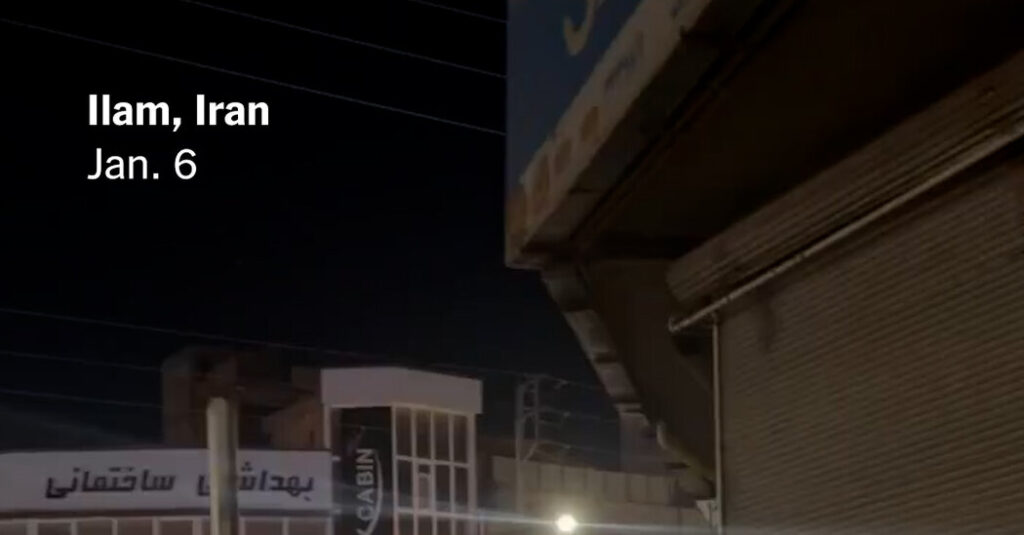
Footage showed huge crowds at a funeral for three people killed in Malekshahi, a rural area in the province of Ilam, on Jan. 4. A week later, videos circulating on social media appeared to show huge crowds not far away, in Abdanan, another city in Ilam, for the funeral of Alireza Saidi, 16, who was said to have been killed in Tehran during protests that week.
At these funerals and that of Ahmad Khosravani, the basketball star, the crowd departed from the traditional mourning rituals of crying and reciting the Quran.
Instead they clapped, cheered and chanted in unison, saying, “This fallen flower is a gift to the nation.”
___________ Methodology Despite a communications blackout, Iranians managed to use virtual private networks, or VPNs, and forbidden Starlink satellite internet systems to share witness accounts and videos, many of which The New York Times was able to collect and authenticate.
Some videos were shared directly with Times journalists. Others with Iranian human rights groups, BBC Persian and the Iranian blog Vahid Online, all of whom circulated the videos on Telegram, X and Instagram. The Times collected over 300 videos and independently verified over 160 of them by matching details seen in the videos — like business names, street fronts, signs and trees — with archival images, satellite imagery and Google Street View. Iranian reporters with The Times watched and listened to the videos for accents or other details indicating their authenticity. Sometimes we referred to verification carried out by GeoConfirmed, a research collective that specializes in geolocating where videos are filmed. The Times independently confirmed all the videos reported on for this story. Two weeks on from the worst of the violence, footage is still emerging. Confirming the date those videos were filmed is not always possible. But by checking that the videos are new and not posted during previous crackdowns in Iran, and by mapping out when and where protests and crackdowns happened in January, we corroborated the date they were most likely taken.
Reporting was contributed by Haley Willis. Videos produced by Jon Hazell. Additional video production by Natalie Reneau, Jeffrey Bernier and Josh Holder. Map by Samuel Granados.
Farnaz Fassihi is the United Nations bureau chief for The Times, leading coverage of the organization. She also covers Iran and has written about conflict in the Middle East for 15 years.
The post How Iran Crushed a Citizen Uprising With Lethal Force appeared first on New York Times.