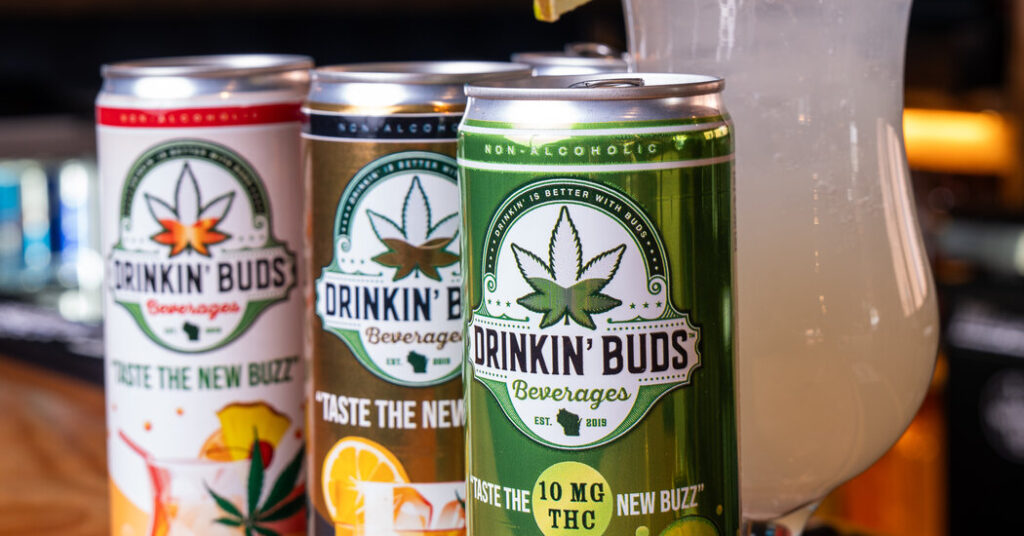
On a chilly January afternoon at a Stew Leonard’s grocery store in Paramus, N.J., prominently featured in the center of the liquor department, sit stacks of colorful boxes of hemp-infused drinks.
There are tropical punch seltzers. Pineapple mojitos. Peach-flavored ice tea. Even root beer “high” soda.
“The growth in the category has been explosive for us,” said Blake Leonard, a member of the third generation to run the family-owned business, and president of Stew Leonard’s Wine & Spirits. The retailer has even removed pallets of beer to make way for the buzzy beverages. Three years ago, Stew Leonard’s carried fewer than 10 of these brands. Today, it offers up to 75, Ms. Leonard said, estimating that sales are 25 percent higher this January than last year.
This month, millions of Americans are practicing Dry January, giving up alcohol entirely. Others are doing Damp January, cutting back on their alcohol consumption. And still others are experimenting with Cali Sober, looking for ways to get buzzed without the booze and the next-morning hangover.
For liquor manufacturers and retailers, January is a bleak month. For the last three years, alcoholic beverages not only have consistently lost ground to nonalcoholic drinks in January, but have rebounded more slowly, “signaling a sustained lifestyle shift rather than a temporary post-holiday reset,” the research firm Numerator wrote this month.
But sales of mocktails, seltzers and teas containing tetrahydrocannabinol, or THC, have surged since their introduction a few years ago. Amid increased consumer demand and legalization of the cannabis-derived drinks, major retailers like Target, Sprouts and Circle K and national liquor stores are putting the beverages on their shelves.
“Our THC beverages, as well as nonalcoholic drinks, are two of our highest-growth categories,” said Andrea Starr, a senior director of merchandising for THC drinks at Total Wine & More, a national chain.
Last year, sales of THC beverages were roughly $850 million, according to the data firm Future Markets Insight, and are expected to reach around $4 billion by 2028.
The industry began to flourish after hemp, which is a variety of the cannabis plant, was legalized as part of the 2018 Farm Bill with the provision that it could have no more than 0.3 percent THC by dry weight. If it exceeds that limit, the hemp is classified as marijuana, which is still illegal at the federal level. The vast majority of THC drinks sold in retail stores are made with hemp, while some of the beverages sold in licensed dispensaries are manufactured with marijuana.
States then began adopting their own rules. While 28 states, including Texas, Florida and Minnesota, allow THC-laced beverages to be sold by mainstream retailers, a handful of others, including California and Arizona, limit their sale to licensed dispensaries. In Connecticut, a 12-ounce THC beverage sold at retailers is capped at three milligrams of THC, while Tennessee has a 30-milligram limit.
And while New York State allows liquor stores or bodegas to sell beverages with one milligram or less of THC, few brands make them at that low level. Some higher-THC drinks are available at licensed cannabis dispensaries.
THC and its sibling, cannabidiol, or CBD, are both produced by the cannabis plant but differ significantly in their effects on the brain. Generally, drinks made with CBD will not make you feel intoxicated, but you may feel less anxious. But you’re likely to feel something — relaxed or euphoric, or anxious and paranoid — about 20 minutes after consuming a beverage containing THC; it can also trigger a positive drug test.
Health experts warn that the beverages can have a significant kick and that consumers new to them should start with drinks that have small amounts of THC. Most drinks sold in retail stores have five to 10 milligrams, but some have 20 and even 60 milligrams.
“Almost everybody knows how they respond to a standard drink, like a gin and tonic, but people don’t necessarily know how they’re going to respond to these cannabis drinks,” said Staci Gruber, an associate professor of psychiatry at Harvard Medical School whose research focuses on the impact of cannabis on the brain.
Like caffeine and alcohol, THC produces a response that varies from person to person, Dr. Gruber and others say. “Some people can become incredibly ill from these products,” Dr. Gruber said.
Manufacturers say interest in THC beverages is coming not only from early adopters like millennials and Generation Z, but from women, and particularly older women, who are trying them amid concerns about alcohol and its links to various diseases.
“Soccer parents are embracing the category, purchasing the beverages once a week,” said Sam Garfinkel, a senior vice president of commercial operations and strategy for Tilray Brands, which owns the THC brands Fizzy Jane’s and Happy Flower. “We’re also seeing these beverages popping up in retirement communities.”
But despite rising popularity, the drinks are at risk of disappearing.
New, much lower federal limits on the level of THC in hemp-derived products, including gummies and beverages, are scheduled to take effect in November, under a provision in the spending package that reopened the federal government late last year. The law’s proponents said some companies were extracting THC from legalized hemp but creating stronger products.
The law capped the level of THC at 0.4 milligrams per beverage. The vast majority of such drinks currently sold by retailers contain significantly higher levels.
“With a limit of 0.4 milligrams, it’s like saying you can still buy pens, but they won’t have any ink in them,” said Christopher Lackner, the president and chief executive of the Hemp Beverage Alliance, an industry group. It worked with members of Congress on a bill, introduced in mid-January, to delay the THC limit to 2028.
Amid the uncertainty, some manufacturers are weighing their futures.
Normally at this time of year, Justin Hopf and Matt Swanson, the co-founders of Drinkin’ Buds, would be ordering hemp seed to be planted in April in Sheboygan, Wis. They use that crop to make their THC-infused spiked lemonade, rum punch and old-fashioned cocktails, which are sold in 14 states.
This year, they are not planting any hemp, worried that if unchanged, the new federal limit on THC beverages and other products would render their drinks illegal.
“Our current beverage product has five or 10 milligrams per can,” Mr. Hopf said. “We wouldn’t be selling them anywhere anymore. And reformulating them would be difficult. It just wouldn’t be worth the risk.”
Julie Creswell is a business reporter covering the food industry for The Times, writing about all aspects of food, including farming, food inflation, supply-chain disruptions and climate change.
The post High January Is the New Dry January appeared first on New York Times.