Who is Geese? To a certain type of music fan, that question would be absurd.
The young, droll and precociously successful Brooklyn quartet has been perhaps the most exhaustively discussed and vehemently debated rock band of the 2020s so far. But any musical guest making its debut on “Saturday Night Live” — as Geese did this weekend, on an episode hosted by the “One Battle After Another” actress Teyana Taylor — knows a sizable portion of the audience will be coming to its performances puzzled and wondering, “Who is that?” Under its brightest spotlight yet, Geese offered two completely different answers.
In a music industry increasingly oriented toward A-listers, streaming juggernauts and viral stars, opportunities for monocultural breakout moments outside of social media have all but gone extinct. The cancellation of “The Late Show With Stephen Colbert” and the uncertain future of late-night shows means that up-and-coming bands will soon have few places to play for network television audiences.
Geese’s appearance on “S.N.L.” was the culmination of a gradual climb that played out for much of last year. After releasing albums in 2021 and 2023, the band enjoyed an unexpected creative and commercial breakthrough — thanks to both the cult popularity of the frontman Cameron Winter’s oddball but stirringly poetic solo album “Heavy Metal,” and Geese’s ambitious third album “Getting Killed,” a side-winding collection of songs that unfolds like a slow descent into an exalted state of madness. Depending on who you ask, Geese is either its generation’s great saviors of rock ’n’ roll, or its most derivative impostors. “Getting Killed” was by far my favorite album of last year, but even I compared Winter’s warble to cilantro (you either love it or you hate it).
Winter’s unique vocal stylings took center stage on Geese’s first song, the glacially paced ballad “Au Pays du Cocaine.” (The title is a an esoteric pun on “The Land of Cockaigne,” a medieval story and later a 16th century Dutch painting depicting catatonic overindulgence.) On “Getting Killed,” the song provides a lovely respite from the album’s higher intensity chaos; amid the luminous twinkle of Emily Green’s guitar, Winter croons lyrics that oscillate between willfully obtuse (“like a sailor in a big green boat”) and nakedly yearning (“you can be free, just come home, please”).
As an introduction to “S.N.L.” viewers unfamiliar with Geese, the song was an inauspicious choice. Onstage, Winter is known for enlivening songs with slight rhythmic and lyrical variations from the recorded versions, and he did this during “Cocaine,” often pausing an extra beat or two before delivering his lines. Those small tweaks may delighted fans, but the performance never quite found its footing rhythmically or melodically. Viewers more familiar with Geese’s reputation than its music were likely left scratching their heads: These kids are supposed to be the great Gen-Z hope for rock ’n’ roll?
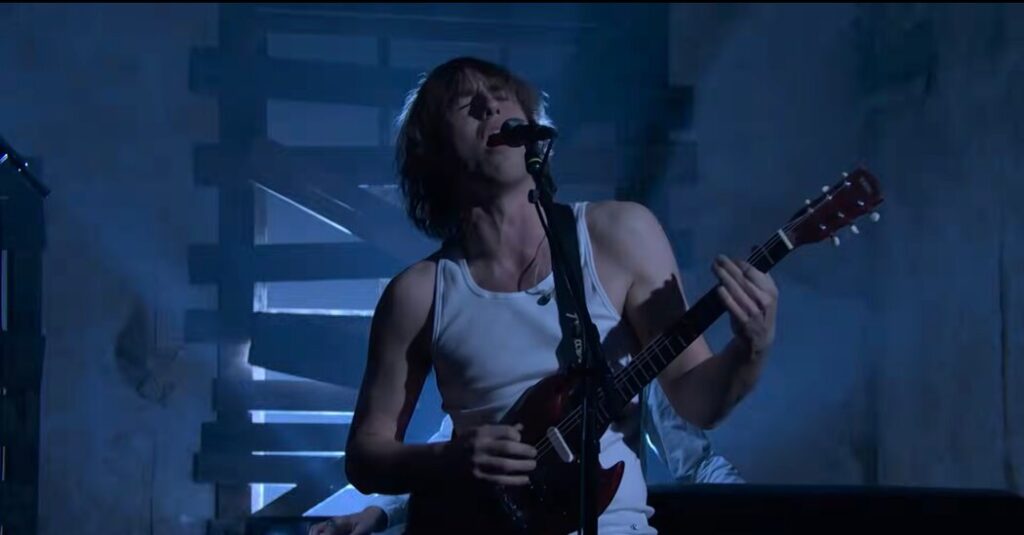
But the band’s studio-shaking second performance provided a more impactful introduction. The song choice itself was audacious: Geese went with “Trinidad,” the eerie “Getting Killed” opener that careens between hushed, haunted verses and an explosive chorus on which the band summons its most cacophonous fury and Winter shouts, like a man possessed, “There’s a bomb in my car!” As Green’s spiky guitar phrasings provided an off-kilter atmosphere and the drummer Max Bassin thrashed at his kit with energetic glee, the band sounded much more locked in. The energy was electric and contagious. In the middle of the first chorus, Winter’s usually stoic face broke into a getting-away-with-it grin.
Geese is sometimes compared to a previous generation’s band of New York upstarts, the Strokes, who broke through to the mainstream after a memorable “Saturday Night Live” performance in January 2002. In advance of Geese’s debut in Studio 8H, some critics wondered if a similar watershed moment will be in store. But 2002 was a very different time, and Geese is a very different band — even after its big moment, it will probably remain an acquired taste. After that exhilarating performance of “Trinidad,” though, it should at least be clear why this is a band that people can’t stop talking — and arguing — about.
Lindsay Zoladz is a pop music critic for The Times and writes the subscriber-only music newsletter The Amplifier.
The post Geese Gives ‘Saturday Night Live’ Viewers Something to Talk About appeared first on New York Times.