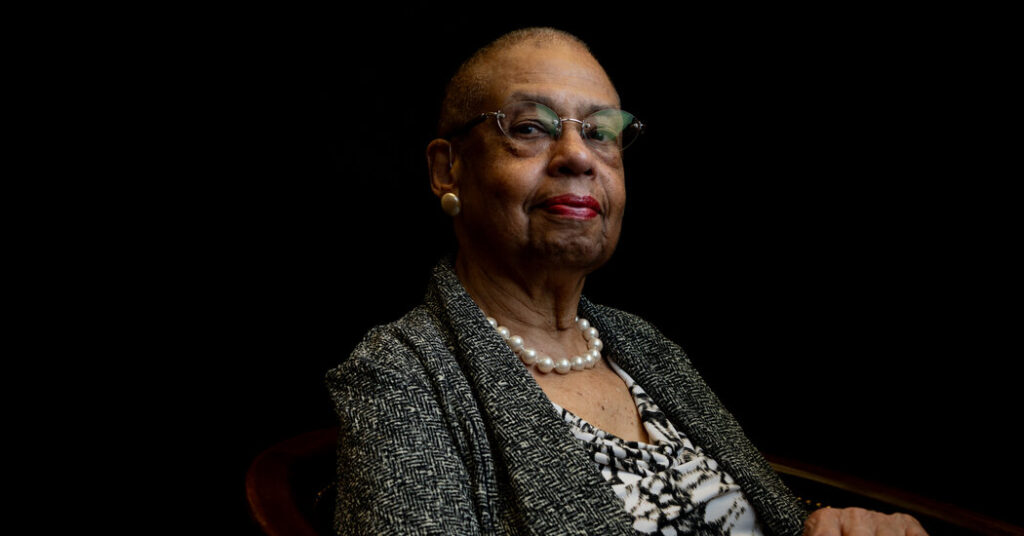
The campaign of Representative Eleanor Holmes Norton, the 88-year-old Democrat who has served for three decades as the nonvoting delegate for Washington, D.C., officially filed a termination notice for her re-election with the Federal Election Commission on Sunday, the strongest signal yet that Ms. Norton will retire after 18 terms in Congress.
Her departure would be a bow to the reality that her age and deteriorating health have rendered her unable to continue in the job.
Ms. Norton, the civil rights leader and law professor-turned-congresswoman who is the oldest person serving in the House, won election in 1991 and came to be known as D.C.’s “warrior on the Hill,” as she fought doggedly for statehood and for the District’s prerogatives. But in recent years, her once forceful voice has become muted amid increasingly concerning signs of mental and physical decline, leaving her vastly diminished and struggling to fulfill her congressional duties.
Still, even as some of Ms. Norton’s confidantes have pressed her publicly to end her long career in politics, and she has sometimes appeared confused at work, she has been unwilling to do so. As recently this month, she told a reporter at the Capitol that she planned to run again in 2026.
“I’m going to run,” Ms. Norton said repeatedly back in June, after being questioned about a Washington Post report in which D.C. council members raised questions about her ability to do the job and said it was time for her to retire. “I don’t know why anybody would even ask me.”
A spokeswoman for Ms. Norton did not respond to a request for comment on Sunday regarding the paperwork, which was reported earlier by NOTUS. It was not clear whether Ms. Norton had authorized the termination of her campaign, or whether she even knew about it.
Some of Ms. Norton’s colleagues on Capitol Hill, who have privately expressed alarm for months about her refusal to step down, were not sure of what to make of the termination notice that appeared to get ahead of any official announcement of her own.
Ms. Norton has also stopped fund-raising, according to her campaign filing. This month, she has raised only $7.50. Her name alone on the ballot in Washington, D.C., however, would be difficult for a lesser known candidate to beat.
Multiple members of the D.C. City Council have already announced that they plan to run for the seat, regardless of her plans. And even a former top staff member, Trent Holbrook, announced he planned to challenge Ms. Norton for the seat.
In her prime, Ms. Norton was an unstoppable and ubiquitous force in Washington, making an impassioned case for voting rights for the District of Columbia.
But in recent years, she has become a symbol of the gerontocracy gripping Washington, where aging lawmakers who have built a life and substantial clout in office are reluctant to give up their power. And in the Capitol, she has come to be regarded much like Senator Dianne Feinstein of California, who died in office at age 90, and former President Joseph R. Biden Jr., both Democrats whose legacies were ultimately tainted by their refusal to step aside amid questions about their age, health and mental acuity.
Ms. Norton’s struggles have at times been on painful and embarrassing display. Standing onstage at a Washington theater in April, Ms. Norton referred to the “National Environment for the Arts”; lauded the theater, Arena Stage, for contributions to “freedom of suppression and democracy”; and half-said, half-spelled the name of a former board chair, Beth Newburger Schwartz, as “Ethel N-E-W Burger Schwartz.”
In October, Ms. Norton was the subject of a police report after a group of scammers entered her home, falsely claiming to be part of a cleaning crew. The police report described her as exhibiting “early stages of dementia” and stated that Ms. Norton’s caretaker had the power of attorney. The police report was obtained by NBC News 4 and was not independently confirmed by The New York Times.
Ms. Norton’s decline has coincided with a critical moment for a district with no voting representation in Congress. For months, President Trump and Republicans in Congress have taken aim at the District of Columbia. A bill to restore more than $1 billion to Washington’s budget that Congress blocked in March stalled for months in the House amid Republican resistance. Since August, members of the National Guard have roamed the streets of the city to fight what Mr. Trump has described as “out of control” crime.
In November, a member of the National Guard, Army Specialist Sarah Beckstrom, 20, was shot and killed in Washington, near the White House.
House Republicans also recently moved on legislation that would undo three local measures passed by D.C. officials, chipping away at the city’s autonomy.
Throughout it all, Ms. Norton has had little to say, sitting mostly silent at committee hearings while her colleagues have clashed over legislation that would impose more federal control over her city.
“After so many years of powerful advocacy, I respect Delegate Norton’s decision to retire, and I am excited to see D.C. pass the torch to the next generation,” said Ankit Jain, the shadow senator for the District of Columbia.
Annie Karni is a congressional correspondent for The Times.
The post Eleanor Holmes Norton Files to End Re-election Campaign appeared first on New York Times.