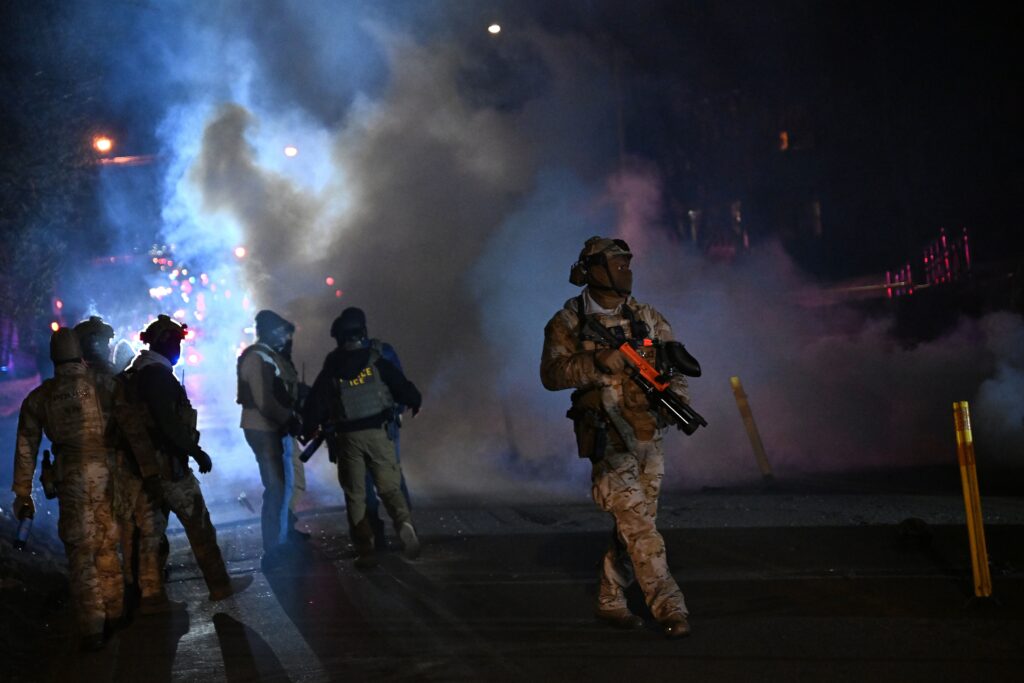
In the 24-hours after an immigration officer fatally shot a protester in Minneapolis, the federal agencies that would typically be involved in investigating an officer-involved shooting have been on the sidelines.
Federal law enforcement leaders in Minnesota haven’t made public statements or appearances. FBI agents and prosecutors in the state are confused about what — if anything — their involvement will be in the investigation, according to multiple people familiar with the U.S. attorney’s office in Minnesota, who spoke on the condition of anonymity due to fear of retaliation.
In the apparent absence so far of the Justice Department, Minnesota authorities have vowed to pursue an investigation under state laws into the shooting of Alex Pretti, a 37-year-old ICU nurse. That has set up a potential legal clash between state and federal authorities. Already, the state has sued the federal government, successfully asking a judge over the weekend to ensure that federal law enforcement officials do not destroy evidence.
The Justice Department’s apparent back seat in the investigation contrasts with how the agency has frequently handled similar fatal officer-involved shootings. Typically, federal investigators would take the lead, deploying FBI agents and Civil Rights Division prosecutors — the department’s experts in investigating use of force cases.
That typical federal deployment of resources has not occurred in this case, according to two people familiar with the matter, who spoke on the condition of anonymity to discuss internal decisions that have not been made public.
“This is extremely out of the norm,” said Bryna Godar, staff attorney for the State Democracy Research Initiative at the University of Wisconsin Law School, who has studied use-of-force investigations. “Typically, whether or not a shooting is ultimately found to be justified, these types of shootings are taken very seriously.”
Rather than the Justice Department, the Department of Homeland Security, of which the Border Patrol is part of, has taken the lead in the investigation, with the FBI assisting, according to a law enforcement official familiar with the matter. That internal probe is at least in part examining whether Border Patrol agents adhered to protocol when Pretti was shot. Homeland Security doesn’t have independent authority to prosecute crimes, but if its examination finds evidence of criminal wrongdoing, DHS officials could refer the investigation to the Justice Department, the law enforcement official said.
That typical federal deployment of resources has not occurred after the most recent shooting, according to two people familiar with the matter, who spoke on the condition of anonymity to discuss internal decisions that have not been made public.
Justice Department officials have said in recent weeks that they only investigate police officers under the civil rights laws involving excessive force if they believe such a probe is warranted. The recent shootings by immigration officers do not necessitate federal criminal investigations, they have said.
Legal experts, however, have noted that while the threshold to charge a police officer is high, the only way to determine if a prosecution is warranted is for the Justice Department and FBI to conduct thorough investigations.
FBI Director Kash Patel, in an interview with Fox News’s “Sunday Morning Futures,” said he trusted Homeland Security Secretary Kristi L. Noem and her agency to “do the right thing.”
“I don’t want to comment on their ongoing investigation,” he said.
In the shooting on Saturday, federal agents wrestled Pretti to the ground and secured a handgun he was carrying moments before Pretti was shot multiple times, according to a Washington Post analysis of videos that captured the incident from several angles.
It is not clear from the video whether all the agents realized Pretti had been disarmed. Local officials have said Pretti had a permit to carry the weapon, and Minnesota law allows the open carrying of firearms.
In the day after the shooting, Justice Department officials sought to shift blame for the shooting onto state and local authorities, who they assert have egged on protesters, and deferred the responsibility to investigate to other agencies.
Deputy Attorney General Todd Blanche appeared on “Meet the Press” Sunday and said the problem was that local police officers were not assisting federal law enforcement in the state.
“I’m very confused why the conversation is about what you’re talking about instead of focusing on what really matters, which is why in one city, in one place we have these problems,” Blanche told NBC’s “Meet the Press,” suggesting that Minnesota officials had contributed to the tensions that provoked Pretti’s shooting.
The immigration crackdown in the Minneapolis-St. Paul region began in early January, despite protests from state officials. The deployment of thousands of federal and immigration agents to the Twin Cities has transformed the region into a center of resistance to the administration’s deportation policies.
Those protests mounted after Jan. 7, when an Immigration Customs and Enforcement officer shot Renée Good while she was in her car. Good and her partner, who was outside the car at the time of the shooting, had been protesting the immigration crackdown.
The FBI briefly opened a civil rights investigation into the shooting of Good, but closed it and instead focused on investigating Good’s partner and protesters, The Washington Post reported last week. The handling of that investigation prompted about a half-dozen experienced federal prosecutors to leave the U.S. attorney’s office in Minnesota, leaving the office severely understaffed. The FBI agent who initially opened the investigation resigned, according to two people familiar with the matter, who spoke on the condition of anonymity to discuss personnel matter.
In the days since, the department has focused its resources on investigating state and local leaders, challenging what Attorney General Pam Bondi has described as “unprecedented judicial activism” in court, and arresting demonstrators, including protesters who interrupted a Jan. 18 church service in St. Paul.
State and local officials have vowed to conduct their own investigation of both the Good and Pretti shootings, but said they’ve been stymied by federal agents denying them access to the scene.
Late Saturday evening, a U.S. district judge, acting on a request from the Hennepin County Attorney’s Office, barred the Department of Homeland Security, the Justice Department or the FBI from “destroying or altering evidence” related to the shooting.
Drew Evans, superintendent of the Minnesota Bureau of Criminal Apprehension, said his agency took the unusual step Saturday of obtaining a search warrant from a state court to access the shooting scene after initial efforts to respond were rebuffed. Federal agents ignored the warrant and continued to deny access to state investigators, he said.
“In my 20-plus years at the BCA, prior to 2026, I had never encountered a situation in which federal authorities blocked BCA access to an incident where there is concurrent federal and state jurisdiction,” he wrote in a declaration filed with the court Saturday night. Hennepin County Attorney Mary Moriarty took to social media urging anyone to submit footage they’d filmed at the scene.
If state authorities determine the shooting was unlawful, they could seek to prosecute agents involved. But any attempt to do so would face stiff legal hurdles.
Any agent charged with state crimes would proabably seek to move the case to federal court and claim federal immunity from prosecution.
Officers are shielded from prosecution for many actions taken in the line of duty. Federal officers facing state prosecution can claim immunity based on the constitutional doctrine of federal supremacy. Those protections only apply, however, if a judge deems the agents’ actions to have been authorized by federal law and “necessary and proper” in fulfilling their federal duties.
Local authorities do sometimes move ahead with cases against federal agents, including a recent instance in Virginia that underscores the extent to which such attempts can get bogged down in litigation spanning years.
In 2020, after the Justice Department declined to file charges, state authorities in Virginia secured involuntary manslaughter indictments against two U.S. Park Police officers who fatally shot an unarmed motorist in Fairfax County in 2017.
The case was tied up in litigation over the immunity question for years, and the charges at one point were dismissed by a federal judge. Local authorities were pursuing an appeal of that decision in 2021 when Republican Jason Miyares was elected attorney general. Miyares abandoned the effort in 2022.
The post DOJ, FBI take back seat in Minnesota shooting, state vows investigation appeared first on Washington Post.