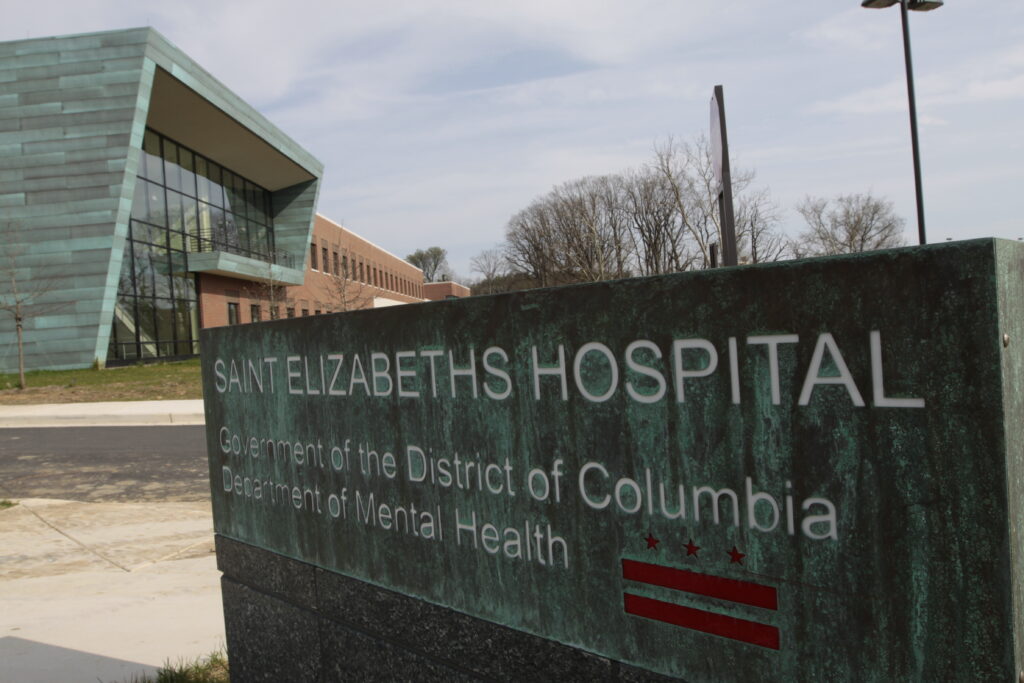
St. Elizabeths, the District-run psychiatric hospital, is riddled with problems such as daily physical assaults on patients and staff, medication mismanagement, and the warehousing of patients cleared for discharge, staff and patient advocates recently told a D.C. Council committee.
The hospital uses antiquated systems to track supplies and work orders, leading to shortages in basic supplies and a lack of heating, hot water and inadequate locks in some areas — all of which, staff said, can agitate patients who may be coping with mental illness, personality disorders and trauma.
Most of the 270 patients at St. Elizabeths are awaiting evaluations to determine if they are competent to stand trial or have been found not guilty by reason of insanity and are committed indefinitely to the Southeast Washington facility.
D.C. Council member Christina Henderson (I-At-Large), chair of the health committee, called a hearing Thursday — the second in less than a year — to raise alarms after receiving grievances from a union representing nurses and meeting with hospital leadership. She said she also wanted to avoid a repeat of the 2007 court-ordered federal monitoring of the hospital, after the Justice Department found that the hospital violated patients’ civil rights.
Henderson said perhaps St. Elizabeths should have a board to offer guidance and accountability, as is commonplace with other hospitals.
“I’m glad some of my colleagues came to this hearing, because they wouldn’t believe me if I told them,” she said afterward. “My confidence in the hospital leadership is quite low, and anybody who watched that hearing today would have the same type of concerns I do.”
She added: “It feels like we’re running a jail, with a medical clinic attached.”
St. Elizabeths chief executive Mark J. Chastang said the hospital has plans to improve the facility’s air-handling system, as well as internal systems and support for staff. Under questioning, though, Chastang said there was no plan for how the HVAC work will be completed while the building is full of patients.
Barbara Bazron, the director of the city’s Department of Behavioral Health, said she and Wayne Turnage, the deputy mayor for health and human services, plan to meet every three weeks at the hospital to track progress on long-standing issues.
“We are systematically chipping away at these deficiencies and will continue to make progress,” she said.
St Elizabeths Hospital was established as the Government Hospital for the Insane in 1852 by an act of Congress as the first federally funded mental hospital in the country.
After World War II, the sprawling campus housed 8,000 patients. Parts of the property have been redeveloped as Cedar Hill Regional Medical Center GW Health and an arena where the WNBA’s Washington Mystics play to the east and the Department of Homeland Security to the west.
The federal government recently determined that more than a dozen century-old structures on the West Campus should be demolished, and Chastang said the construction will have some impact on staff’s ability to come and go for shifts.
About 30 St. Elizabeths nurses and hospital workers packed the hearing room Thursday to hear their colleagues and hospital leadership testify over five hours.
“We have no faith in the leadership or what they can do to make this a safe and operational facility to function at its optimal capacity,” said Nancy Boyd, a registered nurse at St. Elizabeths and president of the D.C. Nurses Association.
Some witnesses made allegations of Medicaid fraud that Henderson said will be referred to the city’s inspector general. Others made allegations of plagiarism of medical records that will be referred to the D.C. Department of Health, Henderson said.
Andrea Procaccino, a senior staff attorney at Disability Rights DC, the federally designated advocate for individuals with disabilities in the District, said the agency remains concerned that St. Elizabeths too often subjects patients to physical restraint, such as being strapped down to a bed, and seclusion.
Staff used restraint on average 72 times a month in 2025, an average of twice a day. In June 2025, staff employed 118 restraints — an average of nearly four times a day, city data show.
The number of physical assaults at St. Elizabeths has increased 55 percent from fiscal year 2023 to fiscal year 2025, and the facility is on track to exceed that this year, city data show.
Under questioning from council members, hospital officials said they do not break down how many incidents occur between patients or patients and staff. In written responses to questions from the health committee, officials said assaults often lead to restraint or seclusion.
Martha Pontz, the chief nurse executive, said there are plans to reinstate and expand a program to support staff who have been assaulted. The comment elicited grumbling from the audience of hospital staff, who say no one checks on them after an assault.
“I’m really sorry that staff do not feel supported,” said Bazron, the city’s behavioral health director. “I am committing to ensuring that staff get the support they need when incidents occur.”
Hans Thomas, a behavioral health technician, said that when patients lack basic hygiene supplies such as soap or toothpaste, or miss medical appointments or physical therapy because there aren’t enough staff to escort them, they become agitated, which can lead to violence.
Bridget Bennett, another behavioral health technician, said that poorly built doors and furniture often break and that patients use the materials as weapons against other patients or staff. Employees described units as hot in the summer and cold in the winter, forcing patients to wear winter coats indoors; nurses are told to run the water for up to 10 minutes before it gets hot.
The hospital is also short-staffed, witnesses said. There are 82 vacancies, including for six clinical psychologists, 26 psychiatric nurses and 18 behavioral health technicians, testimony and city data show. Bazron attributed the nursing vacancies in part to retirements. A locksmith retired six months ago, and the single plumber on-site may retire as well, Chastang said.
There is no longer an ophthalmologist on-site, meaning patients can’t get prescription eyeglasses, a major issue for those who have to read an exam to determine if they are competent to stand trial.
Katerina Semyonova, special counsel for policy and legislation at the Public Defender Service for the District of Columbia, which at any time represents about 40 patients at the hospital, said many are elderly and struggle with dementia and other age-related illnesses.
Semyonova said they would be better served at a nursing home, but no such facility exists after the city closed a 120-bed public nursing facility at United Medical Center in 2023. Her office has found dangerously high levels of lithium or abrupt discontinuation of medication, allegations hospital officials denied.
“The failure to provide timely medical treatment and testing at outside facilities may be the result of chronic understaffing in addition to poor case management,” Semyonova said.
Council member Zachary Parker (D-Ward 5), who attended the hearing, pressed hospital leaders for data on how often they use medication to calm patients when they are an immediate danger to themselves or others.
“This has been a deeply unnerving hearing,” he said. “I’ve been deeply troubled by today’s testimony.”
The post D.C. psychiatric hospital accused of compromising safety, security appeared first on Washington Post.